
What is a Judge ?
A judge is a legal professional who presides over court proceedings and makes rulings and judgments on legal cases.
Judges are responsible for ensuring that trials are conducted fairly and impartially, and for interpreting and applying the law in accordance with the relevant statutes, legal precedents, and principles of justice.
Check out our articles Could AI replace judges ? and Could AI replace lawyers ? for a detailed analysis of Artificial Intelligence (AI) and what it means for the Justice system not only in the UK but also around the world.
Types of Judges
- District Judges – who preside over cases in the County Court and in certain types of tribunals.
- Tribunal Judges – who preside over hearings in the various tribunals that exist to resolve disputes in specific areas of law. These tribunals include the Employment Tribunal, the First-tier Tribunal, the Upper Tribunal, and the Tax Tribunal, amongst others.
- Circuit Judges – who preside over cases in the Crown Court and some types of civil cases in the County Court.
- High Court Judges – who preside over cases in the High Court, which is a superior court with jurisdiction over a wide range of legal matters.
- Court of Appeal Judges – who preside over cases in the Court of Appeal, which hears appeals from the High Court and other lower courts.
- Supreme Court Justices – who preside over cases in the UK’s highest court, the Supreme Court, which is the final court of appeal in the UK for civil cases.
Day to Day tasks of a Judge
Judges daily tasks include :-
National Careers Service
- prepare for trials by reading papers submitted by legal teams
- hear civil, family and criminal cases
- listen to evidence from witnesses, defendants and victims
- advise juries and legal teams on points of law
- pass sentences on conviction and impose other penalties
- reach decisions in tribunals, for example on employment disputes or immigration cases
- help sides to find agreement in civil cases before proceedings begin
- take expert opinion, for instance in custody or child welfare cases
- hear appeals and review decisions of lower courts
- write reports, giving reasons for rulings
- keep up to date with legal developments
Judges Pay and Hours
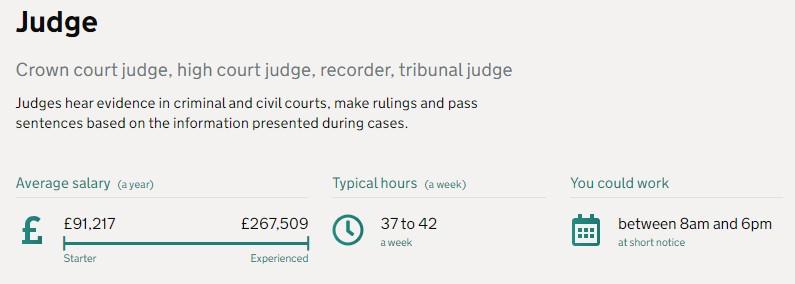
According to the National Careers Service judges can expect to get paid up to £267,509 and work up to 42 hours in a typical week. Please also see our article on Judges Salaries and Fees.
Working Hours of Judges
Some people do mistakenly think that judges’ working hours are confined to court sitting hours, which are normally 10.30am-4.30pm.
But the reality is very different; most judges also carry a lot of ‘box work’ (paperwork) on current and future (and sometimes past) cases – especially as most cases are settled or concluded before they reach the stage of a court hearing. It is not unusual for judges to work late into the evening, writing judgments and reading files of evidence and letters from parties. They do not claim overtime for this.
There are 4 terms in the legal year, which are the main sitting times for the High Court and Court of Appeal. Most courts do have sittings around the year, and even in the High Court and Court of Appeal, emergency hearings and processing of cases continue during the vacations.
Senior judges use the ‘vacation’ periods between terms to catch up on new legislation and case law, as well as undertaking formal training.
Courts and Tribunal Judiciary Working Hours
Judicial sitting days
Court of Appeal Judges and High Court Judges are expected to devote themselves to judicial business throughout the legal year which usually amounts to somewhere in the region of 185-190 days.
Circuit Judges are expected to sit for a minimum of 210 days, although the expectation is for between 215-220 per year.
District Judges are expected to sit for a minimum of 215 days.
Judges also have out of court duties to perform such as reading case papers, writing judgments, and keeping up to date with new developments in the law.
Courts and Tribunal Judiciary The legal year, term dates and sitting days
The Legal Year
The origins of the legal year are the service in Westminster Abbey which dates back to 1897 when judges prayed for guidance at the start of the legal term. Judges, whose courts were held in Westminster Hall, left the city and walked to the abbey to take part in the service.
The ceremonies now are more or less as they have always been but, instead of the two mile walk from Temple Bar to Westminster Abbey, the judges now travel by car.
The 45-minute service, which starts at 11:30am, is conducted by the Dean of Westminster. It includes prayers, hymns, psalms and anthems; the Lord Chancellor reads a lesson.
Around 700 people are invited to attend the service and breakfast. These include judges, senior judicial officers, the Law Officers, King’s Counsel (KC), government ministers, lawyers, members of the European Court and other overseas judges and lawyers. Judges and KCs wear ceremonial dress.
Courts and Tribunal Judiciary The legal year, term dates and sitting days
Term Dates
The term dates for the legal year apply to sittings in the High Court and Court of Appeal only, and are fixed in accordance with the Practice Direction 2F which supplements Part 39 of the Civil Procedure Rules.
2023
Hilary: Wednesday 11 January to Wednesday 5 April 2023
Easter: Tuesday 18 April to Friday 26 May 2023
Trinity: Tuesday 6 June to Monday 31 July 2023
Michaelmas: Monday 2 October to Thursday 21 December 20232024
Hilary: Thursday 11 January to Wednesday 27 March 2024
Courts and Tribunal Judiciary The legal year, term dates and sitting days
Easter: Tuesday 9 April to Friday 24 May 2024
Trinity: Tuesday 4 June to Wednesday 31 July 2024
Michaelmas: Tuesday 1 October to Friday 20 December 2024
How to Become a Judge
You can only become a Judge through an official appointment.
Volunteering
You can get valuable experience and insights into the work of a judge through the Judicial Work Shadowing Scheme. This may help if you later apply for selection to become a judge.
You normally have to be a qualified legal professional, with at least 7 years’ experience in law-related work to join.
If you have been on the Judicial Work Shadowing Scheme, you can apply for a place on the Judicial Mentoring Scheme. This scheme is open to applications from people who are currently under-represented in the judiciary. For example:
National Careers Service
- women
- ethnic minorities
- lawyers with a state school education
Other routes to becoming a Judge
Judges are appointed by the Judicial Appointments Commission. You’ll need to apply to them to be considered for selection.
To apply, you must:
- be a qualified solicitor, barrister or chartered legal executive
- have worked as a legal professional for between 5 and 7 years, depending on the type of judge you want to be
- meet nationality requirements
Common starting roles include district, recorder and tribunal judges. For certain other judicial roles, you can apply if you’re an experienced legal academic, or trademark or patent attorney.
You must successfully complete several application stages to get through to shortlisting by the Commission. You’ll then be invited to attend an assessment and selection day, which will include interviews.
National Careers Service
The Ministry of Injustice is not the Ministry of Justice nor is it affiliated in any way with the justice system, legal profession, police or any other law enforcement agencies.
“Publicity is the very soul of justice. . . . It keeps the judge himself, while trying, under trial….Where there is no publicity there is no justice”
Jeremy Bentham – Mr Justice Cobb: ‘Justice must be seen to be done’
Latest Articles ↓
- His Honour Judge Daniel Sawyer
 Judge Daniel Sawyer, known as His Honour Judge Daniel Sawyer,… Read more: His Honour Judge Daniel Sawyer
 - UK National Centre for Information Defence
 Prime Minister Andy Burnham used his first United Nations General… Read more: UK National Centre for Information Defence
 - Judges Behaving Badly and His Honour Judge Simon Oliver
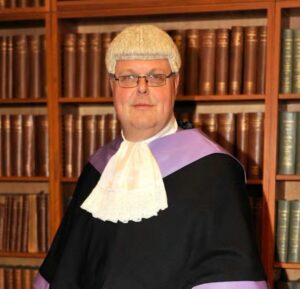 On the 27th August 2026 the Crown Prosecution Service announced… Read more: Judges Behaving Badly and His Honour Judge Simon Oliver
 - Jo Morris Barrister
 Jo Morris is a practising criminal barrister of Drystone Chambers… Read more: Jo Morris Barrister
 - Good Law Project
 The Good Law Project is a UK campaigning organisation that… Read more: Good Law Project
 - Police Federation of England and Wales (PFEW)
 The Police Federation of England and Wales (PFEW) is the… Read more: Police Federation of England and Wales (PFEW)
 - What is the Criminal Justice System (CJS) Common Platform ?
 The Criminal Justice System Common Platform (also known as HMCTS… Read more: What is the Criminal Justice System (CJS) Common Platform ?
 - Strategic Lawsuit Against Public Participation (SLAPPs)
 Strategic Lawsuits Against Public Participation, or SLAPPs, are legal actions… Read more: Strategic Lawsuit Against Public Participation (SLAPPs)
 - His Honour Judge Tony Baumgartner – Recorder of Westminster
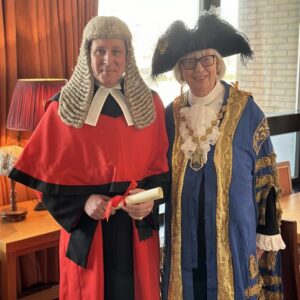 Judge Tony Alan Walter Baumgartner, known as His Honour Judge… Read more: His Honour Judge Tony Baumgartner – Recorder of Westminster
 - New Protocol for Legal Professionals to Raise Informal Concerns About Judges Behaviour
 On the 8th July 2026, the Courts and Tribunals Judiciary… Read more: New Protocol for Legal Professionals to Raise Informal Concerns About Judges Behaviour
 - The Policing Performance System
 In April 2026, His Majesty’s Inspectorate of Constabulary and Fire… Read more: The Policing Performance System
 - What is the Judicial College ?
 The Judicial College serves as the central pillar of professional… Read more: What is the Judicial College ?
Most Popular ↓
You should always seek formal legal advice from a qualified and reputable lawyer (solicitor or barrister).
There are a number of links to Free and Paid For Legal Resources and Legal Organisations on the Free Legal Advice , Legal Aid and Pro Bono pages.
[post_title] was last updated on the 12th October 2026
