
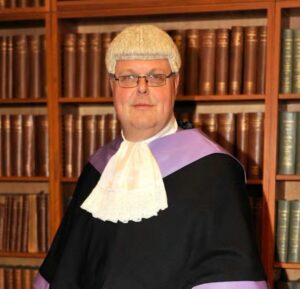
Judge Daniel Sawyer, known as His Honour Judge Daniel Sawyer, is Circuit Judge of England and Wales who is assigned to the Western Circuit.
HHJ Daniel Sawyer should not be confused with HHJ Sawyer :-
| His Honour Judge Sawyer | South East | 09-10-2023 |
Judge Daniel Sawyer’s judicial achievements includes both the high-profile 2026 sentencing of Del Somerville in an anti-migrant protest case and an earlier rejected complaint to the Judicial Conduct Investigations Office over anonymous social media posts.
Daniel James Sawyer was called to the Bar (Middle Temple) in 2001 and practised as a criminal barrister at 3PB, handling murder, violence, drugs, sexual offences, military cases and fatal driving offences.
3 Paper Buildings (3PB) is one of the UK’s oldest chambers and is the third largest set of barristers in the UK.
3 Paper Buildings
Judge Daniel Sawyer was appointed a Recorder in 2020 and a circuit judge on the Western Circuit from the 4th November 2024, sitting at Portsmouth Crown Court.
He is also known for horseback archery, a detail that later helped identify an anonymous X account as his.
HHJ Daniel Sawyer is shown on the List of Circuit Judges published on the Courts and Tribunal Judiciary website.
| His Honour Judge Daniel Sawyer | Western | 04-11-2024 |
The JCIO complaint and “Yet Another Tweeting Barrister”
In 2022, while still a Recorder, Judge Daniel Sawyer operated an anonymous X account that presented itself as a criminal barrister commenting on legal issues and court practice. According to The Times, Legal Cheek and the Daily Mail, a complaint to the Judicial Conduct Investigations Office alleged that he used the account “Yet Another Tweeting Barrister” to target family-law barrister and academic Dr Charlotte Proudman over her public comments on rape prosecutions, rape myths and the treatment of victims.
The complaint said the account repeatedly posted, liked and replied to hostile commentary about Dr Proudman.
Dr Proudman was subject to posts by His Honour Judge Daniel Sawyer (then a Recorder) who used an anonymous social media account to make comments designed to attack and ridicule her professionalism, qualifications and experience and encouraged members of the public to send offensive messages, as well as complain about her to the Bar Standards Board. Indeed, he made a malicious complaint to the BSB which was dismissed. This amounts to harassment and bullying of a female barrister specialising in protecting victims from abuse. We note that HHJ Daniel Sawyer’s comments reflected views on the treatment of victims in the criminal justice system that many would regard as outdated and inconsistent with a modern understanding of sexual violence. His conduct was never investigated by the JCIO.
Right to Equality – A case that raises more than just the “administration of justice”: A letter to the Lady Chief Justice
Alleged posts included claims that she knew “nothing” about the criminal courts; that her commentary was “unprofessional drivel” or “nonsense”; that followers should “ignore anything that this person tweets”; and that “the average GCSE student knows this.”
One thread adapted Jay-Z’s “99 Problems” lyric.
The complaint said followers could read the line as a reference to Proudman as a “b****.” A later post said the account had not realised the song contained that word.
Judge Daniel Sawyer was also alleged to have reported Dr Proudman to the Bar Standards Board and to have encouraged others to complain. That regulator investigation was later discontinued without an explanation or apology, according to material cited in the complaint.
Daniel Sawyer admitted the account was his. He denied that the posts amounted to bullying or harassment. Coverage said he described some posts as a “forceful correction” of claims he regarded as false and harmful, including arguments about clothing being used as a defence in rape cases.
A colleague of Proudman’s filed the JCIO complaint in June 2025, arguing that the three-month time limit should run from discovery of the author’s identity rather than from the original 2022 posts. Judicial social-media guidance tells judges to “pause before you post” and notes that likes can be read as endorsement.
The JCIO refused to proceed. It said the complaint was outside the three-month time limit measured from publication. It added that even if the complaint had been admitted, the conduct would not have breached disciplinary standards in a way that required action, and that there was no intent to bully Proudman. Some reports said the office first appeared to accept the complaint and refer it to a nominated judge before reversing course after a stricter reading of the time-limit rules.
Proudman said the JCIO was “not fit for purpose.”
In a post on X she wrote that Sawyer had harassed her with an anonymous account after she spoke out about the treatment of rape victims, that the JCIO refused the complaint, and that “when judges police judges, we have no confidence in the JCIO.”
The watchdog’s public position is that it investigates personal misconduct, not judicial decisions, and that complaints must generally be made within three months.
The Portsmouth protest trial
On the 6th September 2026, protesters gathered near Eastney Marina in Portsmouth after a small boat carrying around 114 to 140 migrants was brought ashore, escorted by the Coastguard and the RNLI.
Hundreds of people assembled. Police locked down the marina area. Disorder followed. Hampshire Police later said official vehicles were damaged and a small number of officers were injured at the wider scene.
Del Somerville, 42, a father of two from Paulsgrove who kept a boat at Eastney and spent part of the week there, was the first person arrested and later the first jailed. On 16 September 2026 he pleaded guilty at Portsmouth Crown Court to violent disorder. A separate charge of assaulting a police constable at his arrest on the 11th September 2026 was not admitted and was left for another hearing.
Prosecution evidence from body-worn video was that Somerville approached a police line in an intimidating manner, threw a small or empty plastic bottle towards officers and shouted at them to “f*** off.” Footage also showed him earlier trying to pull someone away from the line. In interview he said he found the bottle on the ground, meant to throw it into a bush, and threw it in the air because he was angry.
His lawyers said he had not set out to join the protest, was stranded after police locked the marina, tried to calm the crowd, threw the bottle in frustration rather than to injure anyone, had mental-health difficulties and only one previous conviction, a motoring offence.
On the 24th September 2026 Sawyer sentenced him to two years’ immediate imprisonment. That hearing is the subject of the LBC article that has driven much of the later controversy, alongside reports from the BBC, The News, Portsmouth, ITV Meridian and the Independent.
What Judge Daniel Sawyer Said
HHJ Daniel Sawyer called Del Somerville a “thug” and said the sentence would act as a deterrent after subsequent protests in the area. According to LBC and the BBC, he told the defendant:
Police officers dedicate their lives to the protection of the public regardless of their own views, the very least they can expect is that those who engage in protests treat them with respect and the courts punish those who assault them.
Judge Daniel Sawyer
HHJ Daniel Sawyer said the right to peaceful protest applies to everyone and to every cause, provided it is not unlawful, and that it does not matter what anybody else thinks of that cause. Once peaceful protest turns into violence, he said, the original cause does not matter either. He added:
I am not sentencing you for your views on the police, the RNLI, or immigration. I am sentencing you for the disgraceful scenes at Eastney Point on September 6…and nothing else.
His Honour Judge Daniel Sawyer
Judge Daniel Sawyer noted that Somerville had first tried to pull someone else away, played a relatively minor role, and effectively lived at the marina rather than travelling there specifically to protest. He still concluded that the offence was so serious that only immediate imprisonment was appropriate.
Legal commentary circulating after the hearing, including a case note shared by CrimeLine, said the overall disorder was placed in a high category of the violent-disorder guideline, Somerville’s own role was assessed lower, and 25 per cent credit for the guilty plea was applied to a starting point of around 32 months.
Why the sentence became controversial ?
The LBC headline a man jailed for two years after throwing a plastic bottle and swearing at police became the version of the case that spread most widely. Critics treated the sentence as evidence of “two-tier justice”: a father of two receiving two years for a light plastic bottle that, on the defence case, caused no injury from that act, while other violent or protest-related cases are often said to attract suspended sentences or shorter terms.
The Noticer article Outrage at two-tier justice as protester jailed for 2 years for throwing plastic bottle and posts on X highlighted comments from Restore Britain’s Rupert Lowe and comparisons with prison overcrowding, early releases and other protest cases. Some posts focused on Judge Sawyer’s “thug” language and his explicit deterrent purpose.
The counter-argument, set out in the sentencing remarks themselves, is that Somerville was not sentenced for an isolated bottle throw. He pleaded guilty to violent disorder arising from a larger confrontation with police after a migrant landing.
The judge applied the guidelines, gave plea credit, recorded mitigation including a minor role and local connection, and still found immediate custody necessary because of seriousness and deterrence under the Sentencing Act 2020.
How the two stories fit together
The JCIO complaint and the Somerville sentence do not legally depend on each other. The JCIO closed the Dr Proudman related complaint without disciplinary action. The two-year term stands unless it is appealed.
What connects them in public argument is the same judge, the same court city, and a wider fight over consistency and accountability.
Critics of HHJ Daniel Sawyer already regarded the JCIO outcome as proof that the complaints system protects judges.
Critics of the Portsmouth sentence now treat the two-year term as proof that protest cases involving immigration are punished more harshly than comparable disorder elsewhere.
Supporters of the sentence say a Crown Court judge applied published guidelines to a guilty plea for violent disorder and said so on the record.
Authorisation to sit as a High Court Judge
HHJ Daniel Sawyer may be authorised to sit as a High Court Judge by s9(1) of the Senior Courts Act as amended by the Crime and Courts Act 2013.
According to CRIMINAL PRACTICE DIRECTIONS 2015 DIVISION XII His Honour Judge Sawyer should be addressed as “My Lord” in court.
Modes of Address B.1 – The following judges, when sitting in court, should be addressed as ‘My Lord’ or ‘My Lady’
(b) any Circuit Judge sitting as a judge of the Court of Appeal (Criminal Division) or the High Court under section 9(1) of the Senior Courts Act 1981;
(d) any Senior Circuit Judge who is an Honorary Recorder.
Description B.3 – In cause lists, forms and orders members of the judiciary should be described as follows:
(a) Circuit Judges, as ‘His [or Her] Honour Judge A’. When the judge is sitting as a judge of the High Court under section 9(1) of the Senior Courts Act 1981, the words ‘sitting as a judge of the High Court’ should be added;
The three key values which are central to the role of judicial office holders (JOHs) in England and Wales are:
• Independence
• Impartiality
• Integrity
“Publicity is the very soul of justice. . . . It keeps the judge himself, while trying, under trial….Where there is no publicity there is no justice”
Jeremy Bentham – Mr Justice Cobb: ‘Justice must be seen to be done’
Image of HHJ Daniel Sawyer : Facebook
The High Court Judge that never was – His Honour Judge Melbourne Inman KC
Check out our articles on Rule of Law, Open Justice, Judges Salaries and Fees, Dodgy Judges, Mr Justice Williams, His Honour Now His Dishonour, His Honour Judge Stuart Farquhar, Do you Have to Bow to a Judge ?, Can you Email a Judge ?, Can you Criticise a Judge ? and the highly dubious Sussex Family Justice Board.
The Ministry of Injustice is not the Ministry of Justice nor is it affiliated in any way with the justice system, legal profession, police or any other law enforcement agencies.
“Publicity is the very soul of justice. . . . It keeps the judge himself, while trying, under trial….Where there is no publicity there is no justice”
Jeremy Bentham – Mr Justice Cobb: ‘Justice must be seen to be done’
Latest Articles ↓
- Presumption of Innocence
 The presumption of innocence is a basic principle of the… Read more: Presumption of Innocence
 - His Honour Judge Daniel Sawyer
 Judge Daniel Sawyer, known as His Honour Judge Daniel Sawyer,… Read more: His Honour Judge Daniel Sawyer
 - UK National Centre for Information Defence
 Prime Minister Andy Burnham used his first United Nations General… Read more: UK National Centre for Information Defence
 - Judges Behaving Badly and His Honour Judge Simon Oliver
 On the 27th August 2026 the Crown Prosecution Service announced… Read more: Judges Behaving Badly and His Honour Judge Simon Oliver
 - Jo Morris Barrister
 Jo Morris is a practising criminal barrister of Drystone Chambers… Read more: Jo Morris Barrister
 - Good Law Project
 The Good Law Project is a UK campaigning organisation that… Read more: Good Law Project
 - Police Federation of England and Wales (PFEW)
 The Police Federation of England and Wales (PFEW) is the… Read more: Police Federation of England and Wales (PFEW)
 - What is the Criminal Justice System (CJS) Common Platform ?
 The Criminal Justice System Common Platform (also known as HMCTS… Read more: What is the Criminal Justice System (CJS) Common Platform ?
 - Strategic Lawsuit Against Public Participation (SLAPPs)
 Strategic Lawsuits Against Public Participation, or SLAPPs, are legal actions… Read more: Strategic Lawsuit Against Public Participation (SLAPPs)
 - His Honour Judge Tony Baumgartner – Recorder of Westminster
 Judge Tony Alan Walter Baumgartner, known as His Honour Judge… Read more: His Honour Judge Tony Baumgartner – Recorder of Westminster
 - New Protocol for Legal Professionals to Raise Informal Concerns About Judges Behaviour
 On the 8th July 2026, the Courts and Tribunals Judiciary… Read more: New Protocol for Legal Professionals to Raise Informal Concerns About Judges Behaviour
 - The Policing Performance System
 In April 2026, His Majesty’s Inspectorate of Constabulary and Fire… Read more: The Policing Performance System
Most Popular ↓
You should always seek formal legal advice from a qualified and reputable lawyer (solicitor or barrister).
There are a number of links to Free and Paid For Legal Resources and Legal Organisations on the Free Legal Advice , Legal Aid and Pro Bono pages.
[post_title] was last updated on the 15th October 2026
