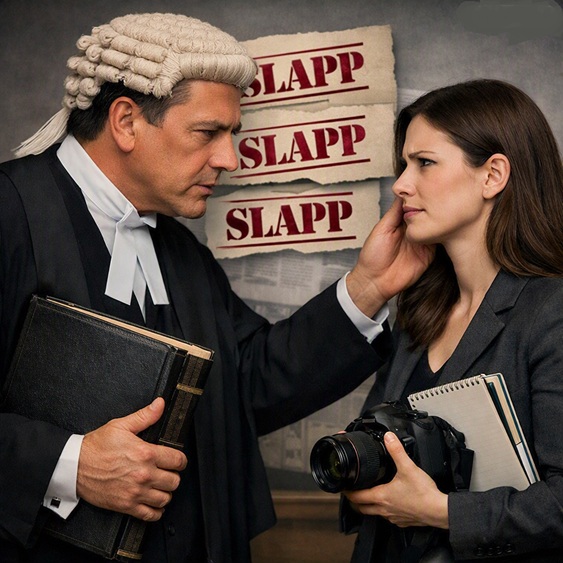
Strategic Lawsuits Against Public Participation, or SLAPPs, are legal actions brought primarily to silence, intimidate or financially exhaust critics rather than to vindicate genuine rights.
In the UK they most often take the form of defamation claims, though privacy, data protection, confidentiality and harassment actions are also frequently used.
SLAPPs are considered an abuse of the legal process, where the primary objective is to harass, intimidate and financially and psychologically exhaust one’s opponent via improper and costly legal intervention.
The impact of strategic lawsuits against public participation (SLAPPs) – House of Commons Research Briefing
These cases typically involve a significant imbalance of resources: well-funded individuals, corporations or organisations pursue claims against journalists, academics, campaigners or private citizens who lack comparable means to defend themselves.
The Chilling Effect on Free Speech
SLAPPs create a powerful chilling effect on public debate. Even when a claim is weak or ultimately unsuccessful, the mere threat of litigation, combined with the high cost of defending it, can force defendants to retract statements, settle, or avoid publishing in the first place.
A 2022 Foreign Policy Centre report found that at least 70 per cent of documented UK SLAPP cases were linked to financial crime or corruption.
Investigative reporting on Russian oligarchs, tax avoidance schemes, environmental issues and corporate misconduct has been particularly vulnerable.
Publishers and individual writers have sometimes chosen to settle or alter content simply to avoid the financial and emotional burden of a full trial, even when they believed their reporting was accurate and in the public interest.
Existing Legal Safeguards
English law already contains several important safeguards.
The Defamation Act 2013 introduced a “serious harm” threshold, abolished the presumption of damage for most corporations, strengthened the public interest defence, and restricted “libel tourism” by requiring claimants to show that England and Wales is the most appropriate jurisdiction.
Despite these reforms, the cost of defending a defamation action remains extremely high. Success fees are no longer recoverable from the losing side, and the inequality of arms between wealthy claimants and ordinary defendants continues to distort the process.
The 2023 Economic Crime Reforms
In response to growing concern, particularly after Russia’s invasion of Ukraine, the Economic Crime and Corporate Transparency Act 2023 introduced limited anti-SLAPP measures (sections 194 and 195).
These provisions came into force on the 18th June 2025. They allow courts to strike out claims at an early stage where the claim seeks to restrict freedom of expression under Article 10 of the European Convention on Human Rights, the speech concerns public-interest disclosures relating to economic crime, and the claimant’s behaviour indicates an improper purpose.
Early dismissal and costs protection for defendants are available under these rules. However, the protection is deliberately narrow and applies only to economic-crime related cases.
Risks for Solicitors and Law Firms
The Law Society has drawn attention to the reputational risks that SLAPP related work can pose for solicitors and their firms. Lawyers instructed in high-profile cases have faced criticism in Parliament and the media, even when they have acted within the professional rules.
Law firms Mishcon de Reya, Schillings, Harbottle & Lewis, CMS and Carter-Ruck were criticised…..for pursuing cases that were deemed SLAPPs.
SLAPPs and reputational risks – Law Society
The Law Society maintains that existing Solicitors Regulation Authority (SRA) standards, combined with more rigorous judicial case management and costs control, offer the most practical immediate way to reduce abusive litigation without the need for extensive new primary legislation.
A Recent Example – Carter Ruck and Jason Arday
A recent illustration of the continuing problem of potential SLAPPs emerged in August 2026.
The Free Speech Union highlighted a letter sent by the law firm Carter-Ruck to Times Higher Education. The letter appeared intended to deter further journalistic questions about the academic record of Professor Jason Arday.
At the same time, police complaints were made against Jack Grove, a journalist at Times Higher Education, and David Harris, a former/emeritus professor.
The Met Police investigated journalist Jack Grove for harassment after he emailed Cambridge professor Jason Arday questions about apparent plagiarism in his work and other claims regarding his academic and charity record; officers later told Grove to stop contacting Arday because it had affected the professor’s mental health, though the four-month inquiry was closed with no action taken and Grove was never interviewed.
Arday contacted the Metropolitan Police to lodge a complaint of harassment against Harris. Because Harris is based in Plymouth, the matter was referred to Devon and Cornwall Police, which declined to pursue it.
Jason Arday reported academic critic to police after questions over his research – Committee For Academic Freedom
Although the complaints were later dropped, the episode raised serious concerns that powerful individuals or institutions may still use legal threats and police involvement to discourage legitimate scrutiny.
Conclusion
The anti-SLAPP measures that took effect in June 2025 represent a meaningful first step.
Nevertheless, their restriction to economic-crime cases leaves a significant gap. Journalists, academics and citizens remain exposed whenever the disputed speech concerns other matters of public interest.
Broader, carefully balanced legislation, together with stronger judicial scrutiny of costs and purpose, would provide more effective protection for public participation while still allowing genuine claimants access to the courts.
Until such reforms are enacted, the threat of strategic litigation will continue to cast a long shadow over free expression and investigative journalism in the United Kingdom.
Check out our related articles on Rule of Law, Open Justice, What is Law, Is the Law Black and White ?, Branches of Law, Bullying, Harassment and Discrimination at the Bar, The Secret Barrister, Barristers, Direct Access Barrister, Barristers Behaving Badly, Inns of Court, Council of the Inns of Court, Bar Standards Board, Bar Tribunal and Adjudication Services, Bar Council, Innocent until Proven Guilty and the highly questionable Sussex Family Justice Board.
The Ministry of Injustice is not the Ministry of Justice nor is it affiliated in any way with the justice system, legal profession, police or any other law enforcement agencies.
“Publicity is the very soul of justice. . . . It keeps the judge himself, while trying, under trial….Where there is no publicity there is no justice”
Jeremy Bentham – Mr Justice Cobb: ‘Justice must be seen to be done’
Latest Articles ↓
- Presumption of Innocence
 The presumption of innocence is a basic principle of the… Read more: Presumption of Innocence
 - His Honour Judge Daniel Sawyer
 Judge Daniel Sawyer, known as His Honour Judge Daniel Sawyer,… Read more: His Honour Judge Daniel Sawyer
 - UK National Centre for Information Defence
 Prime Minister Andy Burnham used his first United Nations General… Read more: UK National Centre for Information Defence
 - Judges Behaving Badly and His Honour Judge Simon Oliver
 On the 27th August 2026 the Crown Prosecution Service announced… Read more: Judges Behaving Badly and His Honour Judge Simon Oliver
 - Jo Morris Barrister
 Jo Morris is a practising criminal barrister of Drystone Chambers… Read more: Jo Morris Barrister
 - Good Law Project
 The Good Law Project is a UK campaigning organisation that… Read more: Good Law Project
 - Police Federation of England and Wales (PFEW)
 The Police Federation of England and Wales (PFEW) is the… Read more: Police Federation of England and Wales (PFEW)
 - What is the Criminal Justice System (CJS) Common Platform ?
 The Criminal Justice System Common Platform (also known as HMCTS… Read more: What is the Criminal Justice System (CJS) Common Platform ?
 - Strategic Lawsuit Against Public Participation (SLAPPs)
 Strategic Lawsuits Against Public Participation, or SLAPPs, are legal actions… Read more: Strategic Lawsuit Against Public Participation (SLAPPs)
 - His Honour Judge Tony Baumgartner – Recorder of Westminster
 Judge Tony Alan Walter Baumgartner, known as His Honour Judge… Read more: His Honour Judge Tony Baumgartner – Recorder of Westminster
 - New Protocol for Legal Professionals to Raise Informal Concerns About Judges Behaviour
 On the 8th July 2026, the Courts and Tribunals Judiciary… Read more: New Protocol for Legal Professionals to Raise Informal Concerns About Judges Behaviour
 - The Policing Performance System
 In April 2026, His Majesty’s Inspectorate of Constabulary and Fire… Read more: The Policing Performance System
Most Popular ↓
You should always seek formal legal advice from a qualified and reputable lawyer (solicitor or barrister).
There are a number of links to Free and Paid For Legal Resources and Legal Organisations on the Free Legal Advice , Legal Aid and Pro Bono pages.