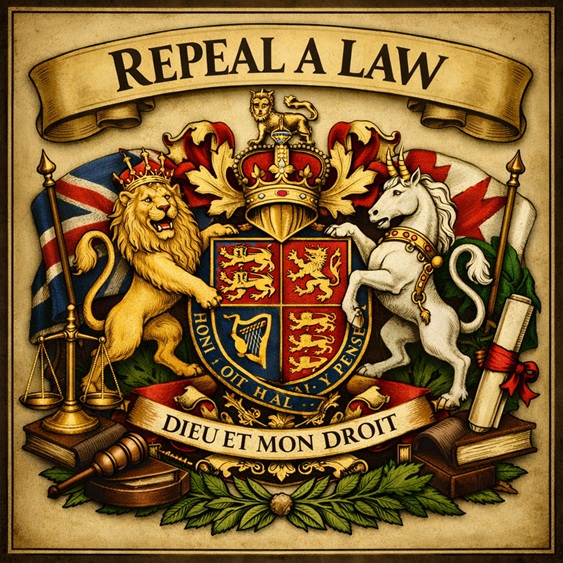
Repealing a law in the United Kingdom does not mean the original law was bad, defective or mistaken. It means Parliament has decided the law is no longer required or useful.
Under the principle of parliamentary sovereignty, Parliament may repeal any legislation without implying criticism of the earlier law or the Parliament that passed it. Repeal is a normal and necessary part of maintaining an effective legal system.
The Process to Repeal a Law
The process of repealing a law in the UK usually follows these steps:
- Proposal – Repeal can be proposed by the government, individual MPs or peers (through Private Members’ Bills), or recommended by the Law Commission.
- Inclusion in a Bill – Most repeals are included in a larger bill (e.g., a reform bill or a dedicated Statute Law (Repeals) Bill). The bill must go through all stages in both the House of Commons and the House of Lords.
- Parliamentary Scrutiny – The bill is debated, amended if necessary, and voted on in both Houses.
- Royal Assent – Once passed by Parliament, the bill receives Royal Assent and becomes an Act.
- Commencement – The repeal may take effect immediately, on a future date, or when brought into force by secondary legislation (commencement regulations).
For routine technical repeals, the Law Commission prepares reports and draft bills that are usually passed with little debate.
Why Laws Are Repealed ?
Laws are repealed for a variety of reasons. Societal values and economic conditions change over time. Rules that were once appropriate can become obsolete as technology, daily life, or public priorities evolve. Some laws are repealed because they are redundant or have been replaced by clearer, modern legislation. Others are removed as part of routine maintenance of the statute book to reduce complexity and improve accessibility.
Routine Repeals: The Law Commission
Much repeal work is technical and non-controversial. The Law Commission plays a central role in this process. It systematically identifies enactments that are no longer of practical utility. Its goal is to reduce the size of the statute book, save time and costs for lawyers and the public, and prevent confusion caused by outdated rules that have no current application.
The Statute Law (Repeals) Act 1969 was the first in a series of modern repeal Acts. It removed numerous old enactments, including certain medieval statutes and most remaining provisions of Magna Carta 1297 (while carefully preserving the four most important articles). The Act was not a judgment on the quality of those ancient laws. It simply recognised that they had become obsolete after centuries.
Another example is the Statute Law (Repeals) Act 1993, which repealed a wide range of obsolete laws covering areas such as justice, agriculture, companies, and ecclesiastical matters, while also correcting a mistake from an earlier repeal Act.
This was followed by the Statute Law (Repeals) Act 1998, which carried out a large-scale clean-up across many different fields.
In 2008, the Statute Law (Repeals) Act 2008 removed numerous old colonial and Indian-related statutes, helping to clear post-empire legislation from the statute book.
More recently, the Statute Law (Repeals) Act 2013 focused on obsolete provisions relating to transport, local government, and finance. These Acts demonstrate the continuing, methodical work of modernising and simplifying the law.
Since 1965, Parliament has passed 19 Statute Law (Repeals) Acts, leading to the complete repeal of more than 3,000 statutes. These are standard “tidying-up” measures designed to keep the law clear and manageable.
Recent Repeal: The Vagrancy Act 1824
Not all repeals are routine. Some reflect significant shifts in social attitudes or government policy. A prominent example is the Vagrancy Act 1824, which criminalised rough sleeping and begging. This Act was repealed by section 81 of the Police, Crime, Sentencing and Courts Act 2022, with the repeal brought into force on the 29th June 2026.
Originally introduced in 1824, the Vagrancy Act has been found to punish people simply for not having a home. As a result, it has pushed vulnerable people away from support, increased the risk of fines or criminal records and made it harder for people to rebuild their lives.
Repealing the Act is a vital step in ending a system that has failed to address the causes of rough sleeping and in shifting the focus towards prevention, support and long-term solutions.
Rough sleeping no longer a crime as Vagrancy Act repealed
The repeal was not proposed by the Law Commission as part of its Statute Law (Repeals) programme. Instead, it resulted from government policy, parliamentary debate, and long-running campaigns by homelessness organisations.
The Vagrancy Act, originally passed in response to post-Napoleonic War conditions and rising homelessness after the Industrial Revolution, was increasingly viewed as outdated and punitive rather than supportive. Its removal marks a clear shift toward addressing homelessness through prevention, support and long-term solutions instead of criminal penalties.
Other Reasons for Repeal
Political or policy changes frequently lead to repeals. A new government may remove or amend measures introduced by its predecessor. In some cases, a law produces unintended consequences or is replaced by better drafting. Repeal then forms part of legislative improvement and modernisation.
Technical consolidation exercises also involve repeal. Older fragmented laws are removed and replaced by single, clearer Acts that are easier to understand and apply.
Conclusion
Repeal does not erase the historical context or the original purpose of the legislation. Many repealed laws were reasonable and effective in their time. The willingness to repeal them demonstrates a mature legal system that adapts to new circumstances rather than preserving outdated rules indefinitely.
Parliament’s power to repeal legislation is an essential feature of UK democracy. It allows the law to remain relevant and responsive. The Law Commission’s ongoing repeal programme handles technical obsolescence, while broader policy repeals, such as the Vagrancy Act, reflect changing societal values and priorities.
In summary, repealing a law is a neutral act of law-making. It reflects current needs rather than a verdict on the quality or wisdom of earlier legislation. Whether through routine tidying by the Law Commission or deliberate policy change, repeal helps keep the statute book clear, accessible and fit for purpose in a modern society.
Check out our articles on Rule of Law, Open Justice, Lady Chief Justice, Judges Salaries and Fees, Dodgy Judges, Magistrates, Chief Magistrate, Do you Have to Bow to a Judge ?, Can you Email a Judge ?, Can you Criticise a Judge ?, Crown Prosecution Service, Director of Public Prosecutions (DPP) and the highly dubious Sussex Family Justice Board.
The Ministry of Injustice is not the Ministry of Justice nor is it affiliated in any way with the justice system, legal profession, police or any other law enforcement agencies.
“Publicity is the very soul of justice. . . . It keeps the judge himself, while trying, under trial….Where there is no publicity there is no justice”
Jeremy Bentham – Mr Justice Cobb: ‘Justice must be seen to be done’
Latest Articles ↓
- Judges Behaving Badly and His Honour Judge Simon Oliver
 On the 27th August 2026 the Crown Prosecution Service announced… Read more: Judges Behaving Badly and His Honour Judge Simon Oliver
 - Jo Morris Barrister
 Jo Morris is a practising criminal barrister of Drystone Chambers… Read more: Jo Morris Barrister
 - Good Law Project
 The Good Law Project is a UK campaigning organisation that… Read more: Good Law Project
 - Police Federation of England and Wales (PFEW)
 The Police Federation of England and Wales (PFEW) is the… Read more: Police Federation of England and Wales (PFEW)
 - What is the Criminal Justice System (CJS) Common Platform ?
 The Criminal Justice System Common Platform (also known as HMCTS… Read more: What is the Criminal Justice System (CJS) Common Platform ?
 - Strategic Lawsuit Against Public Participation (SLAPPs)
 Strategic Lawsuits Against Public Participation, or SLAPPs, are legal actions… Read more: Strategic Lawsuit Against Public Participation (SLAPPs)
 - His Honour Judge Tony Baumgartner – Recorder of Westminster
 Judge Tony Alan Walter Baumgartner, known as His Honour Judge… Read more: His Honour Judge Tony Baumgartner – Recorder of Westminster
 - New Protocol for Legal Professionals to Raise Informal Concerns About Judges Behaviour
 On the 8th July 2026, the Courts and Tribunals Judiciary… Read more: New Protocol for Legal Professionals to Raise Informal Concerns About Judges Behaviour
 - The Policing Performance System
 In April 2026, His Majesty’s Inspectorate of Constabulary and Fire… Read more: The Policing Performance System
 - What is the Judicial College ?
 The Judicial College serves as the central pillar of professional… Read more: What is the Judicial College ?
 - Police Leadership Commission Report
 An independent review by the Police Leadership Commission has concluded… Read more: Police Leadership Commission Report
 - Repeal a Law
 Repealing a law in the United Kingdom does not mean… Read more: Repeal a Law
Most Popular ↓
You should always seek formal legal advice from a qualified and reputable lawyer (solicitor or barrister).
There are a number of links to Free and Paid For Legal Resources and Legal Organisations on the Free Legal Advice , Legal Aid and Pro Bono pages.
[post_title] was last updated on the 28th August 2026
