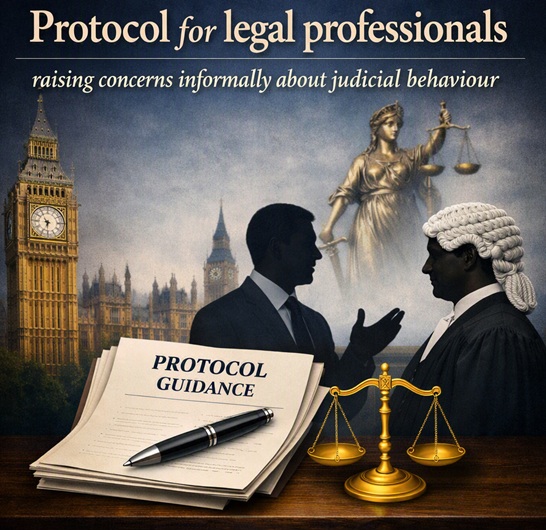
On the 8th July 2026, the Courts and Tribunals Judiciary published a new Protocol for legal professionals wishing to raise concerns informally about judicial behaviour which is designed to help legal professionals raise concerns informally about a judge’s behaviour.
The document issued by the Lady Chief Justice of England and Wales and the Senior President of Tribunals, formalises long-standing practices, offering greater clarity and confidence for solicitors, barristers, and legal executives working in the courts and tribunals.
Purpose and Scope of the Protocol
The protocol aims to address less serious issues, such as perceived discourtesy, minor procedural unfairness, or exclusionary conduct through early and proportionate resolution.
It encourages informal dialogue as the preferred first step, allowing concerns to be resolved quickly without damaging professional relationships or resorting to formal processes.
This approach does not replace the formal complaints system. The protocol explicitly directs that more serious allegations, patterns of behaviour, or unresolved informal matters should be referred to the Judicial Conduct Investigations Office (JCIO). The JCIO is the independent body responsible for investigating formal complaints against judicial office holders in England and Wales.
It examines whether conduct breaches judicial guidelines and recommends outcomes to the Lord Chancellor and Lady Chief Justice, ranging from advice and training to suspension or removal in extreme cases.
Broader Context and Supporting Measures
The protocol forms part of a comprehensive package of reforms aimed at tackling bullying, harassment, discrimination, and exclusionary behaviour. Key accompanying initiatives include:
- A published Statement of Expected Behaviour that sets clear standards for judicial conduct.
- Mandatory training for leadership judges on identifying and addressing inappropriate behaviour.
- Wider training programmes for all judicial office holders.
- Improved access to reporting routes, advice, and wellbeing resources.
These efforts are supported by a joint statement from the Lady Chief Justice, the Senior President of Tribunals, and the Bar Council’s Commissioner for Conduct. The reforms respond directly to evidence from the Judicial Attitude Survey, the Bar Council’s 2023 report on bullying at the Bar, and Baroness Harriet Harman’s 2025 Independent Review.
Statement from Lady Justice Whipple
“The judiciary is committed to upholding the highest standards of integrity, fairness and respect. While the majority of judicial office holders behave professionally and courteously, we take concerns about bullying, harassment and discrimination very seriously and are committed to providing clear, accessible routes for legal professionals working in our courts and tribunals to raise and resolve concerns about a judge’s behaviour. This protocol formalises and improves a process that has long existed – giving legal professionals clarity about how they can raise concerns informally.”
Lady Justice Whipple, Lead Judge for Diversity and Inclusion, Leadership, Development and Wellbeing
Practical Guidance and Next Steps
The detailed Protocol for legal professionals wishing to raise
concerns informally about judicial behaviour for legal professionals wishing to raise concerns informally about judicial behaviour should be consulted.
The protocol clearly outlines the process, including options for direct or indirect approaches, expected responses and timelines.
Legal professionals are encouraged to consult this guidance before deciding whether to pursue informal resolution or escalate directly to the JCIO.
Protocol for legal professionals wishing to raise concerns informally about coroner behaviour
On the 22nd July 2026, following the Lady Chief Justice and Senior President of Tribunals issuing the protocol setting out an informal resolution route if legal professionals have a concern about a judge’s behaviour, the Chief Coroner issued the Protocol for Legal Professionals Wishing to Raise Concerns Informally About
Coroner Behaviour.
The Chief Coroner is unable to investigate complaints relating to the personal conduct of a coroner or any other judicial office holder. As with all judges, matters concerning personal conduct fall within the remit of the Judicial Conduct Investigations Office (JCIO). Information about the complaints process and how to make a complaint is available via the JCIO website.
Check out our articles on Rule of Law, Open Justice, Judicial Conduct Investigations Office (JCIO), R v Sussex Justices, Judges Salaries and Fees, Dodgy Judges, Do you Have to Bow to a Judge ?, Can you Email a Judge ?, Can you Criticise a Judge ? and the highly dubious Sussex Family Justice Board.
The Ministry of Injustice is not the Ministry of Justice nor is it affiliated in any way with the justice system, legal profession, police or any other law enforcement agencies.
“Publicity is the very soul of justice. . . . It keeps the judge himself, while trying, under trial….Where there is no publicity there is no justice”
Jeremy Bentham – Mr Justice Cobb: ‘Justice must be seen to be done’
Latest Articles ↓
- Judges Behaving Badly and His Honour Judge Simon Oliver
 On the 27th August 2026 the Crown Prosecution Service announced… Read more: Judges Behaving Badly and His Honour Judge Simon Oliver
 - Jo Morris Barrister
 Jo Morris is a practising criminal barrister of Drystone Chambers… Read more: Jo Morris Barrister
 - Good Law Project
 The Good Law Project is a UK campaigning organisation that… Read more: Good Law Project
 - Police Federation of England and Wales (PFEW)
 The Police Federation of England and Wales (PFEW) is the… Read more: Police Federation of England and Wales (PFEW)
 - What is the Criminal Justice System (CJS) Common Platform ?
 The Criminal Justice System Common Platform (also known as HMCTS… Read more: What is the Criminal Justice System (CJS) Common Platform ?
 - Strategic Lawsuit Against Public Participation (SLAPPs)
 Strategic Lawsuits Against Public Participation, or SLAPPs, are legal actions… Read more: Strategic Lawsuit Against Public Participation (SLAPPs)
 - His Honour Judge Tony Baumgartner – Recorder of Westminster
 Judge Tony Alan Walter Baumgartner, known as His Honour Judge… Read more: His Honour Judge Tony Baumgartner – Recorder of Westminster
 - New Protocol for Legal Professionals to Raise Informal Concerns About Judges Behaviour
 On the 8th July 2026, the Courts and Tribunals Judiciary… Read more: New Protocol for Legal Professionals to Raise Informal Concerns About Judges Behaviour
 - The Policing Performance System
 In April 2026, His Majesty’s Inspectorate of Constabulary and Fire… Read more: The Policing Performance System
 - What is the Judicial College ?
 The Judicial College serves as the central pillar of professional… Read more: What is the Judicial College ?
 - Police Leadership Commission Report
 An independent review by the Police Leadership Commission has concluded… Read more: Police Leadership Commission Report
 - Repeal a Law
 Repealing a law in the United Kingdom does not mean… Read more: Repeal a Law
Most Popular ↓
You should always seek formal legal advice from a qualified and reputable lawyer (solicitor or barrister).
There are a number of links to Free and Paid For Legal Resources and Legal Organisations on the Free Legal Advice , Legal Aid and Pro Bono pages.
[post_title] was last updated on the 16th September 2026
