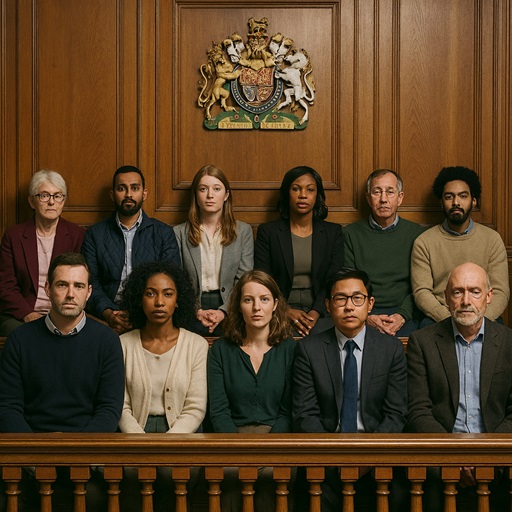
In the criminal justice system of England and Wales, the jury is one of the oldest and most distinctive features of the common law tradition. Twelve ordinary people, randomly selected, sit in judgment of their peers and decide whether a defendant is guilty or not guilty.
This system places enormous trust in the collective common sense of lay people rather than leaving the decision solely to professional judges.
History and Origins
The jury system in its modern form traces its roots to the 12th century.
The Assize of Clarendon in 1166, issued by Henry II, required groups of 12 lawful men in each hundred and 4 in each township) to present (report or accuse) people they believed had committed serious crimes.
These 12 men were not yet deciding guilt or innocence in a trial, they were acting as accusers or witnesses, reporting suspected criminals to the King’s itinerant judges.
By the 14th and 15th centuries, juries had evolved from being witnesses themselves into impartial triers of fact who listened to evidence presented in court.
The principle of trial by jury was firmly enshrined in English law through Magna Carta (1215), particularly clause 39, which stated that no free man should be imprisoned or deprived of property “except by the lawful judgement of his peers or by the law of the land”. Over centuries, the role shifted from local notables to ordinary citizens, and the jury became a cornerstone of democratic justice.
Who Can Serve on a Jury ?
In England and Wales, almost everyone aged 18–75 who is on the electoral register is liable for jury service. You are automatically disqualified if:
- You have been sentenced to imprisonment for life, or for five years or more
- You have served a prison sentence (or suspended sentence) of any length in the last 10 years
- You are currently on bail in criminal proceedings
Certain people can be excused or deferred, including full-time serving members of the armed forces, medical professionals, and MPs.
Since 2004, judges, lawyers, and police officers are no longer automatically exempt and may serve.
Jury service normally lasts two weeks, though serious cases (e.g., murder or major fraud) can last many months.
How Jurors Are Selected ?
Potential jurors are chosen at random from the electoral roll by a computer at the Jury Central Summoning Bureau. If summoned, you must attend unless you have a valid reason to be excused or deferred.
Once at court, and once a judge indicates that a trial is ready to start, those who have been summoned are once again randomly selected by a computer system to form a panel to go into court.
From this panel usually 12 are then selected at random, in court, by the court clerk to form a jury on each trial. Those not selected will return to the waiting area to be available for selection for the next panel.
The Role of the Jury
In Crown Court trials the jury has two main functions:
- Deciding guilt: After hearing all the evidence and the judge’s directions on the law, the jury retires to consider its verdict. The verdict should normally be unanimous, but after at least two hours (longer in complex cases) the judge may accept a majority verdict of 11–1 or 10–2.
- Occasionally deciding other issues: In some defamation cases (now rare) or coroner’s inquests, juries may still be used.
Jurors must decide the case solely on the evidence heard in court. They are not allowed to conduct their own research, talk about the case outside the jury room, or look up information online. Contempt of court charges and even imprisonment can follow if they do so.Judge vs Jury
The division of responsibility is clear:
- The judge decides questions of law (admissibility of evidence, legal directions, sentencing if guilty).
- The jury decides questions of fact (what happened, whether witnesses are credible, and ultimately guilt or innocence).
This separation is seen as a vital safeguard against state power: a professional judge controls the law, but ordinary citizens decide whether the state has proved its case.Advantages and CriticismsAdvantages often cited:
- Democratic participation in justice
- Protection against overreach by the state or biased judges
- Collective wisdom of twelve diverse minds
- Verdicts seen as legitimate because they come from peers
Criticisms include:
- Jurors may not fully understand complex evidence (e.g., in long fraud trials)
- Risk of perverse verdicts or prejudice
- Burden on jurors (loss of earnings, childcare issues, trauma from horrific evidence)
- Occasional high-profile cases of jury misconduct (e.g., using social media)
Jury Trials
Jury trial remains compulsory for serious crimes tried in the Crown Court (murder, rape, robbery, etc.). Magistrates’ courts and youth courts do not use juries. In civil cases, jury trial is now extremely rare, limited mainly to defamation, false imprisonment, and malicious prosecution claims and even then a judge may order trial without jury.
Jury trials to be scrapped ?
On the 2nd December 2025, the government announced the most significant restriction on jury trials in centuries. For the first time, defendants charged with offences carrying a maximum sentence of less than three years will no longer have the automatic right to be tried by a jury in the Crown Court.
“The right to trial by jury is an important factor in the delicate balance between the power of the state and the freedom of the individual. The further it is restricted, the greater the imbalance. Despite the inevitable increase in costs, the Haldane Society urges that there be a right of trial by jury in all criminal cases.”
Sir Keir Starmer writing for the Socialist Lawyer magazine 1992
The change, recommended by retired Court of Appeal judge Sir Brian Leveson in the report Independent Review of the Criminal Courts: Part 1, is intended to tackle a backlog that has reached almost 78,000 cases and is projected to hit 100,000 within a few years.
“Dispensing with juries will damage our democracy”
David Lammy MP (Labour, then Shadow Secretary of State for Justice)
writing in the Telegraph in June 2020
Under the new rules, jury trials will be reserved for the most serious indictable offences such as murder, rape, robbery, serious violence, people trafficking, and major drug crimes involving drugs or firearms.
Mid-level offences previously tried in the Crown Court, including many thefts, lower-level assaults and some sexual offences, will now be heard either by a single judge or by expanded panels of magistrates who will gain new powers to impose sentences of up to 18 months (or two years in reserve).
The reforms also remove the defendant’s historic right to “elect” jury trial in “either-way” cases, a choice often used to cause delay.
Complex fraud and financial trials, long criticised for bewildering juries, will move to judge-only hearings. The government says the measures will clear cases up to five times faster in some instances and prevent the criminal justice system from “total collapse”.
Critics, including the Bar Council, Criminal Bar Association, opposition parties, and civil-rights groups, have condemned the changes as an attack on a cornerstone of British justice dating back to Magna Carta. They argue that juries provide essential protection against state power and are often seen as fairer, especially by ethnic-minority defendants, than magistrates or professional judges sitting alone.
Supporters insist the right to jury trial is being preserved where it matters most, while allowing swifter justice for less serious matters and for victims who currently wait years for resolution.
Is the UK Criminal Justice System Broken ?
Legislation to enact the reforms is expected in preparation, and the full Leveson follow-up report on court efficiency is due shortly.
Conclusion
The jury system in England and Wales, though not perfect, is regarded by many as a fundamental constitutional safeguard and a powerful expression of the idea that ordinary people should play a direct role in the administration of justice. Will Jury trials be scrapped ?
Check out our related articles on What is a Hung Jury ?, Rule of Law, Open Justice, Is the Law Black and White ?, What Does Lady Justice Symbolise ?, Law Society, Law Commission, Solicitors, Solicitors Regulation Authority, Barristers, Bar Council of England and Wales, Bar Standards Board, Contra Mundum, R v Sussex Justices, Police Impartiality and the highly questionable Sussex Family Justice Board.
The Ministry of Injustice is not the Ministry of Justice nor is it affiliated in any way with the justice system, legal profession, police or any other law enforcement agencies.
“Publicity is the very soul of justice. . . . It keeps the judge himself, while trying, under trial….Where there is no publicity there is no justice”
Jeremy Bentham – Mr Justice Cobb: ‘Justice must be seen to be done’
Latest Articles ↓
- His Honour Judge Daniel Sawyer
 Judge Daniel Sawyer, known as His Honour Judge Daniel Sawyer,… Read more: His Honour Judge Daniel Sawyer
 - UK National Centre for Information Defence
 Prime Minister Andy Burnham used his first United Nations General… Read more: UK National Centre for Information Defence
 - Judges Behaving Badly and His Honour Judge Simon Oliver
 On the 27th August 2026 the Crown Prosecution Service announced… Read more: Judges Behaving Badly and His Honour Judge Simon Oliver
 - Jo Morris Barrister
 Jo Morris is a practising criminal barrister of Drystone Chambers… Read more: Jo Morris Barrister
 - Good Law Project
 The Good Law Project is a UK campaigning organisation that… Read more: Good Law Project
 - Police Federation of England and Wales (PFEW)
 The Police Federation of England and Wales (PFEW) is the… Read more: Police Federation of England and Wales (PFEW)
 - What is the Criminal Justice System (CJS) Common Platform ?
 The Criminal Justice System Common Platform (also known as HMCTS… Read more: What is the Criminal Justice System (CJS) Common Platform ?
 - Strategic Lawsuit Against Public Participation (SLAPPs)
 Strategic Lawsuits Against Public Participation, or SLAPPs, are legal actions… Read more: Strategic Lawsuit Against Public Participation (SLAPPs)
 - His Honour Judge Tony Baumgartner – Recorder of Westminster
 Judge Tony Alan Walter Baumgartner, known as His Honour Judge… Read more: His Honour Judge Tony Baumgartner – Recorder of Westminster
 - New Protocol for Legal Professionals to Raise Informal Concerns About Judges Behaviour
 On the 8th July 2026, the Courts and Tribunals Judiciary… Read more: New Protocol for Legal Professionals to Raise Informal Concerns About Judges Behaviour
 - The Policing Performance System
 In April 2026, His Majesty’s Inspectorate of Constabulary and Fire… Read more: The Policing Performance System
 - What is the Judicial College ?
 The Judicial College serves as the central pillar of professional… Read more: What is the Judicial College ?
Most Popular ↓
You should always seek formal legal advice from a qualified and reputable lawyer (solicitor or barrister).
There are a number of links to Free and Paid For Legal Resources and Legal Organisations on the Free Legal Advice , Legal Aid and Pro Bono pages.
[post_title] was last updated on the 6th October 2026
