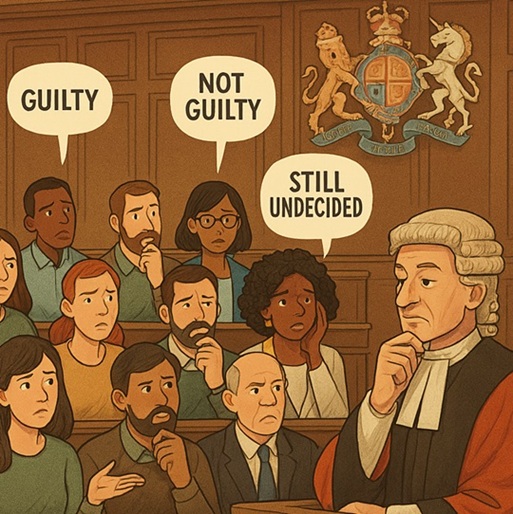
A hung jury refers to a situation in a criminal trial where the jury cannot reach a unanimous or majority verdict as required by law, resulting in a failure to deliver a conclusive decision on the defendant’s guilt or innocence.
Explanation of a Hung Jury
In England and Wales, juries in criminal trials typically consist of 12 jurors, though this number can reduce to as few as 9 due to illness or other exceptional circumstances.
For a verdict to be reached, the jury must either deliver a unanimous verdict (all jurors agree) or, after a minimum period of deliberation (usually at least two hours and ten minutes, as specified by the court), a majority verdict.
A majority verdict requires at least 10 jurors to agree (e.g., 10-2 or 11-1) when 12 jurors remain, or 9-1 if only 10 jurors remain, as outlined in the Juries Act 1974. A hung jury occurs when the jurors, even after extended deliberation, cannot achieve the required level of agreement. This deadlock means the jury is discharged by the judge without delivering a verdict, and the trial does not result in a conviction or acquittal.
Implications of a Hung Jury
When a jury is hung, the court typically discharges the jurors, and the case is referred back to the prosecution, usually the Crown Prosecution Service (CPS). The CPS then decides whether to pursue a retrial, based on factors such as the strength of the evidence, the seriousness of the offense, and the public interest.
According to CPS guidelines, a retrial is often sought if the prosecution believes a conviction is still likely and it serves the interests of justice CPS Retrial Guidance.
In some cases, if the evidence is weak or a retrial is deemed unlikely to succeed, the prosecution may choose not to proceed further, effectively halting the case. Alternatively, if a retrial is ordered, a new jury is empanelled, and the trial process begins anew, with the same or adjusted evidence presented.
Frequency and Causes of a Hung Jury
Hung juries are relatively rare in England and Wales due to the allowance of majority verdicts, which reduces the likelihood of deadlock compared to jurisdictions requiring unanimous verdicts.
Hung juries occur in a small percentage of cases, though exact figures vary year to year. Common reasons for a hung jury include conflicting evidence, complex legal issues, or differing juror perspectives on the case.
Legal Framework and Procedure
The process for handling juries, including hung juries, is governed by the Juries Act 1974 and supplemented by guidance in the Crown Court Compendium.
The Crown Court Compendium is a resource published by the Judicial College for judges presiding over criminal trials. The Compendium includes directions on jury management, such as how to handle deadlocked juries and when to give a “majority direction” or a “Watson direction” (based on R v Watson [1988] QB 650), which encourages jurors to reach a verdict without coercion.
Judges may provide additional directions to encourage jurors to reach a verdict, such as a “majority direction” after sufficient deliberation time, but they must avoid pressuring jurors unduly.
If a hung jury is declared, the judge discharges the jury, and the case is reviewed for further action. The Courts and Tribunals Service manages the procedural aspects of scheduling retrials or other proceedings.
In addition to the Juries Act 1974, which is the primary legislation governing jury composition, deliberations, and majority verdicts in England and Wales, other relevant legislation and legal frameworks may apply to the context of hung juries or related jury processes.
- Criminal Justice Act 2003
- This act introduced reforms to the criminal justice system, including provisions affecting jury trials. While it primarily focuses on evidence admissibility and sentencing, it also contains provisions that can influence retrials following a hung jury, such as rules on double jeopardy (Part 10, Sections 75–97). In rare cases, a hung jury in a serious offense may lead to a retrial under relaxed double jeopardy rules for certain offenses if new and compelling evidence emerges.
- Relevance to Hung Juries: If a hung jury occurs and a retrial is pursued, the Criminal Justice Act 2003 may govern aspects of the retrial process, particularly for serious crimes.
- Criminal Procedure Rules 2020
- The Criminal Procedure Rules, issued by the Ministry of Justice, provide detailed procedural guidance for criminal trials, including jury management and the handling of hung juries. Part 25 of the Rules outlines procedures for trial conduct, including jury deliberations and what happens when a jury cannot reach a verdict.
- Relevance to Hung Juries: These rules ensure that the court follows consistent procedures when discharging a hung jury and scheduling a retrial.
- Contempt of Court Act 1981
- This act regulates juror conduct and protects the integrity of jury deliberations. It prohibits jurors from disclosing details of their deliberations, which is relevant to hung juries as it ensures confidentiality even when a jury fails to reach a verdict. Breaches of this act (e.g., jurors researching cases online) can contribute to a hung jury or lead to a mistrial.
- Relevance to Hung Juries: Misconduct by jurors, such as improper research or external influence, can result in a hung jury or jury discharge, governed by this legislation.
- Criminal Justice and Public Order Act 1994
- This act includes provisions related to jury tampering and juror intimidation (Sections 51–52), which can lead to a hung jury if jurors feel unable to deliberate freely. If tampering is suspected, the court may discharge the jury, effectively resulting in a hung jury scenario.
- Relevance to Hung Juries: Ensures that external pressures do not improperly influence jury decisions, which could otherwise lead to a deadlock.
Impact on Defendants and Victims
A hung jury can be emotionally and financially taxing for all parties involved. Defendants may face prolonged uncertainty, while victims and witnesses may need to prepare for a retrial, potentially reliving traumatic experiences. The CPS considers these factors when deciding whether to pursue a retrial, balancing justice with practicality.
Conclusion
A hung jury in England and Wales represents a rare but significant outcome in criminal trials, reflecting the challenges of achieving consensus in complex cases.
Governed by clear legal frameworks like the Juries Act 1974 and CPS guidelines, the system ensures that hung juries are handled methodically, with retrials or case discontinuations decided in the interest of justice. For further information on jury processes or retrials, refer to the following resources:
- Juries Act 1974
- Crown Prosecution Service Retrial Guidance
- Judiciary of England and Wales
- HM Courts and Tribunals Service
- Ministry of Justice
Check out our related articles on What is a Jury ?, Rule of Law, Open Justice, Is the Law Black and White ?, What Does Lady Justice Symbolise ?, Can a Judge Direct a Jury to Find a Defendant Not Guilty ?,Law Society, Law Commission, Solicitors, Solicitors Regulation Authority, Barristers, Bar Council of England and Wales, Bar Standards Board, Contra Mundum, R v Sussex Justices, Police Impartiality and the highly questionable Sussex Family Justice Board.
The Ministry of Injustice is not the Ministry of Justice nor is it affiliated in any way with the justice system, legal profession, police or any other law enforcement agencies.
“Publicity is the very soul of justice. . . . It keeps the judge himself, while trying, under trial….Where there is no publicity there is no justice”
Jeremy Bentham – Mr Justice Cobb: ‘Justice must be seen to be done’
Latest Articles ↓
- Presumption of Innocence
 The presumption of innocence is a basic principle of the… Read more: Presumption of Innocence
 - His Honour Judge Daniel Sawyer
 Judge Daniel Sawyer, known as His Honour Judge Daniel Sawyer,… Read more: His Honour Judge Daniel Sawyer
 - UK National Centre for Information Defence
 Prime Minister Andy Burnham used his first United Nations General… Read more: UK National Centre for Information Defence
 - Judges Behaving Badly and His Honour Judge Simon Oliver
 On the 27th August 2026 the Crown Prosecution Service announced… Read more: Judges Behaving Badly and His Honour Judge Simon Oliver
 - Jo Morris Barrister
 Jo Morris is a practising criminal barrister of Drystone Chambers… Read more: Jo Morris Barrister
 - Good Law Project
 The Good Law Project is a UK campaigning organisation that… Read more: Good Law Project
 - Police Federation of England and Wales (PFEW)
 The Police Federation of England and Wales (PFEW) is the… Read more: Police Federation of England and Wales (PFEW)
 - What is the Criminal Justice System (CJS) Common Platform ?
 The Criminal Justice System Common Platform (also known as HMCTS… Read more: What is the Criminal Justice System (CJS) Common Platform ?
 - Strategic Lawsuit Against Public Participation (SLAPPs)
 Strategic Lawsuits Against Public Participation, or SLAPPs, are legal actions… Read more: Strategic Lawsuit Against Public Participation (SLAPPs)
 - His Honour Judge Tony Baumgartner – Recorder of Westminster
 Judge Tony Alan Walter Baumgartner, known as His Honour Judge… Read more: His Honour Judge Tony Baumgartner – Recorder of Westminster
 - New Protocol for Legal Professionals to Raise Informal Concerns About Judges Behaviour
 On the 8th July 2026, the Courts and Tribunals Judiciary… Read more: New Protocol for Legal Professionals to Raise Informal Concerns About Judges Behaviour
 - The Policing Performance System
 In April 2026, His Majesty’s Inspectorate of Constabulary and Fire… Read more: The Policing Performance System
Most Popular ↓
You should always seek formal legal advice from a qualified and reputable lawyer (solicitor or barrister).
There are a number of links to Free and Paid For Legal Resources and Legal Organisations on the Free Legal Advice , Legal Aid and Pro Bono pages.
[post_title] was last updated on the 15th October 2026
