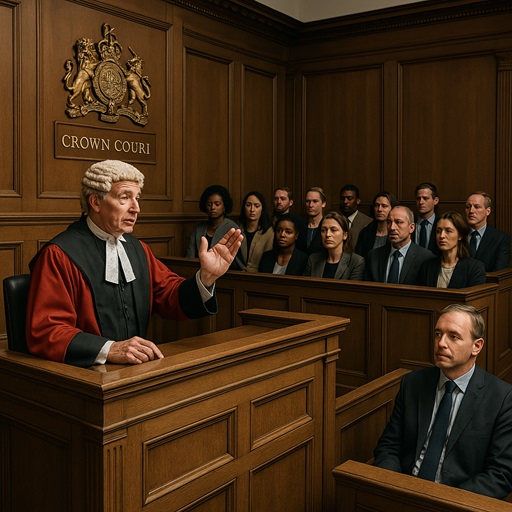
In England and Wales, a judge in a crown court trial can decide on their own or direct a jury to find a defendant not guilty in specific circumstances, primarily when there is insufficient evidence to support a conviction. This is known as a directed acquittal.
Legal Basis and Crown Court Procedure
Pre-Trial Dismissal
Under Section 6 of the Criminal Justice Act 1987 (for serious or complex fraud cases) or Schedule 3 of the Crime and Disorder Act 1998 (for other indictable offenses), the judge reviews written evidence and submissions without a hearing and may dismiss the charges, resulting in an acquittal.
The judge acts alone, without a jury, and the acquittal is formally recorded, barring further prosecution for the same offense (subject to the double jeopardy rule).
During Trial
A judge can direct an acquittal under Section 17 of the Criminal Justice Act 1967 if, after the prosecution presents its case, the judge finds “no case to answer” because the evidence is so weak that no reasonable jury could convict. This often follows a defense submission at the close of the prosecution’s case.
- The judge assesses whether the evidence is sufficient for a jury to properly convict. If it’s deemed insufficient (e.g., lacks key elements of the offense or is unreliable), the judge can direct the jury to return a not guilty verdict.
- This is often seen in cases where the prosecution fails to establish a prima facie case or the evidence is legally inadmissible or too weak.
Abuse of Process
A judge may also dismiss a case if continuing it would be an abuse of process (e.g., due to unfairness or procedural irregularities), leading to a stay or acquittal.
Key Case Law
The test for a directed acquittal is based on R v Galbraith [1981] 1 WLR 1039, which sets out that a case should be stopped if:
- There is no evidence that the defendant committed the offense, or
- The prosecution’s evidence is so tenuous or inconsistent that a conviction would be unsafe.
Judge’s Role
The judge cannot direct a not guilty verdict simply because they personally believe the defendant is innocent. The decision must be based on the legal sufficiency of the evidence. If there’s enough evidence for a jury to consider, the case proceeds, and the jury decides the verdict.
Limitations
A judge cannot direct a jury to find a defendant guilty, as this would infringe on the jury’s role as the arbiter of facts (R v Wang [2005] UKHL 9).
- Directed acquittals are rare and typically occur in clear-cut cases of evidential deficiency.
In summary, a judge in England and Wales can direct a jury to find a defendant not guilty if the prosecution’s case is legally insufficient, but this is a procedural safeguard rather than a subjective judgment on guilt or innocence.
What about a Magistrate ?
In England and Wales, a magistrate (or magistrates, as they often sit in panels of 3 in magistrates’ courts), or district judge does not direct a jury in the same way a judge does in a Crown Court, as magistrates’ courts do not have juries.
Instead, magistrates act as both the trier of law and fact in summary trials (less serious offenses). However, the concept of a directed acquittal or dismissing a case due to insufficient evidence still applies in magistrates’ courts, adapted to their context. Here’s a concise explanation:
Magistrates’ Role in Dismissing a Case
Magistrates or District Judge can dismiss a case if they find there is no case to answer, similar to a directed acquittal in a Crown Court. This happens when the prosecution’s evidence, at the close of their case, is insufficient for a conviction.
- The defense may make a submission of no case to answer, arguing that the prosecution has failed to present enough evidence to prove the offense. The magistrates or District Judge then assess whether the evidence is sufficient to proceed.
Magistrate Legal Test
The same principles from R v Galbraith [1981] 1 WLR 1039 apply:
- If there is no evidence that the defendant committed the offense, the case must be dismissed.
- If the evidence is so weak, inconsistent, or unreliable that a conviction would be unsafe, the magistrates or district judge can stop the case.
Magistrates Court Procedure
In a magistrates’ court, if the prosecution’s case is deemed insufficient after their evidence is presented, the magistrates can dismiss the case without requiring the defense to present their case.
- This is effectively equivalent to a judge directing a not guilty verdict in a Crown Court, but since magistrates or district judge are the decision-makers, they simply dismiss the case or acquit the defendant directly.
Key Differences from Crown Court
There is no jury in magistrates’ court cases, so magistrates do not “direct” a jury. They decide the outcome themselves.
- Magistrates’ courts handle less serious offenses, so the threshold for dismissing a case may be applied more frequently due to simpler evidential issues.
- Cases in a magistrates court are heard by either three magistrates or a district judge.
Magistrate and District Judge Limitations
Like Crown Court judges, magistrates cannot dismiss a case based on their personal belief in the defendant’s innocence. The decision must be based on the legal insufficiency of the prosecution’s evidence.
- If the evidence is sufficient to proceed, magistrates will hear the defense’s case and make a final decision on guilt or innocence.
In summary, a magistrate or district judge in England and Wales can effectively “direct” a not guilty outcome by dismissing a case or acquitting a defendant if the prosecution’s evidence is insufficient, following the same legal principles as in a directed acquittal in a Crown Court.
Check out our related articles on What is a Jury ?, What is a Hung Jury ?, Rule of Law, Open Justice, Is the Law Black and White ?, What Does Lady Justice Symbolise ?, Law Society, Law Commission, Solicitors, Solicitors Regulation Authority, Barristers, Bar Council of England and Wales, Bar Standards Board, Contra Mundum, R v Sussex Justices, Police Impartiality and the highly questionable Sussex Family Justice Board.
The Ministry of Injustice is not the Ministry of Justice nor is it affiliated in any way with the justice system, legal profession, police or any other law enforcement agencies.
“Publicity is the very soul of justice. . . . It keeps the judge himself, while trying, under trial….Where there is no publicity there is no justice”
Jeremy Bentham – Mr Justice Cobb: ‘Justice must be seen to be done’
Latest Articles ↓
- Presumption of Innocence
 The presumption of innocence is a basic principle of the… Read more: Presumption of Innocence
 - His Honour Judge Daniel Sawyer
 Judge Daniel Sawyer, known as His Honour Judge Daniel Sawyer,… Read more: His Honour Judge Daniel Sawyer
 - UK National Centre for Information Defence
 Prime Minister Andy Burnham used his first United Nations General… Read more: UK National Centre for Information Defence
 - Judges Behaving Badly and His Honour Judge Simon Oliver
 On the 27th August 2026 the Crown Prosecution Service announced… Read more: Judges Behaving Badly and His Honour Judge Simon Oliver
 - Jo Morris Barrister
 Jo Morris is a practising criminal barrister of Drystone Chambers… Read more: Jo Morris Barrister
 - Good Law Project
 The Good Law Project is a UK campaigning organisation that… Read more: Good Law Project
 - Police Federation of England and Wales (PFEW)
 The Police Federation of England and Wales (PFEW) is the… Read more: Police Federation of England and Wales (PFEW)
 - What is the Criminal Justice System (CJS) Common Platform ?
 The Criminal Justice System Common Platform (also known as HMCTS… Read more: What is the Criminal Justice System (CJS) Common Platform ?
 - Strategic Lawsuit Against Public Participation (SLAPPs)
 Strategic Lawsuits Against Public Participation, or SLAPPs, are legal actions… Read more: Strategic Lawsuit Against Public Participation (SLAPPs)
 - His Honour Judge Tony Baumgartner – Recorder of Westminster
 Judge Tony Alan Walter Baumgartner, known as His Honour Judge… Read more: His Honour Judge Tony Baumgartner – Recorder of Westminster
 - New Protocol for Legal Professionals to Raise Informal Concerns About Judges Behaviour
 On the 8th July 2026, the Courts and Tribunals Judiciary… Read more: New Protocol for Legal Professionals to Raise Informal Concerns About Judges Behaviour
 - The Policing Performance System
 In April 2026, His Majesty’s Inspectorate of Constabulary and Fire… Read more: The Policing Performance System
Most Popular ↓
You should always seek formal legal advice from a qualified and reputable lawyer (solicitor or barrister).
There are a number of links to Free and Paid For Legal Resources and Legal Organisations on the Free Legal Advice , Legal Aid and Pro Bono pages.
[post_title] was last updated on the 15th October 2026
