
A District Judge in England and Wales is a judicial officer who presides over lower court proceedings, primarily in the Magistrates’ Courts and County Courts.
Magistrates’ Courts:
- Criminal Cases: District Judges handle criminal cases, but their jurisdiction is generally limited to less serious offenses or cases where the accused opts for summary trial (trial without a jury). They can sentence defendants for offenses like summary offenses or either-way offenses where the defendant pleads guilty or is found guilty in a summary trial. However, they can only impose sentences up to 6 months imprisonment for a single offense (or up to 12 months in total for multiple offenses).
- Civil Cases: Although less common, they might deal with civil proceedings in the Magistrates’ Courts, like family proceedings under the Family Law Act 1996.
County Courts:
- Civil Jurisdiction: In the County Court, District Judges handle a variety of civil matters including small claims (up to £10,000), possession proceedings for property, and other civil disputes. They can also deal with some aspects of insolvency, family law, and housing law.
Other Duties:
- Appeals: They might hear appeals from decisions made by magistrates or other lower judicial officers.
- Case Management: District Judges often play a significant role in case management, helping to direct cases towards mediation or trial, making procedural rulings, and sometimes conducting pre-trial reviews or settlement hearings.
District Judges are legally qualified (they must be barristers or solicitors with at least seven years of rights of audience) and are appointed by the Judicial Appointments Commission. They are distinct from “Magistrates,” who are lay judges, meaning they are not legally trained but trained for their role.
The appointment to the position of District Judge is quite competitive, requiring significant legal experience and passing through a rigorous selection process. They play a crucial role in the administration of justice at a grassroots level, dealing with a high volume of cases that affect the daily lives of many citizens.
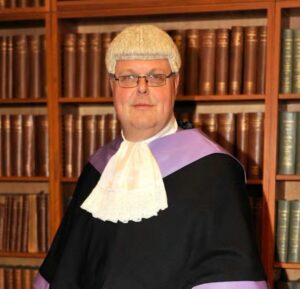
In open court district judges wear the civil robe introduced in October 2008, with blue tabs at the neck and without a wig.
Court Working Dress – District Judge
Check out our articles on Dodgy Judges, Judges Salaries and Fees, His Honour Judge Melbourne Inman KC, His Honour Now His Dishonour, His Honour Judge Michael Slater, His Honour Judge Martin Davis, HHJ Farquhar, Do you Have to Bow to a Judge ?, Can you Email a Judge ?, Can you Criticise a Judge ? and the highly dubious Sussex Family Justice Board.
The Ministry of Injustice is not the Ministry of Justice nor is it affiliated in any way with the justice system, legal profession, police or any other law enforcement agencies.
“Publicity is the very soul of justice. . . . It keeps the judge himself, while trying, under trial….Where there is no publicity there is no justice”
Jeremy Bentham – Mr Justice Cobb: ‘Justice must be seen to be done’
Latest Articles ↓
- Presumption of Innocence
 The presumption of innocence is a basic principle of the… Read more: Presumption of Innocence
 - His Honour Judge Daniel Sawyer
 Judge Daniel Sawyer, known as His Honour Judge Daniel Sawyer,… Read more: His Honour Judge Daniel Sawyer
 - UK National Centre for Information Defence
 Prime Minister Andy Burnham used his first United Nations General… Read more: UK National Centre for Information Defence
 - Judges Behaving Badly and His Honour Judge Simon Oliver
 On the 27th August 2026 the Crown Prosecution Service announced… Read more: Judges Behaving Badly and His Honour Judge Simon Oliver
 - Jo Morris Barrister
 Jo Morris is a practising criminal barrister of Drystone Chambers… Read more: Jo Morris Barrister
 - Good Law Project
 The Good Law Project is a UK campaigning organisation that… Read more: Good Law Project
 - Police Federation of England and Wales (PFEW)
 The Police Federation of England and Wales (PFEW) is the… Read more: Police Federation of England and Wales (PFEW)
 - What is the Criminal Justice System (CJS) Common Platform ?
 The Criminal Justice System Common Platform (also known as HMCTS… Read more: What is the Criminal Justice System (CJS) Common Platform ?
 - Strategic Lawsuit Against Public Participation (SLAPPs)
 Strategic Lawsuits Against Public Participation, or SLAPPs, are legal actions… Read more: Strategic Lawsuit Against Public Participation (SLAPPs)
 - His Honour Judge Tony Baumgartner – Recorder of Westminster
 Judge Tony Alan Walter Baumgartner, known as His Honour Judge… Read more: His Honour Judge Tony Baumgartner – Recorder of Westminster
 - New Protocol for Legal Professionals to Raise Informal Concerns About Judges Behaviour
 On the 8th July 2026, the Courts and Tribunals Judiciary… Read more: New Protocol for Legal Professionals to Raise Informal Concerns About Judges Behaviour
 - The Policing Performance System
 In April 2026, His Majesty’s Inspectorate of Constabulary and Fire… Read more: The Policing Performance System
Most Popular ↓
You should always seek formal legal advice from a qualified and reputable lawyer (solicitor or barrister).
There are a number of links to Free and Paid For Legal Resources and Legal Organisations on the Free Legal Advice , Legal Aid and Pro Bono pages.
[post_title] was last updated on the 15th October 2026
