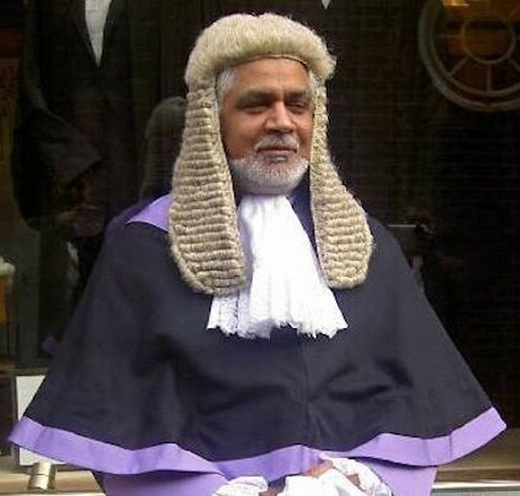
Judge Amjad Nawaz, known as His Honour Judge Amjad Nawaz, is a long-serving Circuit Judge of England and Wales who is assigned to the South East Circuit.
Judge Nawaz was appointed to the Circuit bench on October 24th 2008 (with the formal announcement made by HM The Queen on the advice of the Lord Chancellor).
Detailed public records on Judge Nawaz’s pre-appointment professional background (such as whether he practiced as a barrister or solicitor, chambers affiliation, year of call to the Bar, or areas of specialization) are limited.
Unlike some judges whose biographies appear on chambers websites, judicial profiles, or in appointment announcements with full career histories, Judge Nawaz’s pre-bench career is not extensively documented in open sources.
Beyond his core judicial duties in England and Wales, Judge Nawaz has undertaken additional roles that reflect his engagement in international judicial matters.
Judge Nawaz has been appointed as a Senior Judge of the Senior Judges’ Court in the Sovereign Base Areas of Akrotiri and Dhekelia (British Overseas Territories in Cyprus).
HHJ Nawaz has also participated in judicial exchanges and collaborations. In 2023, he joined discussions and visits (often alongside Her Honour Judge Azmat Nisa) to Nigeria, invited for talks on judicial case management, digitalization of court processes, paperless trials, and exchange programs.
Similar engagements have included visits to the UAE to discuss judicial decision-making, international arbitration, and legal traditions.
His Honour Judge Amjad Nawaz was appointed as the Resident Judge at Reading Crown Court for a period of four years commencing 20 April 2026.
HHJ Nawaz is shown on the List of Circuit Judges published on the Courts and Tribunal Judiciary website.
| His Honour Judge Nawaz | South East | 24-10-2008 |
Judge Nawaz Legal Controversy – Chaudhry Zaman spared jail for sexually assaulting 12 year old girl
In February 2026, a sentencing decision by His Honour Judge Amjad Nawaz at Reading Crown Court sparked widespread public outrage and debate over judicial leniency, cultural biases and the protection of child victims in the UK justice system.
Migrant, 70, told 12-year-old girl to ‘cover her head’ during sexual assault – Telegraph
The case involved 70-year-old Chaudhry Zaman, a migrant living in Berkshire, who was convicted of sexually assaulting a 12-year-old girl in Slough. What began as a straightforward criminal proceeding quickly escalated into a broader controversy, fuelled by media coverage, social media backlash, and accusations of favouritism.
On the 2nd February 2026 Judge Nawaz handed down a nine-month prison sentence, suspended for 18 months. Additional penalties included 80 hours of unpaid community work, a five-year restraining order barring Zaman from approaching within 200 meters of the girl’s school, and a 10-year registration on the sex offenders’ register.
In his remarks, Judge Nawaz acknowledged the victim’s suffering, stating: “The victim has lost her self-esteem, lost her confidence and lost her friends and that is all down to your actions… That has caused a breakup of friendships which she regrets.”
Judge Nawaz also addressed Zaman directly about the CCTV evidence and the girl’s account of the forced hand-holding and kiss.
Judge Amjad Nawaz justified the suspended sentence by agreeing with the pre-sentence report that Zaman’s risk could be “managed in the community,” considering his age, remorse (despite denying guilt) and assurances it would “never happen again.”
It has prompted calls for reviews of sentencing guidelines for child sexual assaults, particularly when offenders cite age or cultural factors. Supporters of the decision point to the pre-sentence report and overcrowding in UK prisons as practical considerations, but detractors see it as prioritizing the perpetrator over the victim.
This controversy highlights ongoing tensions in the UK over immigration, cultural integration and judicial accountability. While some view the outrage as racially tinged, others insist it’s about ensuring justice for vulnerable children. The debate continues online, with thousands of views and shares amplifying demands for stricter penalties in similar cases.
Authorisation to sit as a High Court Judge
HHJ Nawaz may be authorised to sit as a High Court Judge by s9(1) of the Senior Courts Act as amended by the Crime and Courts Act 2013.
According to CRIMINAL PRACTICE DIRECTIONS 2015 DIVISION XII His Honour Judge Nawaz should be addressed as “My Lord” in court.
Modes of Address B.1 – The following judges, when sitting in court, should be addressed as ‘My Lord’ or ‘My Lady’
(b) any Circuit Judge sitting as a judge of the Court of Appeal (Criminal Division) or the High Court under section 9(1) of the Senior Courts Act 1981;
(d) any Senior Circuit Judge who is an Honorary Recorder.
Description B.3 – In cause lists, forms and orders members of the judiciary should be described as follows:
(a) Circuit Judges, as ‘His [or Her] Honour Judge A’. When the judge is sitting as a judge of the High Court under section 9(1) of the Senior Courts Act 1981, the words ‘sitting as a judge of the High Court’ should be added;
The three key values which are central to the role of judicial office holders (JOHs) in England and Wales are:
• Independence
• Impartiality
• Integrity
“Publicity is the very soul of justice. . . . It keeps the judge himself, while trying, under trial….Where there is no publicity there is no justice”
Jeremy Bentham – Mr Justice Cobb: ‘Justice must be seen to be done’
Image of HHJ Nawaz : @BasilTheGreat
The High Court Judge that never was – His Honour Judge Melbourne Inman KC
Check out our articles on Rule of Law, Open Justice, Judges Salaries and Fees, Dodgy Judges, Mr Justice Williams, His Honour Now His Dishonour, His Honour Judge Stuart Farquhar, Do you Have to Bow to a Judge ?, Can you Email a Judge ?, Can you Criticise a Judge ? and the highly dubious Sussex Family Justice Board.
The Ministry of Injustice is not the Ministry of Justice nor is it affiliated in any way with the justice system, legal profession, police or any other law enforcement agencies.
“Publicity is the very soul of justice. . . . It keeps the judge himself, while trying, under trial….Where there is no publicity there is no justice”
Jeremy Bentham – Mr Justice Cobb: ‘Justice must be seen to be done’
Latest Articles ↓
- His Honour Judge Daniel Sawyer
 Judge Daniel Sawyer, known as His Honour Judge Daniel Sawyer,… Read more: His Honour Judge Daniel Sawyer
 - UK National Centre for Information Defence
 Prime Minister Andy Burnham used his first United Nations General… Read more: UK National Centre for Information Defence
 - Judges Behaving Badly and His Honour Judge Simon Oliver
 On the 27th August 2026 the Crown Prosecution Service announced… Read more: Judges Behaving Badly and His Honour Judge Simon Oliver
 - Jo Morris Barrister
 Jo Morris is a practising criminal barrister of Drystone Chambers… Read more: Jo Morris Barrister
 - Good Law Project
 The Good Law Project is a UK campaigning organisation that… Read more: Good Law Project
 - Police Federation of England and Wales (PFEW)
 The Police Federation of England and Wales (PFEW) is the… Read more: Police Federation of England and Wales (PFEW)
 - What is the Criminal Justice System (CJS) Common Platform ?
 The Criminal Justice System Common Platform (also known as HMCTS… Read more: What is the Criminal Justice System (CJS) Common Platform ?
 - Strategic Lawsuit Against Public Participation (SLAPPs)
 Strategic Lawsuits Against Public Participation, or SLAPPs, are legal actions… Read more: Strategic Lawsuit Against Public Participation (SLAPPs)
 - His Honour Judge Tony Baumgartner – Recorder of Westminster
 Judge Tony Alan Walter Baumgartner, known as His Honour Judge… Read more: His Honour Judge Tony Baumgartner – Recorder of Westminster
 - New Protocol for Legal Professionals to Raise Informal Concerns About Judges Behaviour
 On the 8th July 2026, the Courts and Tribunals Judiciary… Read more: New Protocol for Legal Professionals to Raise Informal Concerns About Judges Behaviour
 - The Policing Performance System
 In April 2026, His Majesty’s Inspectorate of Constabulary and Fire… Read more: The Policing Performance System
 - What is the Judicial College ?
 The Judicial College serves as the central pillar of professional… Read more: What is the Judicial College ?
Most Popular ↓
You should always seek formal legal advice from a qualified and reputable lawyer (solicitor or barrister).
There are a number of links to Free and Paid For Legal Resources and Legal Organisations on the Free Legal Advice , Legal Aid and Pro Bono pages.
[post_title] was last updated on the 6th October 2026
