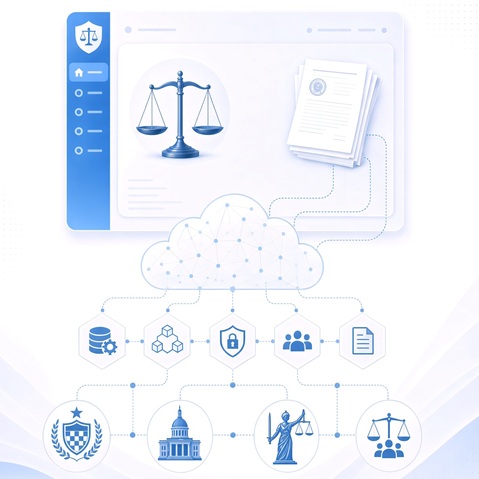
The Criminal Justice System Common Platform (also known as HMCTS Common Platform or CJSCP) is the national digital case management system for criminal cases in the Crown Courts and magistrates’ courts of England and Wales.
Designed and developed by HM Courts & Tribunals Service (HMCTS) as part of its Reform Programme (which began in earnest around 2016, building on earlier modernisation efforts dating back to 2011), it replaces multiple outdated “heritage” or legacy systems such as Libra, Xhibit, and the Digital Case System (DCS).
The platform creates a single, shared source of case information that professional users across the criminal justice system can access securely and in near real time.
Purpose and Key Benefits
The HMCTS CJS Common Platform allows Police, the Crown Prosecution Service (CPS), judiciary, court staff, defence solicitors and barristers, Legal Aid Agency, prisons, probation, and other agencies to view, update and share case materials digitally.
The CJS Common Platform is the official digital record of case progress, results and structured hearing outcomes in magistrates and crown courts
Core functions include:
- Case creation, progression, and resulting (recording outcomes, orders, warrants, and notices).
- Self-service of Initial Details of the Prosecution Case (IDPC) and digital forms such as the Preparation for Effective Trial (PET) or Better Case Management forms.
- Association of defence firms/chambers with specific defendants or cases (marking them “on record”).
- Hearing check-in for advocates.
- Real-time notifications and updates.
- Support for Single Justice Procedure (SJP) cases, postal requisitions, and summons via Automated Track Case Management (ATCM).
By February 2025, more than 2.3 million criminal cases had been managed on the platform. It is live in all criminal courts in England and Wales (full national rollout completed around August 2023), handling thousands of hearings daily and supporting tens of thousands of concurrent users. Benefits include reduced paper handling, fewer errors, faster information sharing, greater resilience (remote access), and better data for performance analysis.
The system uses Unique Reference Numbers (URNs) which are typically 11-character case identifiers that link records across partners.
CJS Common Platform Technology Stack
Common Platform is a cloud-native, microservices-based system hosted primarily on Microsoft Azure. Key technical elements include:
- Architecture: Microservices framework supporting CQRS (Command Query Responsibility Segregation) and event sourcing (public GitHub repositories under CJSCommonPlatform/microservice-framework show a Java-based core). It uses a service-oriented approach with Docker containers.
- Backend: Heavily Java-based services; some Node.js components for front-end gateways. PostgreSQL databases (with migrations to managed instances noted in backlogs), Redis for sessions/caching.
- Frontend / User Interface: Angular-based single-page applications in related HMCTS services, with GOV.UK Design System influences; accessible via modern browsers (Chrome, Edge, Firefox, Safari — Internet Explorer is unsupported).
- Identity and Access Management (Crime IdAM): Central to secure login. Uses ForgeRock now Ping Identity (AM, IDM, IG, DS/LDAP components) integrated with Microsoft Entra ID (formerly Azure Active Directory). Supports Multi-Factor Authentication (MFA) via Microsoft Authenticator app (Time-based One-Time Password / TOTP), Single Sign-On (SSO), and Role-Based Access Control (RBAC). Environments include production (PRD), pre-production (PRP), system integration testing (SIT), non-functional testing (NFT), and an internal BAE (PR) environment (an HMCTS technical label for a specific identity instance, unrelated to the defence company BAE Systems).
- Infrastructure: Azure Kubernetes Service (AKS) for container orchestration, Azure Key Vault for secrets, Application Insights / Dynatrace for monitoring, Jenkins for CI/CD, Terraform for infrastructure-as-code, Docker, Nginx, Tomcat, and Ubuntu (with migrations from RHEL). Platform-as-a-Service databases and auto-scaling have reduced costs and improved resilience.
Emails for account activation come from Azure-hosted servers ([email protected]). The domain name is cjscp.org.uk (Criminal Justice System Common Platform).
If you have arrived at the Ministry of Injustice from https://cjscp.uk (MOI domain) you may well have been looking for https://cjscp.org.uk which is the official website for The Criminal Justice System (CJS) Common Platform
CJS Common Platform Contract Values and Suppliers
Development and ongoing support for the CJS Common Platform (and its related Crime IdAM identity layer) have involved multiple suppliers working under Crown Commercial Service (CCS) frameworks.
Key confirmed examples include:
- Digital Outcomes (and related Digital Marketplace frameworks) — used for the larger HMCTS Crime Programme Design, Development and Testing Managed Service (indicative budget up to £12.75 million), with Scrumconnect later becoming a primary supplier for ongoing development work.
- RM6100 Technology Services 3 was used for the HMCTS Crime IdAM Product Enhancement Team Managed Service awarded to CGI IT UK Limited (value ~£5.19 million).
CJSCP development contracts
- HMCTS Crime Programme Design, Development and Testing Managed Service
This was the large development contract for the Common Platform itself (indicative budget up to £12.75 million).
Scrumconnect was later reported as a key (and in some periods sole) supplier for ongoing design, development, testing, automation features, and maintenance work. Subsequent related contracts and extensions have supported continued enhancement of the platform.
Other supporting contracts cover broader MoJ identity work (e.g., Entra ID configuration) and platform operations.
Primary Crime IdAM document
- Title: HMCTS Crime IdAM Product Enhancement Team Managed Service
- Award notice summaries: Available on the D3 Tenders page and bidstats.uk award notice.
- Supplier: CGI IT UK Limited
- Value: ~£5.19 million (£5,185,766)
- Period: October 2024 – September 2029 (approx.)
- Framework: RM6100 Technology Services 3
How to Access the Common Platform
Access is restricted to authorised professional users and organisations. Members of the public cannot log in directly.
Defendants in certain cases (e.g. Single Justice Procedure) may submit online pleas or receive information through other channels, but they do not access the Common Platform itself.
Organisation Registration
- Defence firms/chambers: An organisation administrator completes the official registration spreadsheet (Excel or CSV, available on GOV.UK) with organisation and user details (including mobile numbers — shared/landline/CJSM emails are not allowed). Accept terms and conditions and email the form to [email protected].
- Prosecuting organisations: Complete a questionnaire covering address, volumes, offence codes, etc.
- HMCTS validates and onboards the organisation.
Individual Account Activation
- Each user receives an email from [email protected] (check spam; links expire after 28 days).
- Follow the link, accept terms, verify mobile number with a one-time code, create a strong password (8+ characters, mixed case, numbers, specials and change every 90 days), and set up Microsoft Authenticator by scanning a QR code.
- Activation must be completed before first court use.
Login and Use
- Main sign-in: https://prosecuting.cjscp.org.uk (or role-specific portals).
- Subdomains such as https://login.bae.cjscp.org.uk point to specific internal environments (e.g., the BAE identity instance).
- Use a supported browser on desktop/laptop/tablet. You need your registered phone for MFA but cannot access the platform solely via mobile.
- After login: Associate with cases (using defendant details or URN), self-serve IDPC, manage materials, check in to hearings, etc.
- Help: Courts and Tribunals Service Centre (CTSC) on 0330 808 4407 or [email protected]; organisation administrators handle day-to-day user management.
Full official guides are published on GOV.UK under “How to use HMCTS Common Platform” and related administrator documents.
HMCTS Common Platform for defence administrators is a guide for legal defence administrators on creating user accounts, assigning roles, and other system tasks.
Summary
The CJS Common Platform represents one of the largest digital transformations in the UK justice system.
Built on modern Azure cloud microservices technology with robust identity controls (ForgeRock + Microsoft Entra ID), it has processed millions of cases.
Ongoing contracts with the CGI-managed IdAM service and Scrumconnect’s development work, ensure continued enhancement.
Access to the Common Platform is tightly controlled through organisational registration and multi-factor authentication to protect sensitive criminal justice data.
Check out our related articles on Criminal Justice Secure Mail, Rule of Law, Open Justice, Is the Law Black and White ?, What Does Lady Justice Symbolise ?, Can a Judge Direct a Jury to Find a Defendant Not Guilty ?,Law Society, Law Commission, Solicitors, Solicitors Regulation Authority, Barristers, Bar Council of England and Wales, Bar Standards Board, Contra Mundum, R v Sussex Justices, Police Impartiality and the highly questionable Sussex Family Justice Board.
The Ministry of Injustice is not the Ministry of Justice nor is it affiliated in any way with the justice system, legal profession, police or any other law enforcement agencies.
“Publicity is the very soul of justice. . . . It keeps the judge himself, while trying, under trial….Where there is no publicity there is no justice”
Jeremy Bentham – Mr Justice Cobb: ‘Justice must be seen to be done’
Latest Articles ↓
- Presumption of Innocence
 The presumption of innocence is a basic principle of the… Read more: Presumption of Innocence
 - His Honour Judge Daniel Sawyer
 Judge Daniel Sawyer, known as His Honour Judge Daniel Sawyer,… Read more: His Honour Judge Daniel Sawyer
 - UK National Centre for Information Defence
 Prime Minister Andy Burnham used his first United Nations General… Read more: UK National Centre for Information Defence
 - Judges Behaving Badly and His Honour Judge Simon Oliver
 On the 27th August 2026 the Crown Prosecution Service announced… Read more: Judges Behaving Badly and His Honour Judge Simon Oliver
 - Jo Morris Barrister
 Jo Morris is a practising criminal barrister of Drystone Chambers… Read more: Jo Morris Barrister
 - Good Law Project
 The Good Law Project is a UK campaigning organisation that… Read more: Good Law Project
 - Police Federation of England and Wales (PFEW)
 The Police Federation of England and Wales (PFEW) is the… Read more: Police Federation of England and Wales (PFEW)
 - What is the Criminal Justice System (CJS) Common Platform ?
 The Criminal Justice System Common Platform (also known as HMCTS… Read more: What is the Criminal Justice System (CJS) Common Platform ?
 - Strategic Lawsuit Against Public Participation (SLAPPs)
 Strategic Lawsuits Against Public Participation, or SLAPPs, are legal actions… Read more: Strategic Lawsuit Against Public Participation (SLAPPs)
 - His Honour Judge Tony Baumgartner – Recorder of Westminster
 Judge Tony Alan Walter Baumgartner, known as His Honour Judge… Read more: His Honour Judge Tony Baumgartner – Recorder of Westminster
 - New Protocol for Legal Professionals to Raise Informal Concerns About Judges Behaviour
 On the 8th July 2026, the Courts and Tribunals Judiciary… Read more: New Protocol for Legal Professionals to Raise Informal Concerns About Judges Behaviour
 - The Policing Performance System
 In April 2026, His Majesty’s Inspectorate of Constabulary and Fire… Read more: The Policing Performance System
Most Popular ↓
You should always seek formal legal advice from a qualified and reputable lawyer (solicitor or barrister).
There are a number of links to Free and Paid For Legal Resources and Legal Organisations on the Free Legal Advice , Legal Aid and Pro Bono pages.
[post_title] was last updated on the 15th October 2026
