The implied right of access refers to a presumed permission for individuals or entities to enter private property for specific purposes, even without formal consent.
Implied rights of access is not explicitly granted but arises from necessity, custom, or legal provisions. It is distinct from explicit rights, such as those granted by easements or licences, which are formally documented.
It should be noted that Implied right of access is a common law principle derived from established legal precedent, rather than a specific law.
Examples of Implied Right of Access
- Utility Companies: Utility providers (e.g., water, gas, electricity, or telecommunications) may have an implied right to access private property to maintain infrastructure, such as meters or cables, often supported by statutory powers.
- Emergency Services: Police, fire services, or paramedics may access private property in emergencies to ensure public safety, as authorised by law.
- Delivery Personnel: Postal workers or delivery couriers may have an implied right to approach a property’s entrance to deliver mail or packages.
- Visitors or Neighbours: Neighbours or visitors may have an implied right to use a pathway or driveway to reach a front door, particularly if it’s the only practical route.
- Statutory Authorities: Local authority officials, such as building inspectors or environmental health officers, may have implied access for regulatory purposes under specific legislation.
Legal Basis in England and Wales
The implied right of access in England and Wales is grounded in:
- Common Law: Implied rights may arise from necessity (e.g., accessing a landlocked property) or long-standing custom (e.g., a pathway used without objection for years).
- Statutory Provisions: Legislation, such as the Gas Act 1986, Electricity Act 1989, or Water Industry Act 1991, grants utility companies rights to access private property for maintenance or inspections. Similarly, emergency services have access rights under laws like the Police and Criminal Evidence Act 1984.
- Implied Easements: An implied easement may exist if a property was divided, and one parcel requires access through another to reach a public highway (e.g., under the rule in Wheeldon v Burrows or s.62 of the Law of Property Act 1925).
What is Trespass ?
Trespassing is when someone enters or remains on land that belongs to someone else without their permission or legal right.
Trespass is generally a civil matter, not a criminal one, unless specific circumstances like causing significant damage or disruption are involved.
Aggravated trespass is a criminal offence under Section 68 of the Criminal Justice and Public Order Act 1994
Why Revoke the Implied Right of Access ?
Property and land owners may seek to revoke implied access for reasons such as:
- Privacy: To prevent unauthorised entry by strangers.
- Security: To reduce risks, especially in rural or secluded properties.
- Disputes: To resolve conflicts with neighbours or utility providers.
How to Revoke the Implied Right of Access
Revoking an implied right of access in England and Wales requires clear communication and, in some cases, legal steps to ensure enforceability.
Revoking is also known as “WOIRA” which means Withdrawing Implied Right of Access.
Understand the Scope of Access:
- Identify who is accessing the property (e.g., utility workers, neighbours) and the legal basis for their access (e.g., statutory rights or common law).
- Consult a solicitor to confirm whether statutory or easement-based rights apply, as these may limit revocation.
Display Clear Signage
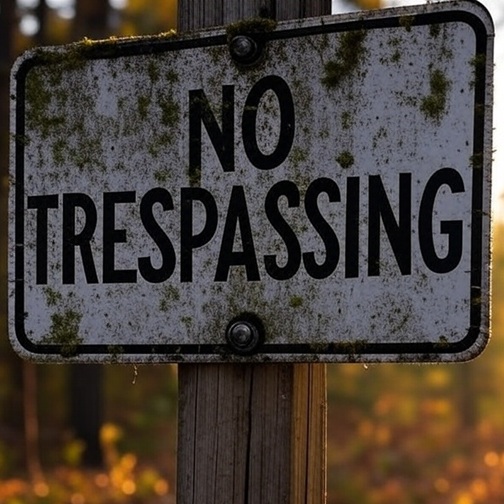
- Install “No Trespassing” or “Private Property” signs at entry points. Under English law, clear signage provides notice that implied access is not permitted.
- Ensure signs are visible and comply with any local regulations.
Provide a Written Notice
- Send a formal written notice to individuals or entities with implied access (e.g., utility companies, neighbours) revoking permission to enter. Use recorded delivery to document the notice. A number of templates are available online.
Install Physical Barriers
- Erect gates, fences, or locks to restrict access, ensuring compliance with local planning laws and regulations.
- For deliveries, provide alternative instructions, such as a designated drop-off point.
Communicate with Relevant Parties
- Contact utility companies or local authorities to negotiate alternative access arrangements if statutory rights apply.
- Discuss boundary issues with neighbours to clarify that access is no longer permitted without agreement.
Address Implied Easements
- If the implied right stems from an easement (e.g., long-term use or necessity), consult a solicitor. Revoking an implied easement may require a legal process, such as a claim to the Land Registry or a court action to quiet title.
- For prescriptive easements (gained through long use under the Prescription Act 1832), formal steps may be needed to interrupt use.
Document Actions
- Keep records of notices, communications, and physical measures taken.
- This documentation is essential for resolving disputes or defending against any legal claims.
Limitations on Revoking Implied Access
Revoking implied access is subject to certain limitations:
- Statutory Rights: Utility companies and emergency services may have non-negotiable access rights. Complete revocation may not be possible, but access can often be restricted to specific purposes or times.
- Easements: Implied or prescriptive easements (e.g., for access to a landlocked property) cannot be revoked without legal action, such as applying to the Land Registry or court.
- Public Safety: Emergency services retain access rights in urgent situations, regardless of notices or barriers.
- Planning Laws: Physical barriers must comply with planning regulations, and blocking statutory access (e.g., for utilities) could lead to legal consequences.
Check out our related articles on What Does Lady Justice Symbolise ?, Law Society, Law Commission, Solicitors, Solicitors Regulation Authority, Barristers, Bar Council of England and Wales, Bar Standards Board, Rule of Law, Open Justice, R v Sussex Justices and the highly questionable Sussex Family Justice Board.
The Ministry of Injustice is not the Ministry of Justice nor is it affiliated in any way with the justice system, legal profession, police or any other law enforcement agencies.
“Publicity is the very soul of justice. . . . It keeps the judge himself, while trying, under trial….Where there is no publicity there is no justice”
Jeremy Bentham – Mr Justice Cobb: ‘Justice must be seen to be done’
Latest Articles ↓
- His Honour Judge Daniel Sawyer
 Judge Daniel Sawyer, known as His Honour Judge Daniel Sawyer,… Read more: His Honour Judge Daniel Sawyer
 - UK National Centre for Information Defence
 Prime Minister Andy Burnham used his first United Nations General… Read more: UK National Centre for Information Defence
 - Judges Behaving Badly and His Honour Judge Simon Oliver
 On the 27th August 2026 the Crown Prosecution Service announced… Read more: Judges Behaving Badly and His Honour Judge Simon Oliver
 - Jo Morris Barrister
 Jo Morris is a practising criminal barrister of Drystone Chambers… Read more: Jo Morris Barrister
 - Good Law Project
 The Good Law Project is a UK campaigning organisation that… Read more: Good Law Project
 - Police Federation of England and Wales (PFEW)
 The Police Federation of England and Wales (PFEW) is the… Read more: Police Federation of England and Wales (PFEW)
 - What is the Criminal Justice System (CJS) Common Platform ?
 The Criminal Justice System Common Platform (also known as HMCTS… Read more: What is the Criminal Justice System (CJS) Common Platform ?
 - Strategic Lawsuit Against Public Participation (SLAPPs)
 Strategic Lawsuits Against Public Participation, or SLAPPs, are legal actions… Read more: Strategic Lawsuit Against Public Participation (SLAPPs)
 - His Honour Judge Tony Baumgartner – Recorder of Westminster
 Judge Tony Alan Walter Baumgartner, known as His Honour Judge… Read more: His Honour Judge Tony Baumgartner – Recorder of Westminster
 - New Protocol for Legal Professionals to Raise Informal Concerns About Judges Behaviour
 On the 8th July 2026, the Courts and Tribunals Judiciary… Read more: New Protocol for Legal Professionals to Raise Informal Concerns About Judges Behaviour
 - The Policing Performance System
 In April 2026, His Majesty’s Inspectorate of Constabulary and Fire… Read more: The Policing Performance System
 - What is the Judicial College ?
 The Judicial College serves as the central pillar of professional… Read more: What is the Judicial College ?
Most Popular ↓
You should always seek formal legal advice from a qualified and reputable lawyer (solicitor or barrister).
There are a number of links to Free and Paid For Legal Resources and Legal Organisations on the Free Legal Advice , Legal Aid and Pro Bono pages.
[post_title] was last updated on the 12th October 2026
