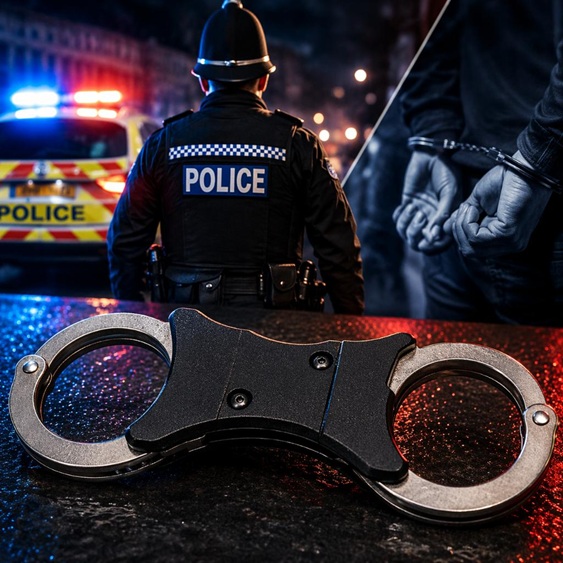
Handcuffs are a standard restraint tool used by police officers across the United Kingdom to help maintain control, prevent escape, protect the public, or reduce the immediate risk of harm.
Any intentional application of force to the person of another is an assault.
College of Policing – Handcuffing Module Personal Safety
The use of handcuffs amounts to such an assault and is unlawful unless it can be justified.
Justification is achieved through establishing not only a legal right to use handcuffs, but also good objective grounds for doing so in order to show that what the officer did was a reasonable, necessary and proportionate use of force
The use of handcuffs is not automatic and is strictly governed by the legal requirement that any force must be lawful, necessary, proportionate and subject to continuous review.
Legal Basis
There is no dedicated legislation that deals solely with handcuffs. Their use is authorised under general provisions governing the use of force.
Section 3 of the Criminal Law Act 1967 states that a person may use “such force as is reasonable in the circumstances” in the prevention of crime or in effecting or assisting in the lawful arrest of an offender or suspected offender.
Section 117 of the Police and Criminal Evidence Act 1984 (PACE) permits a constable to use reasonable force when exercising powers conferred by the Act, including powers of arrest.
Applying handcuffs constitutes a trespass to the person (technically an assault or battery) unless it is justified by these provisions.
Officers must have an objective, reasonable belief that the individual presents a risk of escape, violence towards officers or others, self-harm, or damage to property. Routine handcuffing, for example during every stop-and-search or low-level arrest, is not permitted. The individual police officer remains personally accountable for the decision.
The Human Rights Act 1998 is engaged where prolonged or unjustified restraint occurs. Unnecessary handcuffing may breach Article 3 (prohibition of inhuman or degrading treatment) or Article 5 (right to liberty and security). Courts judge reasonableness on the basis of the information available to the officer at the time, not with the benefit of hindsight.
College of Policing and Force Guidance
The College of Policing’s Authorised Professional Practice (APP) on Personal Safety and Use of Force requires officers to assess each situation individually. Relevant risk factors include the person’s behaviour, demeanour, level of intoxication, known medical conditions and any available intelligence regarding previous violence.
The Metropolitan Police Service Handcuffing procedures – Policy and Handcuffing procedures – Policy FAQ, released under Freedom of Information, makes clear that “the justification to handcuff a person is a use of force and it is up to the officer to justify his/her reasons for handcuffing.” Key procedural requirements include:
- Double-locking the cuffs to prevent overtightening;
- Regular checks for circulation and signs of distress;
- Removal as soon as the risk has sufficiently subsided;
- Particular caution with vulnerable groups (children, elderly, pregnant individuals, or those with visible injuries or medical conditions).
Rigid “speedcuffs” are the standard issue in most UK forces. They are usually applied with hands behind the back for high-risk subjects.
Body-worn video is routinely used to capture both the decision and the application, supporting accountability. Similar risk-based principles apply in all UK police forces.
The Henry Nowak Case
The death of 18-year-old Henry Nowak in Southampton on the 3rd December 2025 highlighted the critical importance of accurate scene assessment when using handcuffs.
Henry Nowak, a first-year Polish-born finance student at the University of Southampton, was stabbed five times by 23-year-old Vickrum Digwa using a 21 cm (approximately 8-inch) Sikh kirpan ceremonial knife. One wound to the chest was fatal. Digwa chased the unarmed Nowak before the attack.
When Hampshire Police officers arrived in the Portswood area, Vickrum Digwa falsely claimed that Nowak had racially abused him and started a fight.
Officers, acting on this information, treated Nowak as the suspect, handcuffed him, and arrested him while he was bleeding. Body-worn camera footage later showed Nowak repeatedly telling officers he had been stabbed and that he could not breathe. He pleaded for help. The handcuffs were removed only after he collapsed. First aid was attempted, but he was pronounced dead at the scene.
Newly released footage shows the teenager saying four times, ‘I’ve been stabbed’, to which one policeman replies, ‘I don’t think you have mate’.
Moment Henry Died Alone – Daily Mail
Officers pull Mr Nowak along the ground as he continues to beg for help, telling them he cannot breathe at least seven times before he is ordered to place his hands in the cuffs.
The injured student was then arrested as he lay dying on the ground, drowning in his own blood.
Following his conviction for murder at Southampton Crown Court, Vickrum Singh Digwa was sentenced on the 1st June 2026 to life imprisonment with a minimum term of 21 years by His Honour Judge William Mousley KC, the Honorary Recorder of Southampton and Resident Judge.
Police officers honestly believed that there were reasonable grounds for suspecting Henry had committed an offence and arrested him with the consequence he was handcuffed for about a minute before his condition further deteriorated and the arresting officer began CPR.
Judge William Mousley KC sentencing remarks in the case of The King v Vickrum Singh Digwa
“I am really sorry that Henry was arrested and handcuffed just before he lost consciousness.”
Temporary Deputy Chief Constable Robert France of Hampshire and Isle of Wight Constabulary Apology
The Independent Office for Police Conduct (IOPC) is independently investigating the officers’ actions, including the decision to handcuff, the assessment of his injuries, and the first aid provided. Officers are currently treated as witnesses. Nowak’s family, including his father Mark, has called for a “full, fearless and transparent” investigation, stating that Henry “did not die with dignity.”
Training and Accountability
Officers receive regular conflict management training that includes restraint techniques, de-escalation, and situational awareness. Handcuffing forms part of personal protective equipment (PPE) programmes. Misuse can lead to internal misconduct proceedings, IOPC investigation, civil claims for assault or false imprisonment, and, in the most serious cases, criminal liability.
Conclusion
Handcuffs remain a lawful and often essential tool in modern policing when used correctly. UK law and policy rightly demand individual risk assessment rather than blanket application.
The tragic death of Henry Nowak illustrates the immense difficulty officers can face when dealing with fast-moving incidents involving conflicting accounts and life-threatening injuries. It also reinforces the need for continual training, effective scene management and public confidence in policing decisions made under pressure.
Check out our articles on Policing by Consent, Police Professional Standards, Police Misconduct Hearings, Police Impartiality, Police Surveillance, Are the Police for Hire ?, Independent Office for Police Conduct (IOPC),Police Public Confidence and Engagement, Crime Reporting, What is a Police and Crime Commissioner ?, Sussex Police, Policing, Police News, Two Tiered Policing, Thought Police, Wasting Police Time, Police Community Support Officers (PCSO), Met Police, Chief Constable Jo Shiner, R v Sussex Justices and the highly questionable Sussex Family Justice Board.
The Ministry of Injustice is not the Ministry of Justice nor is it affiliated in any way with the justice system, legal profession, police or any other law enforcement agencies.
Latest Articles ↓
- What are Judges Lodgings ?
 The provision of judges’ lodgings is a longstanding feature of… Read more: What are Judges Lodgings ?
 - What is Two Tier Policing ?
 The BBC describes so-called “two-tier policing” as where right-wing protests… Read more: What is Two Tier Policing ?
 - Lawful Use of Handcuffs by the Police
 Handcuffs are a standard restraint tool used by police officers… Read more: Lawful Use of Handcuffs by the Police
 - His Honour Judge Nicholas Rowland
 Judge Nicholas Edward Rowland, known as His Honour Judge Nicholas… Read more: His Honour Judge Nicholas Rowland
 - Police Barred and Advisory Lists
 The police barred and advisory lists, which are managed by… Read more: Police Barred and Advisory Lists
 - President of the Family Division
 The President of the Family Division is a highly esteemed… Read more: President of the Family Division
 - Is Crimestoppers Anonymous ?
 Crimestoppers is widely promoted as the United Kingdom’s leading provider… Read more: Is Crimestoppers Anonymous ?
 - What is a Court Legal Adviser ?
 In magistrates’ courts across England and Wales, lay justices (magistrates… Read more: What is a Court Legal Adviser ?
 - What is a Skeleton Argument ?
 A skeleton argument is a concise written document prepared by… Read more: What is a Skeleton Argument ?
 - Can you Buy a Judge ?
 His Honour Judge Martin John Cook was for sale, in… Read more: Can you Buy a Judge ?
 - Norwich Pharmacal Orders and Dodgy Fire Sticks
 Norwich Pharmacal orders (NPOs) are a form of court-ordered disclosure… Read more: Norwich Pharmacal Orders and Dodgy Fire Sticks
 - What is a Statutory Instrument ?
 A statutory instrument is the most common form of secondary… Read more: What is a Statutory Instrument ?
Most Popular ↓
You should always seek formal legal advice from a qualified and reputable lawyer (solicitor or barrister).
There are a number of links to Free and Paid For Legal Resources and Legal Organisations on the Free Legal Advice , Legal Aid and Pro Bono pages.
[post_title] was last updated on the 9th June 2026
