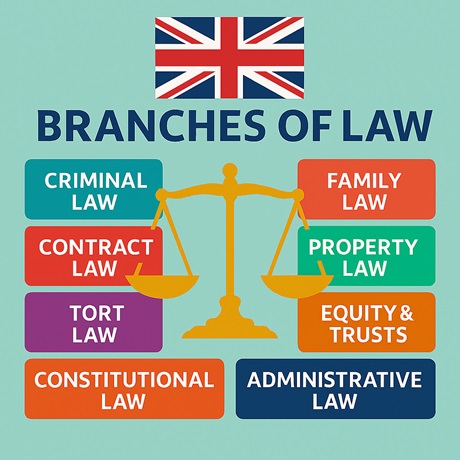
The United Kingdom’s legal system is a rich and intricate framework that governs society through a variety of legal branches. These branches, each with distinct purposes and applications, reflect the UK’s unique blend of common law traditions, statutory provisions, and historical practices.
Understanding these branches is essential for grasping how justice is administered in the UK, from resolving private disputes to regulating state power.
Constitutional Law
Constitutional law forms the foundation of the UK’s governance, defining the structure and powers of the state, its institutions, and their relationship with citizens.
Unlike countries with a single written constitution, the UK’s constitution is uncodified, comprising statutes, conventions, judicial precedents, and historical documents such as the Magna Carta 1215 and the Bill of Rights 1689.
Key legislation, like the Human Rights Act 1998, incorporates protections from the European Convention on Human Rights into domestic law. Constitutional law governs the roles of Parliament, the monarchy, the government, and the judiciary, ensuring a balance of power.
It also addresses devolution, defining the powers of the Scottish Parliament, Welsh Senedd, and Northern Ireland Assembly. Landmark cases, such as R (Miller) v Secretary of State for Exiting the European Union (2017), highlight its role in resolving disputes over governmental authority, particularly during Brexit.
Administrative Law
Closely linked to constitutional law, administrative law regulates the actions of public bodies, ensuring they operate within legal boundaries. It provides mechanisms, such as judicial review, to challenge decisions by government departments, local authorities, or public institutions if they are unlawful, irrational, or procedurally unfair.
For example, a citizen might seek judicial review if a local council’s planning decision violates statutory requirements. Key principles, like natural justice and fairness, underpin this branch, with cases such as Ridge v Baldwin (1964) shaping its development. Administrative law is vital for maintaining accountability, especially in an era of expanding government functions.
Criminal Law
Criminal law addresses offences against society, such as theft, assault, murder, or fraud. Its primary aim is to maintain public order by defining prohibited conduct and prescribing punishments, ranging from fines to imprisonment.
Governed by statutes like the Theft Act 1968, the Offences Against the Person Act 1861, and the Criminal Justice Act 2003, criminal law operates under a high burden of proof, “beyond reasonable doubt.”
The Crown Prosecution Service (CPS) decides whether to prosecute based on evidence and public interest. Criminal law also evolves through case law, with precedents clarifying issues like intent or self-defence. Its societal impact is profound, balancing punishment, deterrence, and rehabilitation.
Civil Law
Civil law governs disputes between private individuals or entities, such as businesses, organisations, or citizens. Unlike criminal law, its focus is on resolving disputes rather than punishing wrongdoing, often through remedies like compensation or injunctions.
Civil law encompasses areas like contract disputes, property issues, and personal injury claims. The standard of proof is lower than in criminal cases, “on the balance of probabilities.”
Statutes like the Consumer Rights Act 2015 and the Civil Procedure Rules 1998 guide civil litigation, ensuring fair and efficient resolution. Civil law’s breadth makes it a cornerstone of everyday legal interactions.
Family Law
Family law regulates personal relationships, including marriage, divorce, child custody, adoption, and domestic violence. It seeks to balance legal, emotional, and social considerations, with the welfare of children being paramount, as outlined in the Children Act 1989.
The Matrimonial Causes Act 1973 governs divorce and financial settlements, while recent reforms, like the Divorce, Dissolution and Separation Act 2020, introduced “no-fault” divorce to reduce conflict. Family courts handle sensitive cases, often involving mediation to minimise adversarial proceedings, reflecting the branch’s focus on practical resolutions.
Tort Law
Tort law, a subset of civil law, addresses civil wrongs where one party’s actions cause harm to another, such as negligence, defamation, or nuisance.
Its goal is to compensate the injured party, typically through damages. Landmark cases like Donoghue v Stevenson (1932) established the modern principle of negligence, introducing the “duty of care” concept. Statutes like the Defamation Act 2013 also shape this branch.
Tort law is dynamic, adapting to societal changes, such as addressing online defamation or environmental harm.
Contract Law
Contract law governs legally binding agreements between parties, ensuring obligations are fulfilled.
It covers issues like breaches of contract, misrepresentation, or unfair terms, with principles derived from statutes like the Sale of Goods Act 1979 and common law. Cases such as Carlill v Carbolic Smoke Ball Co (1893) illustrate foundational principles like offer and acceptance.
Contract law underpins commercial and personal transactions, fostering economic stability.
Property Law
Property law regulates the ownership, use, and transfer of assets, divided into real property (land and buildings) and personal property (e.g., goods or intellectual property).
Statutes like the Land Registration Act 2002 and the Law of Property Act 1925 govern land ownership, leases, and mortgages. Property law also intersects with inheritance and trusts, ensuring clarity in asset distribution.
Its complexity reflects the economic and social importance of property in the UK.
Equity and Trusts
Equity and trusts law addresses fairness in legal remedies, originating from historical courts of equity.
It includes trusts, where one party holds property for another’s benefit, governed by statutes like the Trustee Act 2000. Equity provides flexible remedies, such as injunctions or specific performance, complementing common law.
Its principles ensure justice in cases where strict legal rules may produce unfair outcomes.
European and International Law
Despite Brexit, international law and retained EU law significantly influence the UK. The European Union (Withdrawal) Act 2018 incorporates certain EU regulations into domestic law, particularly in trade, employment, and environmental standards.
International law encompasses treaties, customary law, and obligations under organisations like the United Nations. Examples include:
- Trade Law: The UK adheres to World Trade Organization (WTO) rules, governing tariffs and trade disputes. Post-Brexit trade agreements, such as the UK-EU Trade and Cooperation Agreement 2020, regulate economic relations with the EU.
- Human Rights Law: The UK is party to the European Convention on Human Rights (ECHR), enforced through the Human Rights Act 1998. Cases like Hirst v UK (2005) at the European Court of Human Rights challenged UK prisoner voting laws.
- Environmental Law: The Paris Agreement 2015 commits the UK to reducing carbon emissions, influencing domestic policies like the Environment Act 2021. The Aarhus Convention ensures public access to environmental justice.
- Maritime Law: The United Nations Convention on the Law of the Sea (UNCLOS) governs UK maritime boundaries. The 2016 Philippines v China arbitration, though not directly involving the UK, illustrates UNCLOS’s role in resolving territorial disputes, relevant to UK interests in global shipping lanes.
- International Humanitarian Law: The Geneva Conventions regulate UK military conduct, ensuring protections for civilians and prisoners during conflicts, such as in Iraq or Afghanistan.
- Sanctions and International Criminal Law: The UK uses UN and domestic sanctions to target regimes or individuals, as seen in measures against Russia post-2022 Ukraine invasion. The International Criminal Court (ICC), to which the UK is a signatory, prosecutes war crimes though enforcement challenges persist.
Check out our related articles on Rule of Law, Open Justice, What is Law, Is the Law Black and White ?, Abuse of Process, What Does Lady Justice Symbolise ?, McKenzie Friend, Can a Judge Direct a Jury to Find a Defendant Not Guilty ?,Law Society, Law Commission, McKenzie Friend Right of Audience, Solicitors, Solicitors Regulation Authority, Barristers, Bar Council of England and Wales, Bar Standards Board, Contra Mundum, R v Sussex Justices, Police Impartiality and the highly questionable Sussex Family Justice Board.
The Ministry of Injustice is not the Ministry of Justice nor is it affiliated in any way with the justice system, legal profession, police or any other law enforcement agencies.
“Publicity is the very soul of justice. . . . It keeps the judge himself, while trying, under trial….Where there is no publicity there is no justice”
Jeremy Bentham – Mr Justice Cobb: ‘Justice must be seen to be done’
Latest Articles ↓
- Presumption of Innocence
 The presumption of innocence is a basic principle of the… Read more: Presumption of Innocence
 - His Honour Judge Daniel Sawyer
 Judge Daniel Sawyer, known as His Honour Judge Daniel Sawyer,… Read more: His Honour Judge Daniel Sawyer
 - UK National Centre for Information Defence
 Prime Minister Andy Burnham used his first United Nations General… Read more: UK National Centre for Information Defence
 - Judges Behaving Badly and His Honour Judge Simon Oliver
 On the 27th August 2026 the Crown Prosecution Service announced… Read more: Judges Behaving Badly and His Honour Judge Simon Oliver
 - Jo Morris Barrister
 Jo Morris is a practising criminal barrister of Drystone Chambers… Read more: Jo Morris Barrister
 - Good Law Project
 The Good Law Project is a UK campaigning organisation that… Read more: Good Law Project
 - Police Federation of England and Wales (PFEW)
 The Police Federation of England and Wales (PFEW) is the… Read more: Police Federation of England and Wales (PFEW)
 - What is the Criminal Justice System (CJS) Common Platform ?
 The Criminal Justice System Common Platform (also known as HMCTS… Read more: What is the Criminal Justice System (CJS) Common Platform ?
 - Strategic Lawsuit Against Public Participation (SLAPPs)
 Strategic Lawsuits Against Public Participation, or SLAPPs, are legal actions… Read more: Strategic Lawsuit Against Public Participation (SLAPPs)
 - His Honour Judge Tony Baumgartner – Recorder of Westminster
 Judge Tony Alan Walter Baumgartner, known as His Honour Judge… Read more: His Honour Judge Tony Baumgartner – Recorder of Westminster
 - New Protocol for Legal Professionals to Raise Informal Concerns About Judges Behaviour
 On the 8th July 2026, the Courts and Tribunals Judiciary… Read more: New Protocol for Legal Professionals to Raise Informal Concerns About Judges Behaviour
 - The Policing Performance System
 In April 2026, His Majesty’s Inspectorate of Constabulary and Fire… Read more: The Policing Performance System
Most Popular ↓
You should always seek formal legal advice from a qualified and reputable lawyer (solicitor or barrister).
There are a number of links to Free and Paid For Legal Resources and Legal Organisations on the Free Legal Advice , Legal Aid and Pro Bono pages.
[post_title] was last updated on the 15th October 2026
