The legal system of England and Wales is a fascinating blend of modern rigor and historical eccentricity.
While contemporary laws tackle issues like cybercrime and environmental issues, a collection of peculiar statutes, which are still legally binding, hark back to times of royal prerogatives, Victorian decorum and other oddities.
Handling Salmon Suspiciously
Legislation: Salmon Act 1986, Section 32
“It is an offence for any person to handle any salmon in suspicious circumstances.”
This anti-poaching measure’s vague wording invites amusement, with fines possible for those caught with fishy intentions.
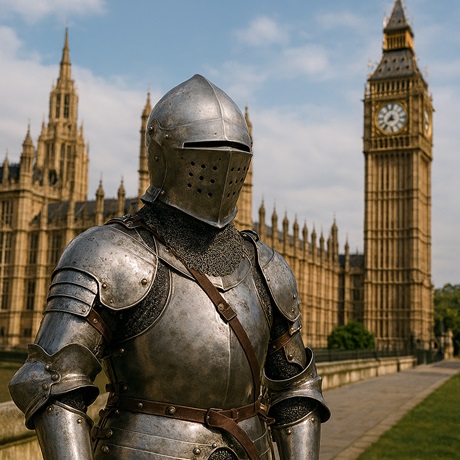
Wear Armour inside Parliament
Legislation: A Statute forbidding Bearing of Armour (1313)
“The King forbids the coming armed to Parliament…that every Man shall come without all Force and Armour, well and peaceably…”
This medieval rule, still in force, prevents armed clashes in Westminster, a quirky nod to its rowdy past.
Drunk in a Pub
Legislation: Licensing Act 1872, Section 12
“Every person found drunk… on any licensed premises, shall be liable to a penalty not exceeding forty shillings.”
This ironic rule could fine overzealous pub-goers up to £200 in modern terms, though enforcement is rare.
Carrying a Plank in London
Legislation: Metropolitan Police Act 1839, Section 54
“Every person who shall… carry or place any cask, tub, hoop, wheel, ladder, plank, or other bulky article, in any street or public place… shall be liable to a penalty.”
Aimed at preventing obstructions, this could net a £500 fine for careless carpenters in London.
Drunk with Cattle
Legislation: Licensing Act 1872, Section 12
“Every person who is drunk while in charge on any highway or other public place of any… cattle… shall be liable to a penalty.”
Aimed at Victorian drovers, this could fine tipsy herdsmen handling livestock today.
Street Sledding
Legislation: Metropolitan Police Act 1839, Section 54
“Every person who shall… slide upon ice or snow… in any street or other thoroughfare, to the danger of any person, shall be liable to a penalty.”
Fines up to £500 target reckless winter sledding that endangers urban pedestrians.
Importing Polish Potatoes
Legislation: Polish Potatoes (Notification) Order 2004
“No person shall… import into England potatoes… originating in Poland unless… written notification is given to an inspector.”
Non-compliance risks fines, making undeclared Polish spud imports a surprisingly risky venture.
Singing Profane Songs
Legislation: Metropolitan Police Act 1839, Section 54
“Every person who shall… sing any profane, indecent, or obscene song or ballad… in any street or public place, shall be liable to a penalty.”
This Victorian rule could fine bawdy buskers up to £500.
Selling Firearms to Drunks
Legislation: Firearms Act 1968, Section 25
“A person who… supplies a firearm or ammunition to a person whom he knows or has reasonable cause to believe to be drunk… commits an offence.”
This ensures sober firearm transactions with penalties for non-compliance.
Royal Whales and Sturgeons
Legislation: Prerogativa Regis 1324
“The King shall have… whales and sturgeons taken in the sea or elsewhere within the realm.”
This medieval perk claims beached whales and sturgeons for the Crown, barring you from claiming maritime treasures.
Drunk on a Bicycle
Legislation: Licensing Act 1872, Section 12
“Every person who is drunk while in charge on any highway or other public place of any carriage… shall be liable to a penalty.”
Interpreted to include bicycles, this could fine wobbly cyclists.
Check out our related articles on the Rule of Law, Branches of Law, Open Justice, What is Law, Is the Law Black and White ?, Abuse of Process, What Does Lady Justice Symbolise ?, McKenzie Friend, Law Society, Law Commission, McKenzie Friend Right of Audience, Solicitors, Solicitors Regulation Authority, Barristers, Bar Council of England and Wales, Bar Standards Board, R v Sussex Justices, Police Impartiality and the highly questionable Sussex Family Justice Board.
The Ministry of Injustice is not the Ministry of Justice nor is it affiliated in any way with the justice system, legal profession, police or any other law enforcement agencies.
“Publicity is the very soul of justice. . . . It keeps the judge himself, while trying, under trial….Where there is no publicity there is no justice”
Jeremy Bentham – Mr Justice Cobb: ‘Justice must be seen to be done’
Latest Articles ↓
- Presumption of Innocence
 The presumption of innocence is a basic principle of the… Read more: Presumption of Innocence
 - His Honour Judge Daniel Sawyer
 Judge Daniel Sawyer, known as His Honour Judge Daniel Sawyer,… Read more: His Honour Judge Daniel Sawyer
 - UK National Centre for Information Defence
 Prime Minister Andy Burnham used his first United Nations General… Read more: UK National Centre for Information Defence
 - Judges Behaving Badly and His Honour Judge Simon Oliver
 On the 27th August 2026 the Crown Prosecution Service announced… Read more: Judges Behaving Badly and His Honour Judge Simon Oliver
 - Jo Morris Barrister
 Jo Morris is a practising criminal barrister of Drystone Chambers… Read more: Jo Morris Barrister
 - Good Law Project
 The Good Law Project is a UK campaigning organisation that… Read more: Good Law Project
 - Police Federation of England and Wales (PFEW)
 The Police Federation of England and Wales (PFEW) is the… Read more: Police Federation of England and Wales (PFEW)
 - What is the Criminal Justice System (CJS) Common Platform ?
 The Criminal Justice System Common Platform (also known as HMCTS… Read more: What is the Criminal Justice System (CJS) Common Platform ?
 - Strategic Lawsuit Against Public Participation (SLAPPs)
 Strategic Lawsuits Against Public Participation, or SLAPPs, are legal actions… Read more: Strategic Lawsuit Against Public Participation (SLAPPs)
 - His Honour Judge Tony Baumgartner – Recorder of Westminster
 Judge Tony Alan Walter Baumgartner, known as His Honour Judge… Read more: His Honour Judge Tony Baumgartner – Recorder of Westminster
 - New Protocol for Legal Professionals to Raise Informal Concerns About Judges Behaviour
 On the 8th July 2026, the Courts and Tribunals Judiciary… Read more: New Protocol for Legal Professionals to Raise Informal Concerns About Judges Behaviour
 - The Policing Performance System
 In April 2026, His Majesty’s Inspectorate of Constabulary and Fire… Read more: The Policing Performance System
Most Popular ↓
You should always seek formal legal advice from a qualified and reputable lawyer (solicitor or barrister).
There are a number of links to Free and Paid For Legal Resources and Legal Organisations on the Free Legal Advice , Legal Aid and Pro Bono pages.
[post_title] was last updated on the 15th October 2026
