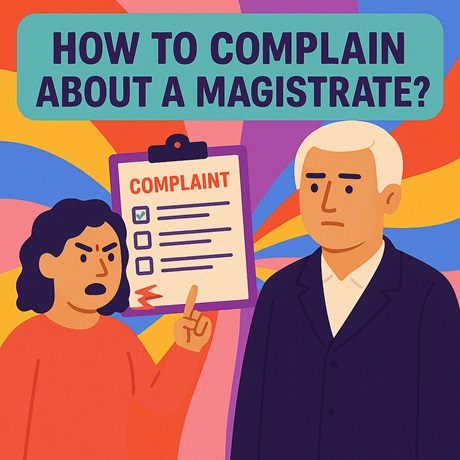
Magistrates (justice of the peace or JP) are essential to the UK’s justice system and preside over cases in magistrates’ courts.
Magistrates hear less serious criminal cases (summary offence and some either-way offences) like minor assaults, motoring offenses, theft, and minor criminal damage but they can also hear civil cases such as those involving council tax and child maintenance, and family court proceedings. Magistrates deal with the majority of criminal cases.
If you believe a magistrate’s conduct was inappropriate, you can make a complaint. The process is governed by specific legislation and rules, ensuring total transparency and accountability.
Members of the judiciary should seek to be courteous, patient, tolerant and punctual and should respect the dignity of all. They should ensure that no one is exposed to any display of bias or prejudice on grounds which include but are not to be limited to “race, colour, sex, religion, national origin, caste, disability, age, marital status, sexual orientation, social and economic status and other like causes
Guide to Judicial Conduct
This article provides a comprehensive guide to complaining about lay magistrates and district judges (magistrates’ courts) in the UK.
The Role of Magistrates
Magistrates include lay magistrates and district judges. Lay magistrates, per the Courts Act 2003, are unpaid community volunteers trained to handle minor criminal, family and civil cases.
District judges, appointed under the same Act, are salaried, legally qualified professionals managing complex cases full-time.
Complaints typically address conduct, not judicial decisions, which are subject to appeal under the Criminal Justice Act 2003 or Magistrates’ Courts Act 1980 etc.
Grounds for a Complaint
The Judicial Conduct (Magistrates) Rules 2023 govern lay magistrate conduct, while district judges, as judicial officeholders, are subject to the Judicial Conduct Rules 2023 and the Judicial Discipline (Prescribed Procedures) Regulations 2023.
Both must adhere to the Guide to Judicial Conduct (revised July 2023), which sets ethical standards like impartiality and integrity. Complaints about either can include:
- Rudeness, unprofessionalism, or dismissive behaviour in court breaching the Guide’s principles.
- Apparent bias, prejudice, or discriminatory remarks potentially violating the Equality Act 2010.
- Inappropriate personal conduct during hearings, such as failing to maintain decorum.
- For district judges, additional concerns may include misuse of judicial authority or failure to uphold the professional standards in the Judicial Conduct Rules 2023.
Complaints about judicial decisions or case outcomes are not permitted; these require appeals to higher courts, such as the Crown Court or High Court, under the Magistrates’ Courts Act 1980 or Senior Courts Act 1981.
Complaints Process
Step 1: Gather Evidence
A robust complaint requires:
- Details of the incident (date, time, court location).
- The magistrate’s name (lay or district judge) or description.
- A factual account of the behaviour.
- Witness names and contact details.
The need for clear evidence aligns with guidelines from the Judicial Conduct Investigations Office (JCIO) and Advisory Committees.
Step 2: Submit to the Correct Authority
The complaints process varies by magistrate type, per the Constitutional Reform Act 2005.
- Lay Magistrates: Complaints go to the local Advisory Committee under the Judicial Conduct (Magistrates) Rules 2023. Find contact details via the magistrates’ court or gov.uk. Submit a formal letter or email with your name, contact details, incident description, evidence, and desired outcome (e.g., investigation or apology). Complaints should be lodged within three months.
- District Judges: Complaints are submitted directly to the JCIO under the Judicial Conduct Rules 2023 and Judicial Discipline (Prescribed Procedures) Regulations 2023, via their online portal (complaints.judicialconduct.gov.uk) or post, with the same detailed requirements.
Ensure submissions are polite and concise.
Step 3: Investigation Process
For lay magistrates, the Advisory Committee investigates under the Judicial Conduct (Magistrates) Rules 2023, reviewing records and interviewing parties confidentially.
For district judges, the JCIO investigates under the Judicial Conduct Rules 2023.
Outcomes, which may include retraining or removal, are authorised by the Lord Chancellor and Lord Chief Justice under the Constitutional Reform Act 2005.
Step 4: Escalating the Complaint
For lay magistrates, if dissatisfied with the Advisory Committee’s response, request a JCIO review within 28 days (or sooner if the process exceeds six months), per the Judicial Conduct (Magistrates) Rules 2023. You should submit prior correspondence via the JCIO’s portal.
For district judges, the JCIO’s decision is final, though clarification can be sought.
Additionally, if you believe the JCIO mishandled the process (e.g., procedural errors, delays, or failure to follow the Regulations), you can escalate to the Judicial Appointments and Conduct Ombudsman (JACO) within 28 days of the JCIO’s decision.
Step 5: Seek Legal Advice
For complex issues or case outcome impacts, consult a solicitor about appeals or judicial review under the Magistrates’ Courts Act 1980 or Senior Courts Act 1981.
Judicial Complaints Disciplinary Outcomes
The Judicial Conduct Investigations Office (JCIO) publishes statements on its website when a disciplinary sanction is issued to a judicial office holder.
Complaints about lay magistrates from 2025/2026 are below (as of 21st October 2025).
- Mr John Garforth JP – JCIO Investigation Statement 45/25
- Ms Nicola Baldwin JP – JCIO Investigation Statement 44/25
- Mr Andrew Dawson JP – JCIO Investigation Statement 43/25
- Mr Ramesh Nayak JP – JCIO Investigation Statement 38/25
- Mr David Armitage JP – JCIO Investigation Statement 34/25
- Mr Joe Bangudu JP – JCIO Investigation Statement 33/25
- Mrs Angela Bradshaw JP – JCIO Investigation Statement 32/25
- Miss Linda Hill JP – JCIO Investigation Statement 30/25
- Mr Martin Dominique JP – JCIO Investigation Statement 29/25
- Mrs Shirley Holmes JP – JCIO Investigation Statement 28/25
- Mr Edmund Sutton JP – JCIO Investigation Statement 26/25
- Mr Alfred Bean JP – JCIO Investigation Statement 25/25
- Mr Terry Regan JP – JCIO Investigation Statement 24/25
- Mr Peter Chapman JP – JCIO Investigation Statement 23/25
- Mrs Sharanjit Sandhu JP – JCIO Investigation Statement 22/25
- Mrs Fiona Jones JP – JCIO Investigation Statement 21/25
- Ms Amie Canham JP – JCIO Investigation Statement 20/25
- Mr Robert Walker JP – JCIO Investigation Statement 19/25
- Recorder James Howlett – JCIO Investigation Statement 17/25
- Ms Abiola Onatade JP – JCIO Investigation Statement 14/25
- Mrs Karen Earnshaw JP – JCIO Investigation Statement 13/25
- Mrs Jane Greasley JP – JCIO Investigation Statement 12/25
- Mrs Susanna Craig JP – JCIO Investigation Statement 10/25
- Dr Charles Jumbo JP – JCIO Investigation Statement 08/25
- Mr Anderson Jordan JP – JCIO Investigation Statement 06/25
- Mrs Christine Parry JP – JCIO Investigation Statement 05/25
- Mr Andrew York JP – JCIO Investigation Statement 04/25
For other judicial holders and up to date disciplinary statements visit the JCIO Disciplinary Statements page or the Dodgy Judges article on this site.
Summary
Complaints about lay magistrates follow the Judicial Conduct (Magistrates) Rules 2023, while district judge complaints adhere to the Judicial Conduct Rules 2023 and Judicial Discipline (Prescribed Procedures) Regulations 2023, with both guided by the Guide to Judicial Conduct.
Submit lay magistrate complaints to the Advisory Committee and district judge complaints to the JCIO. Provide clear evidence and act promptly. Check gov.uk or the JCIO website for details.
Check out our related articles on Chief Magistrate, Judiciary, Dodgy Magistrates, Rule of Law, Open Justice, Is the Law Black and White ?, Abuse of Process, What Does Lady Justice Symbolise ?, McKenzie Friend, Law Society, Law Commission, McKenzie Friend Right of Audience, Solicitors, Solicitors Regulation Authority, Barristers, Bar Council of England and Wales, Bar Standards Board, R v Sussex Justices, Police Impartiality and the highly questionable Sussex Family Justice Board.
The Ministry of Injustice is not the Ministry of Justice nor is it affiliated in any way with the justice system, legal profession, police or any other law enforcement agencies.
“Publicity is the very soul of justice. . . . It keeps the judge himself, while trying, under trial….Where there is no publicity there is no justice”
Jeremy Bentham – Mr Justice Cobb: ‘Justice must be seen to be done’
Latest Articles ↓
- Presumption of Innocence
 The presumption of innocence is a basic principle of the… Read more: Presumption of Innocence
 - His Honour Judge Daniel Sawyer
 Judge Daniel Sawyer, known as His Honour Judge Daniel Sawyer,… Read more: His Honour Judge Daniel Sawyer
 - UK National Centre for Information Defence
 Prime Minister Andy Burnham used his first United Nations General… Read more: UK National Centre for Information Defence
 - Judges Behaving Badly and His Honour Judge Simon Oliver
 On the 27th August 2026 the Crown Prosecution Service announced… Read more: Judges Behaving Badly and His Honour Judge Simon Oliver
 - Jo Morris Barrister
 Jo Morris is a practising criminal barrister of Drystone Chambers… Read more: Jo Morris Barrister
 - Good Law Project
 The Good Law Project is a UK campaigning organisation that… Read more: Good Law Project
 - Police Federation of England and Wales (PFEW)
 The Police Federation of England and Wales (PFEW) is the… Read more: Police Federation of England and Wales (PFEW)
 - What is the Criminal Justice System (CJS) Common Platform ?
 The Criminal Justice System Common Platform (also known as HMCTS… Read more: What is the Criminal Justice System (CJS) Common Platform ?
 - Strategic Lawsuit Against Public Participation (SLAPPs)
 Strategic Lawsuits Against Public Participation, or SLAPPs, are legal actions… Read more: Strategic Lawsuit Against Public Participation (SLAPPs)
 - His Honour Judge Tony Baumgartner – Recorder of Westminster
 Judge Tony Alan Walter Baumgartner, known as His Honour Judge… Read more: His Honour Judge Tony Baumgartner – Recorder of Westminster
 - New Protocol for Legal Professionals to Raise Informal Concerns About Judges Behaviour
 On the 8th July 2026, the Courts and Tribunals Judiciary… Read more: New Protocol for Legal Professionals to Raise Informal Concerns About Judges Behaviour
 - The Policing Performance System
 In April 2026, His Majesty’s Inspectorate of Constabulary and Fire… Read more: The Policing Performance System
Most Popular ↓
You should always seek formal legal advice from a qualified and reputable lawyer (solicitor or barrister).
There are a number of links to Free and Paid For Legal Resources and Legal Organisations on the Free Legal Advice , Legal Aid and Pro Bono pages.
[post_title] was last updated on the 15th October 2026
