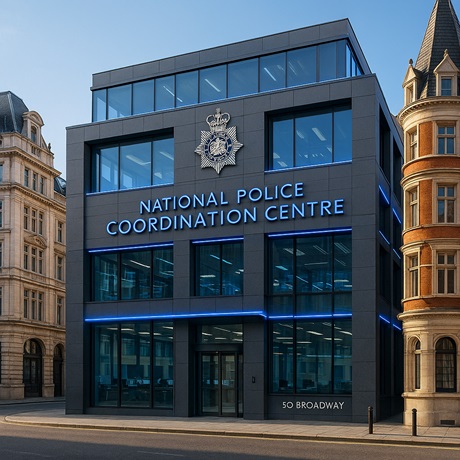
The National Police Coordination Centre (NPoCC) is a UK national unit that supports police forces across the United Kingdom, Crown Dependencies, and British Overseas Territories by coordinating the deployment of police officers and staff during large-scale events, operations, and national crises, such as civil emergencies, major protests, or significant public events.
It ensures effective mobilisation of specialist resources and mutual aid across forces, maintains national capacity assessments for over 200 specialist skills, and provides strategic intelligence and briefing support, particularly for protest-related threats.
NPoCC also represents UK policing at government-level meetings, including the Civil Contingencies Committee (COBR), and supports operations like disaster victim identification and international policing efforts.
The unit is composed of officers and staff seconded from UK police forces, organised into two teams: Operations and Strategic Intelligence and Briefing (SIB). Assistant Chief Constable Mark Williams serves as the Strategic Lead and National Mobilisation Coordinator as of January 2025.
Location
NPoCC is based at 50 Broadway, London, SW1H 0BL. The National Police Chiefs’ Council (NPCC) shares the same building as the National Police Coordination Centre (NPoCC).
The office was officially opened in April 2024 by The Duke of Gloucester. The Duke of Gloucester was welcomed by NPCC Chair Chief Constable Gavin Stephens, and Assistant Chief Constable Mark Williams of the National Police Coordination Centre (NPoCC). Also in attendance was the Rt Hon Chris Philp MP, who was the Minister for Crime, Policing and Fire.
It relocated to this site following a lease agreement approved in 2023, after previously being housed at 10 Victoria Street, London, under a temporary extension of occupancy. The relocation was funded by NPoCC and the National Police Chiefs’ Council (NPCC), with no liability to the Mayor’s Office for Policing and Crime (MOPAC).
Relevant Legislation
NPoCC operates under the following legal frameworks:
- Section 22A of the Police Act 1996: This legislation underpins the NPoCC’s operations through a collaboration agreement signed by Chief Constables, Police and Crime Commissioners (PCCs), and non-Home Office force equivalents. It facilitates the funding and coordination of NPoCC by contributions from all UK police forces and enables the NPCC, which NPoCC reports to, to function as a national coordination body.
- Public Contracts Regulations 2015 (revoked on 24 February 2025 by the Procurement Act 2023): For contracts exceeding £213,477, NPoCC’s procurement activities, such as those related to its relocation and fit-out costs, must comply with these regulations. The 2023 relocation to 50 Broadway adhered to these rules, using existing Metropolitan Police Service (MPS) frameworks for construction and design services.
- Police Reform and Social Responsibility Act 2011: This act defines the roles of Police and Crime Commissioners, who, along with MOPAC and the Common Council of the City of London, are part of the policing bodies contributing to NPoCC’s governance and funding.
Budget and Funding
The National Police Coordination Centre (NPoCC) does not have a publicly disclosed specific budget figure for 2025 in available records.
Its funding is derived from contributions by all UK police forces under a Section 22A Police Act 1996 collaboration agreement, managed through the National Police Chiefs’ Council (NPCC). The exact amount allocated to NPoCC is not itemised separately in public documents, as it forms part of broader NPCC and police funding streams.
For context, the overall police funding settlement for England and Wales in 2025-26 is up to £19.6 billion, an increase of £1.1 billion from 2024-25, with £17.5 billion allocated to Police and Crime Commissioners (PCCs) and including £1 billion for national policing priorities, which encompasses NPoCC’s operations.
However, the specific portion for NPoCC is not detailed, as its budget is embedded within these contributions and NPCC operational costs. Additional costs, such as the 2023 relocation to 50 Broadway, London, were covered by NPoCC and NPCC without liability to the Mayor’s Office for Policing and Crime (MOPAC), indicating shared funding mechanisms.
Without precise figures, the NPoCC’s budget is likely a small fraction of the national priorities funding, tailored to support its coordination, intelligence, and mobilisation activities across UK forces.
Check out our articles on Policing by Consent, Police Impartiality, Are the Police for Hire ?, Police Surveillance, Police Public Confidence and Engagement, Police Professional Standards Department, Are the Police for Hire ?, IOPC, Crime Reporting, What is a Police and Crime Commissioner ?, Policing, Police News, Two Tiered Policing, Thought Police, Police Digital Service, Knowledge Hub – Police Digital Service, Wasting Police Time, Police Community Support Officers (PCSO), Met Police, Sussex Police, Chief Constable Jo Shiner, R v Sussex Justices and the highly questionable Sussex Family Justice Board.
The Ministry of Injustice is not the Ministry of Justice nor is it affiliated in any way with the justice system, legal profession, police or any other law enforcement agencies.
“Publicity is the very soul of justice. . . . It keeps the judge himself, while trying, under trial….Where there is no publicity there is no justice”
Jeremy Bentham – Mr Justice Cobb: ‘Justice must be seen to be done’
Latest Articles ↓
- Presumption of Innocence
 The presumption of innocence is a basic principle of the… Read more: Presumption of Innocence
 - His Honour Judge Daniel Sawyer
 Judge Daniel Sawyer, known as His Honour Judge Daniel Sawyer,… Read more: His Honour Judge Daniel Sawyer
 - UK National Centre for Information Defence
 Prime Minister Andy Burnham used his first United Nations General… Read more: UK National Centre for Information Defence
 - Judges Behaving Badly and His Honour Judge Simon Oliver
 On the 27th August 2026 the Crown Prosecution Service announced… Read more: Judges Behaving Badly and His Honour Judge Simon Oliver
 - Jo Morris Barrister
 Jo Morris is a practising criminal barrister of Drystone Chambers… Read more: Jo Morris Barrister
 - Good Law Project
 The Good Law Project is a UK campaigning organisation that… Read more: Good Law Project
 - Police Federation of England and Wales (PFEW)
 The Police Federation of England and Wales (PFEW) is the… Read more: Police Federation of England and Wales (PFEW)
 - What is the Criminal Justice System (CJS) Common Platform ?
 The Criminal Justice System Common Platform (also known as HMCTS… Read more: What is the Criminal Justice System (CJS) Common Platform ?
 - Strategic Lawsuit Against Public Participation (SLAPPs)
 Strategic Lawsuits Against Public Participation, or SLAPPs, are legal actions… Read more: Strategic Lawsuit Against Public Participation (SLAPPs)
 - His Honour Judge Tony Baumgartner – Recorder of Westminster
 Judge Tony Alan Walter Baumgartner, known as His Honour Judge… Read more: His Honour Judge Tony Baumgartner – Recorder of Westminster
 - New Protocol for Legal Professionals to Raise Informal Concerns About Judges Behaviour
 On the 8th July 2026, the Courts and Tribunals Judiciary… Read more: New Protocol for Legal Professionals to Raise Informal Concerns About Judges Behaviour
 - The Policing Performance System
 In April 2026, His Majesty’s Inspectorate of Constabulary and Fire… Read more: The Policing Performance System
Most Popular ↓
You should always seek formal legal advice from a qualified and reputable lawyer (solicitor or barrister).
There are a number of links to Free and Paid For Legal Resources and Legal Organisations on the Free Legal Advice , Legal Aid and Pro Bono pages.
[post_title] was last updated on the 15th October 2026
