Categories
Law Legal Analysis Police

What is Bail ?

Bail is a fundamental aspect of the criminal justice system in England and Wales, allowing individuals accused of a crime to remain out of custody while awaiting trial or further legal proceedings. This article explains what bail is, how it works, the types of bail, and the conditions that may be imposed, providing a clear overview for those seeking to understand the process.

What is Bail?

Bail is the temporary release of a person accused of a crime, granted by a court, police, or other authorized body, with the expectation that they will attend future court hearings or comply with specific requirements. It ensures that individuals are not unnecessarily detained before their guilt or innocence is determined, balancing the rights of the accused with public safety and the integrity of the judicial process.

In England and Wales, bail is governed primarily by the Bail Act 1976, which establishes a general presumption in favour of granting bail unless specific exceptions apply. The decision to grant or deny bail depends on factors such as the nature of the offense, the risk of the accused absconding, or the potential for further offenses.

Types of Bail

There are two main types of bail in England and Wales:

  1. Police Bail:
    • Pre-Charge Bail: After an arrest, the police may release a suspect on bail while they continue their investigation. This is often referred to as “released under investigation” (RUI) if no bail conditions are imposed. The Policing and Crime Act 2017 introduced reforms to limit the duration of pre-charge bail to 28 days initially, with extensions subject to oversight, to prevent prolonged uncertainty for suspects.
    • Post-Charge Bail: If the police charge a suspect, they may grant bail for the individual to appear at court at a later date.
  2. Court Bail:
    • Once a case reaches the courts (Magistrates’ Court, Crown Court, or higher courts), a judge or magistrate decides whether to grant bail. This typically occurs during an initial hearing or when a case is adjourned. Court bail may come with stricter conditions than police bail, depending on the circumstances.

The Bail Decision Process

When deciding whether to grant bail, the court or police consider several factors under the Bail Act 1976, including:

  • The likelihood of the defendant attending court.
  • The risk of the defendant committing further offenses while on bail.
  • The potential for the defendant to interfere with witnesses or obstruct justice.
  • The nature and seriousness of the alleged offense.
  • The defendant’s character, past conduct, and community ties.

For certain serious offenses (e.g., murder or specific firearms offenses), the presumption in favor of bail is reversed, meaning the defendant must demonstrate why bail should be granted.

If bail is denied, the defendant is remanded in custody, meaning they are held in prison until their next court appearance or trial. However, courts must justify their reasons for refusing bail, ensuring decisions align with the principles of fairness and necessity.

Bail Conditions

Bail is often granted with conditions to ensure compliance and protect the public. Common conditions in England and Wales include:

  • Reporting: Requiring the defendant to report to a police station at regular intervals.
  • Residence: Mandating that the defendant live at a specific address.
  • Curfew: Restricting the defendant to their home during certain hours, sometimes enforced with an electronic tag.
  • No-Contact Orders: Prohibiting contact with specific individuals, such as victims or witnesses.
  • Surety or Security: Requiring a third party (a surety) to guarantee the defendant’s compliance, or the payment of a sum of money as a security deposit (rarely used).

Failure to comply with bail conditions can result in arrest, revocation of bail, or additional charges.

Conditional vs. Unconditional Bail

  • Unconditional Bail: The defendant is released with no specific restrictions, only the requirement to attend court as directed.
  • Conditional Bail: The defendant must comply with specific conditions, as outlined above, tailored to the case’s circumstances.

Appeals and Variations

If bail is refused, defendants can appeal the decision to a higher court, such as the Crown Court (for Magistrates’ Court decisions) or the High Court (for Crown Court decisions). Similarly, defendants or prosecutors can request a variation of bail conditions if they are deemed too restrictive or insufficient.

Special Considerations

  • Youth Defendants: For individuals under 18, the courts prioritize alternatives to custody, such as release to a responsible adult or youth-specific bail conditions, reflecting their vulnerability.
  • Immigration Cases: Defendants who are not UK citizens may face additional scrutiny, with immigration status potentially influencing bail decisions.
  • Domestic Abuse Cases: Courts may impose stricter conditions, such as no-contact orders, to protect victims.

Why is Bail Important?

Bail serves as a cornerstone of justice in England and Wales, upholding the principle that individuals are innocent until proven guilty. By allowing defendants to remain in the community, it minimizes disruption to their lives while ensuring accountability through conditions and oversight. However, it also protects society by enabling authorities to impose restrictions or detain those deemed a significant risk.

Conclusion

In England and Wales, bail is a critical mechanism that balances individual rights with public safety. Governed by the Bail Act 1976 and shaped by subsequent reforms, the system ensures that decisions are fair, transparent, and proportionate. Whether granted by the police or courts, bail reflects the justice system’s commitment to due process, allowing defendants to prepare for their case while meeting necessary obligations to the court and society.

Check out our articles on Justice System, Open Justice, Rule of Law, R v Sussex Justices, Litigants in Person, McKenzie Friend, Reasonable Person Test, Do you Have to Bow to a Judge ?, Can you Email a Judge ?, Can you Criticise a Judge ? and the highly dubious Sussex Family Justice Board.


The Ministry of Injustice is not the Ministry of Justice nor is it affiliated in any way with the justice system, legal profession, police or any other law enforcement agencies.

“Publicity is the very soul of justice. . . . It keeps the judge himself, while trying, under trial….Where there is no publicity there is no justice”

Jeremy Bentham – Mr Justice Cobb: ‘Justice must be seen to be done’

Latest Articles


Most Popular


You should always seek formal legal advice from a qualified and reputable lawyer (solicitor or barrister).

There are a number of links to Free and Paid For Legal Resources and Legal Organisations on the Free Legal Advice , Legal Aid and Pro Bono pages.

Categories
Police

Sussex Police, the King and High Sheriff

A High Sheriff is the King’s representative for law and order and the administration of justice in a county. Philippa Mary Gogarty of Bosham was the High Sheriff for West Sussex 2024–2025.

I have been disappointed in the response of the police to a number of community meetings I have held in West Sussex….Going forward if the police do not want to be involved in these meetings or cannot attend I would prefer to know in advance please.

Philippa Gogarty – Former High Sheriff for West Sussex

Read the following email, sent to the Ministry of Injustice, dated the 31st October 2024 and decide for yourself how rude and disrespectful Sussex Police and the Sussex Police Senior Leadership team were to the former High Sheriff of West Sussex and ultimately His Majesty King Charles III.

The email has no Government Security Classification. The Surrey Police and Sussex Police Information Security Policy (722/2023) provides an overarching protective security for Surrey Police and Sussex Police information assets and overall strategy for information security throughout both Forces. It forms the framework and outlines the security measures adopted in order to safeguard the integrity and confidentiality of Force information and information systems.

Thank you for the clarity and for outlining the circumstances which I am frankly mortified about and offer my sincere apologies. I am also very disappointed in those who have let you down and I have asked for that/them to be addressed.

Chief Constable Jo Shiner – Sussex Police

I wonder how the Sussex Police Officers disgraceful behaviour was addressed by the Sussex Police Chief Constable Jo Shiner ?

Check out the Sussex Police Senior Leadership and others implicated in this email !

Chief Constable Jo Shiner
Assistant Chief Constable Dave Mclaren
Temporary Assistant Chief Constable Rosie Royce (not listed on Sussex Police Senior Leadership)

Temp Chief Superintendent Nick Dias (East Sussex Divisional Commander
Superintendent Imran Ashgar (Crawley and Mid Sussex)
Chief Inspector Will Keating Jones (District Commander of Chichester and Arun in West Sussex)
Chief Inspector James Davidson (District Commander of Adur, Worthing and Horsham)

Inspector Rob Hart

DC Loader
Molly O’Mailey
Daniel West
Stu Hale

The latest His Majesty’s Inspectorate of Constabulary and Fire & Rescue Services (HMICFRS) Sussex Police PEEL Assessment – PEEL 2021/22 dated 13th April 2023 stated that Sussex Police Investigating Crime Requires Improvement and Recording data about crime was Inadequate.

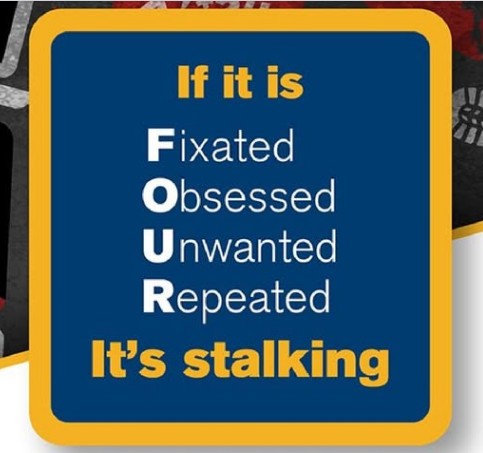
Sussex Police refused to record an allegation of stalking as a crime….hardly policing without fear of favour. Check out the article National Stalking Awareness Week – Sussex Police.

Check out our articles on Sussex Police, Policing by Consent, Police Impartiality, Police Public Confidence and Engagement, Police Professional Standards Department, IOPC, Crime Reporting, What is a Police and Crime Commissioner ?, Policing, Police News, Two Tiered Policing, Thought Police, Police Digital Service, Knowledge Hub – Police Digital Service, Wasting Police Time, Police Community Support Officers (PCSO), Met Police, Chief Constable Jo Shiner, R v Sussex Justices and the highly questionable Sussex Family Justice Board.

The High Court Judge that never was – His Honour Judge Melbourne Inman KC


The Ministry of Injustice is not the Ministry of Justice nor is it affiliated in any way with the justice system, legal profession, police or any other law enforcement agencies.

“Publicity is the very soul of justice. . . . It keeps the judge himself, while trying, under trial….Where there is no publicity there is no justice”

Jeremy Bentham – Mr Justice Cobb: ‘Justice must be seen to be done’

Latest Articles


Most Popular


You should always seek formal legal advice from a qualified and reputable lawyer (solicitor or barrister).

There are a number of links to Free and Paid For Legal Resources and Legal Organisations on the Free Legal Advice , Legal Aid and Pro Bono pages.
Categories
Police

National Stalking Awareness Week – Sussex Police

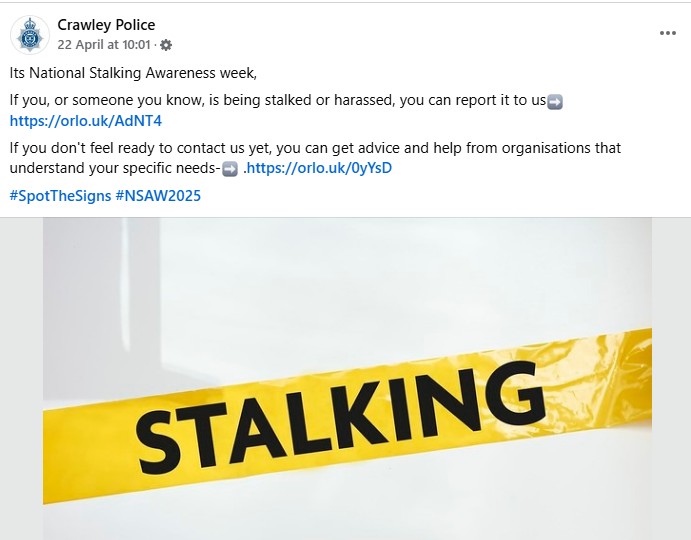
This week (April 25-29) is National Stalking Awareness Week – an annual campaign developed by the Suzy Lamplugh Trust to raise awareness about the severity of stalking and focus on different issues related to the crime.

Stalking and harassment is when someone repeatedly behaves in a way that makes you feel scared, distressed or threatened. Stalking and harassment is a criminal offence.

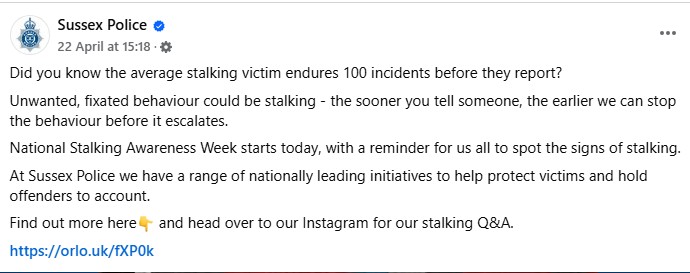
Sussex PCC Katy Bourne looks at how Sussex is leading the way in tackling stalking. “We take stalking seriously in Sussex”

Sussex Police and Crime Commissioner Katy Bourne

I have reported a stalker on several occasions to Sussex Police. Strangely Sussex Police Constable Vinh Tran EB131 or was it Sussex Police Sergeant James Poll EA193 refused to record this as a crime or explain themselves.

Seems odd that Sussex Police promote National Stalking Awareness Week when they don’t deal with a crime that they have evidence of ?

Crawley Police National Stalking Awareness Week
Sussex Police National Stalker Awareness Week

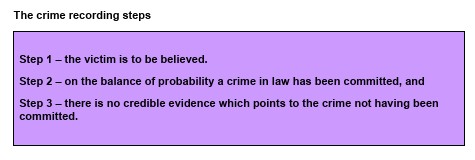
The UK Home Office released an updated version of the Crime Recording Rules for Frontline Officers and Staff, effective April 26th 2025. This 47-page document outlines the standardised procedures for recording crimes, ensuring consistency and accuracy across police forces in England and Wales.

Crime Reporting Steps

If you are or have been a victim of stalking you should report it to the police.

The latest His Majesty’s Inspectorate of Constabulary and Fire & Rescue Services (HMICFRS) Sussex Police PEEL Assessment – PEEL 2021/22 dated 13th April 2023 stated that Sussex Police Investigating Crime Requires Improvement and Recording data about crime was Inadequate.

Do Sussex Police take stalking seriously in Sussex ?

123.4K Views

Check out our articles on Policing by Consent, Police Impartiality, Two Tiered Policing, What is a Police and Crime Commissioner ?, Sussex Police, Policing, Police News, Thought Police, Wasting Police Time, Police Community Support Officers (PCSO), Met Police, Chief Constable Jo Shiner, R v Sussex Justices and the highly questionable Sussex Family Justice Board.


The Ministry of Injustice is not the Ministry of Justice nor is it affiliated in any way with the justice system, legal profession, police or any other law enforcement agencies.

“Publicity is the very soul of justice. . . . It keeps the judge himself, while trying, under trial….Where there is no publicity there is no justice”

Jeremy Bentham – Mr Justice Cobb: ‘Justice must be seen to be done’

Latest Articles


Most Popular


You should always seek formal legal advice from a qualified and reputable lawyer (solicitor or barrister).

There are a number of links to Free and Paid For Legal Resources and Legal Organisations on the Free Legal Advice , Legal Aid and Pro Bono pages.
Categories
Police

New Crime Recording Rules for UK Frontline Police Officers and Staff

The UK Home Office has released an updated version of the Crime Recording Rules for Frontline Officers and Staff, effective April 26th 2025. This 47-page document outlines the standardised procedures for recording crimes, ensuring consistency and accuracy across police forces in England and Wales. The guidelines aim to improve data integrity, enhance public trust, and support effective policing by providing clear instructions for officers and staff on the front lines.

Key Updates and Objectives

The 2025 update builds on previous frameworks, refining the rules to reflect evolving crime trends, technological advancements, and feedback from law enforcement. It emphasizes the importance of recording crimes based on victim reports and available evidence, adhering to the National Crime Recording Standard (NCRS). The primary goal remains unchanged: to ensure crime data is victim-focused, transparent, and consistent, enabling better resource allocation and policy-making.

Core Principles

  • Victim-Centered Approach: Crimes must be recorded when a victim reports an incident, unless there is credible evidence to the contrary. The threshold for recording remains “on the balance of probabilities.”
  • Timeliness: Officers are required to log crimes within 24 hours of the report, barring exceptional circumstances.
  • Accuracy: The rules specify how to classify offenses, from violent crimes to cybercrimes, ensuring alignment with legal definitions under UK law.

Notable Changes in 2025

While the document retains much of its foundational structure, updates include:

  • Digital and Cybercrime: Expanded guidance on recording online offenses, such as fraud, harassment, and data breaches, reflecting their growing prevalence.
  • Hate Crimes: Strengthened emphasis on identifying and flagging hate-motivated incidents, with clearer criteria for officers.
  • Outcome Recording: Enhanced rules for documenting investigation outcomes, aiming to improve accountability and public reporting.

Practical Guidance for Officers

The document provides detailed scenarios and examples to assist frontline staff. For instance, it clarifies how to handle cases involving multiple victims or offenders, and when to record a crime as “attempted” versus “completed.” It also addresses common challenges, such as distinguishing between civil disputes and criminal acts.

Implications for Policing

These rules are part of a broader effort to modernize crime recording in the UK. By standardizing processes, the Home Office seeks to reduce administrative burdens on officers, allowing more time for active policing. The updates also respond to public and governmental calls for greater transparency in crime statistics, particularly amid debates over policing priorities and funding.

The Crime Recording Rules for Frontline Officers and Staff 2025 is a critical resource for law enforcement, balancing operational practicality with the need for reliable data. As crime continues to evolve, this framework ensures police forces are equipped to adapt while maintaining public confidence.

Check out our articles on What is a Police and Crime Commissioner ?, Sussex Police, Policing, Police News, Policing by Consent, Police Professional Standards Department, Independent Office for Police Conduct (IOPC), Two Tiered Policing, Thought Police, Wasting Police Time, Police Community Support Officers (PCSO), Met Police, Chief Constable Jo Shiner, R v Sussex Justices and the highly questionable Sussex Family Justice Board.


The Ministry of Injustice is not the Ministry of Justice nor is it affiliated in any way with the justice system, legal profession, police or any other law enforcement agencies.

“Publicity is the very soul of justice. . . . It keeps the judge himself, while trying, under trial….Where there is no publicity there is no justice”

Jeremy Bentham – Mr Justice Cobb: ‘Justice must be seen to be done’

Latest Articles


Most Popular


You should always seek formal legal advice from a qualified and reputable lawyer (solicitor or barrister).

There are a number of links to Free and Paid For Legal Resources and Legal Organisations on the Free Legal Advice , Legal Aid and Pro Bono pages.
Categories
Law Legal Analysis Police

Counter Disinformation Data Platform (CDDP)

In a move that has sparked alarm among civil liberties advocates, the Labour government in the United Kingdom is reportedly advancing plans to deploy artificial intelligence (AI) to monitor social media for what it deems “concerning” content.

According to a recent article from the Free Speech Union (FSU), this initiative involves a £2.3 million contract awarded to Faculty AI by the Department for Science, Innovation and Technology (DSIT).

The goal ? To develop a sophisticated system capable of trawling through online posts to detect potential threats to “public safety” and “national security.” While the government frames this as a necessary step to counter disinformation and foreign interference, critics warn it could herald a chilling new era of state-sponsored censorship.

The Counter Disinformation Data Platform: Scope and Ambiguity

At the heart of this initiative is the Counter Disinformation Data Platform (CDDP), a tool originally developed under the auspices of the Counter Disinformation Unit (CDU), now rebranded as the National Security Online Information Team (NSOIT). The platform is designed to identify “foreign interference,” detect deepfakes, and analyse social media narratives. DSIT insists its current focus is narrow—targeting threats like election meddling by hostile states. However, documents obtained through Freedom of Information (FoI) requests by Big Brother Watch reveal a broader potential. An executive summary notes that while the CDDP’s present emphasis is on national security, it “has the ability to be pivoted to focus on any priority area.” This flexibility has raised red flags among those who fear it could easily be turned toward domestic dissent or controversial opinions.

The Labour government’s stated justification hinges on protecting the public from misinformation—a term that, historically, has proven slippery in its application. During the COVID-19 pandemic, the CDU was criticized for compiling dossiers on journalists, academics, and MPs who questioned official narratives, even when their speech was lawful. Past targets included voices skeptical of lockdown policies, vaccine mandates, or alternative treatments like hydroxychloroquine—later validated to some extent by research from Oxford University. This precedent fuels concerns that “concerning” could become a catch-all label for anything that challenges the government’s preferred storyline.

A £2.3 Million Investment in Control?

The £2.3 million contract with Faculty AI underscores the scale of Labour’s ambitions. The London-based firm, once backed by Matt Clifford—until recently the Prime Minister’s AI opportunities adviser—promises a system that can sift through vast amounts of online data to flag posts for “action.” What that action entails remains vague. Will it involve reporting to policymakers? Pressuring social media platforms to remove content? Or even direct intervention by law enforcement? The lack of transparency only deepens suspicions.

Jake Hurfurt of Big Brother Watch has accused the government of dodging accountability, noting that it continues to withhold “huge swathes of information” about the CDDP despite inquiries from Parliament and the Intelligence and Security Committee. This opacity echoes criticisms leveled at the NSOIT’s earlier incarnations, which leveraged ties to intelligence agencies to operate beyond public scrutiny. For a government led by Sir Keir Starmer, who once built his reputation as a human rights lawyer, the irony of such secrecy is not lost on observers.

Free Speech Under Siege ?

The FSU, a staunch defender of expression rights, sees this as part of a broader Labour assault on free speech. Lord Young, a prominent voice within the organization, has called the move “politically unwise,” especially given the timing. Across the Atlantic, the incoming Trump-Vance administration has signaled a rollback of censorship efforts, with figures like JD Vance decrying threats to “basic liberties” at the Munich Security Conference. Meanwhile, the UK appears to be doubling down, targeting platforms—many of them American-owned—like X, which has already clashed with European regulators over content moderation.

The implications for ordinary citizens are stark. Posts on X reflect growing unease, with users labeling the plan “Orwellian” and likening it to “thought crime policing.” One grandmother in Greater Manchester recently faced police questioning over a Facebook post calling for Labour councillors to resign—a chilling anecdote cited by civil liberties groups. If AI-driven surveillance scales up, such incidents could become routine, with algorithms casting a wide net over political critique, satire, or even casual venting.

The Slippery Slope of “Concerning” Content

What exactly constitutes “concerning” content? FoI documents reveal past CDU preoccupations with “anti-vaxx rhetoric,” criticism of COVID-19 vaccines, and discussions around 5G or alternative cancer treatments—topics that, while divisive, often fall within the realm of lawful debate. The CDDP’s ability to pivot suggests it could just as easily target climate skepticism, gender-critical views, or anti-government sentiment. Without clear boundaries, the risk of overreach looms large.

Critics argue this aligns with Labour’s broader regulatory agenda, including the Online Safety Act, which empowers Ofcom to fine tech giants for failing to curb “harmful” but legal speech. The FSU has long warned that such measures incentivize platforms to preemptively censor, stifling dissent under the guise of safety. The CDDP could supercharge this trend, marrying human bias with algorithmic efficiency to silence voices at scale.

A Crossroads for Liberty ?

The Labour government stands at a crossroads. Its AI surveillance push could position the UK as a leader in combating digital threats—or as a cautionary tale of authoritarian creep. For now, the balance between security and freedom hangs in the air, with civil liberties groups like the FSU vowing to fight back. Whether through public pressure, legal challenges, or international backlash, the battle over this technology’s use will shape the future of free expression in Britain.

The question remains: can a government that prides itself on progressive values justify peering into the thoughts of its citizens? Or will this £2.3 million experiment prove a step too far, even for those who champion safety over liberty?

Check out our articles on Office for Communications Data Authorisations, National Security Online Information Team (NSOIT), Thought Police, Policing, Police News, Policing by Consent, Two Tiered Policing, Wasting Police Time, and the highly questionable Sussex Family Justice Board.


The Ministry of Injustice is not the Ministry of Justice nor is it affiliated in any way with the justice system, legal profession, police or any other law enforcement agencies.

“Publicity is the very soul of justice. . . . It keeps the judge himself, while trying, under trial….Where there is no publicity there is no justice”

Jeremy Bentham – Mr Justice Cobb: ‘Justice must be seen to be done’

Latest Articles


Most Popular


You should always seek formal legal advice from a qualified and reputable lawyer (solicitor or barrister).

There are a number of links to Free and Paid For Legal Resources and Legal Organisations on the Free Legal Advice , Legal Aid and Pro Bono pages.

Categories
Criminal Justice Law Legal Analysis Police

Thought Police

In George Orwell’s seminal novel 1984, the Thought Police represent the ultimate tool of oppression, monitoring and punishing individuals not just for their actions but for their very thoughts. Orwell’s dystopian vision was a warning, a fictional exaggeration meant to provoke reflection on the dangers of authoritarian control. Yet, in 2025, that fiction seems to be inching closer to reality, as evidenced by a disturbing incident in Britain that has reignited debates about free speech, police priorities, and the creeping specter of thought control.

According to the Daily Mail article Knock knock, it’s the Thought Police, published on the 22nd February 2025, Helen Jones, a 54-year-old grandmother from Stockport, found herself on the receiving end of a police visit—not for committing a crime, but for posting criticism of local Labour councillors on Facebook. The councillors in question were embroiled in a scandal uncovered by The Mail on Sunday, involving a WhatsApp group where offensive messages, including a Labour MP’s wish that an elderly constituent would die were shared. Jones’s post called for their resignation, a sentiment many might consider a reasonable exercise of free expression. Yet, within 48 hours of a complaint, two plain-clothes officers knocked on her door.

Greater Manchester Police conceded that Jones had committed no crime. No charges were filed, no laws were broken. Still, the visit left her shaken, too intimidated to post on social media again. “I’ve effectively been silenced,” she told the Daily Mail. Critics have likened the officers’ actions to those of East Germany’s Stasi, the notorious secret police known for stifling dissent through fear and surveillance. The comparison is stark, but it’s hard to ignore the parallels: a citizen targeted not for illegal acts, but for voicing an opinion.

The Daily Mail published a follow up article on the 24th February 2025, Fury deepens over ‘sinister’ Thought Police targeting

This incident raises uncomfortable questions about the state of free speech in Britain. At a time when police resources are stretched thin—thousands of serious crimes, from burglaries to assaults, go uninvestigated due to lack of manpower—why were detectives dispatched to confront a grandmother over a Facebook post?

The speed of the response is particularly jarring. The Daily Mail notes that within two days of the complaint, officers were at Jones’s door, a stark contrast to the often sluggish investigations into violent offenses or property crimes. It suggests a troubling skew in priorities, where policing thoughts takes precedence over policing streets.

The “Hope you Die” WhatsApp scandal itself is a messy affair. It led to the sacking of Health Minister Andrew Gwynne and the suspension of Burnley MP Oliver Ryan and 11 Labour Councillors after their vile messages came to light.

Public outrage was swift, and Jones was far from alone in her criticism. Yet, her case isn’t isolated. The Daily Mail article points to a growing trend of police investigating social media posts, citing examples like columnist Allison Pearson, feminist writer Julie Bindel, and former policeman Harry Miller, whose name was logged in a non-crime hate incident database for his online comments. These cases suggest a pattern: authorities increasingly treating speech as a potential offense, even when it falls short of illegality.

BlackBeltBarristerMonumental waste of police time (Though Police)

What’s driving this shift? Some argue it’s the fallout of vague hate speech laws, which give police broad discretion to interpret what constitutes an offense. Others point to a cultural shift, where public criticism—especially of those in power—prompts swift complaints from offended parties, triggering police action. In Jones’s case, the complaint’s origin remains unclear, but the response was immediate and intimidating. It’s a tactic that doesn’t need to result in prosecution to be effective; the mere act of a police visit can chill dissent, as it did for Jones.

The implications are profound. If expressing frustration with elected officials online can summon detectives to your doorstep, what’s next? The Daily Mail quotes critics accusing the police of wasting resources on “thought crimes” while real criminals roam free. It’s a sentiment echoed across social media, where users have decried the incident as an overreach of power and a betrayal of public trust. The phrase “Thought Police” has trended, not as a literary allusion, but as a lived experience.

This isn’t to say police shouldn’t investigate genuine threats or incitements to violence—those have clear legal boundaries. But Jones’s post, by all accounts, was neither. It was a call for accountability, not a call to harm. The distinction matters. When authorities blur the line between policing actions and policing opinions, they risk eroding the very freedoms they’re meant to protect.

Orwell’s Thought Police didn’t just punish; they instilled fear, ensuring citizens self-censored to avoid scrutiny. Helen Jones’s story suggests Britain may be flirting with a similar dynamic. As she retreats from social media, silenced by the knock of a detective, one wonders how many others will follow suit. The Daily Mail article serves as both a report and a warning: when the state prioritizes thoughts over crimes, the dystopia Orwell imagined ceases to be fiction. It becomes our reality.

British ‘thought police’ order pensioner to apologise for ‘upsetting’ Facebook post or face investigation

Thames Valley Police – Thought Police for a Facebook Post
Thames Valley Police

Check out our articles on Policing, Police News, Policing by Consent, Police Impartiality, Free Speech Union, Two Tiered Policing, Wasting Police Time, National Security Online Information Team (NSOIT), Counter Disinformation Data Platform (CDDP) and the highly questionable Sussex Family Justice Board.


The Ministry of Injustice is not the Ministry of Justice nor is it affiliated in any way with the justice system, legal profession, police or any other law enforcement agencies.

“Publicity is the very soul of justice. . . . It keeps the judge himself, while trying, under trial….Where there is no publicity there is no justice”

Jeremy Bentham – Mr Justice Cobb: ‘Justice must be seen to be done’

Latest Articles


Most Popular


You should always seek formal legal advice from a qualified and reputable lawyer (solicitor or barrister).

There are a number of links to Free and Paid For Legal Resources and Legal Organisations on the Free Legal Advice , Legal Aid and Pro Bono pages.

Categories
Criminal Justice Law Police

Firearms Amnesty 2025

In an unprecedented move to tackle the rising threat of converted firearms within the UK, a national amnesty has been initiated for specific types of blank-firing guns, commonly known as top-venting blank firers (TVBFs). The amnesty which started on the 3rd February 2025 and concludes on the 28th February, 2025, targets four Turkish-manufactured models that tests have shown can be readily converted into lethal weapons.

TVBFs are illegal under Section 1(6) of the Firearms Act 1982, meaning that they are prohibited firearms under Section 5 (1) of the Firearms Act 1968.

The National Police Chiefs’ Council (NPCC), in collaboration with the National Crime Agency (NCA), National Ballistics Intelligence Service and various police forces across the country, has launched this amnesty following alarming evidence that these guns have been implicated in criminal activities, including at least four homicides since 2023. The models in question, produced by Retay, Ekol, Ceonic, and Blow, were initially designed for non-lethal uses such as starting races or theatrical performances. However, their convertibility into functioning firearms has caught the attention of law enforcement.

The top-venting blank firers are used by criminals and can be converted into lethal firearms.

During the last two years, policing and the NCA has identified and disrupted several workshops used to convert these pistols into lethal weapons.

In the same period, large numbers of converted weapons were recovered across multiple locations, alongside thousands of rounds of blank calibre and modified ammunition.

One investigation recovered more than 400 converted weapons from a single crime group. There is a strong demand for them evidenced by the numbers imported and subsequent recovery from criminals.

Stopping the sale of these top-venting blank firers from being converted will go a significant way to help protect the public.

Assistant Chief Constable Tim Metcalfe, National Police Chiefs’ Council Lead for the Criminal Use of Firearms

Check out the article on the National Firearms Amnesty

Why the Amnesty?

The primary aim of this amnesty is to remove these potentially dangerous weapons from the public domain, reducing the risk they pose when falling into the wrong hands. According to the NPCC, while gun crime in the UK remains relatively low compared to other countries, the conversion of these blank-firing guns into lethal weapons presents a significant emerging threat. Since 2021, over 800 converted TVBFs have been recovered in criminal circumstances, highlighting the urgency of this initiative.

How the Gun Amnesty Works

During the amnesty period, individuals who possess any of these four models can surrender them at local police stations without facing prosecution for the illegal possession of these now-banned firearms. This leniency is intended to encourage those who might have these guns for legitimate, non-criminal purposes to hand them over.

The guns will not only be removed from circulation but will also be analysed to see if they have been involved in previous criminal acts, thereby potentially aiding in ongoing investigations.

Public Response and Implications

The response from the public has been cautiously optimistic. Many see this amnesty as a chance to rectify unintended possession of these newly classified illegal firearms. There’s an acknowledgment among communities that while these guns might have been bought legally or even as souvenirs from trips, their potential for misuse is now too significant to ignore.

Law enforcement officials, including Assistant Chief Constable Tim Metcalfe, the NPCC Lead for the Criminal Use of Firearms, have stressed the importance of public cooperation. “This initiative is about protecting our communities by ensuring these firearms don’t end up being used for criminal intent,” Metcalfe stated. “We urge anyone with these weapons to do the responsible thing and surrender them.”

Legal Implications Post Amnesty

Post-amnesty, the possession of these TVBFs will be strictly prohibited, with severe penalties including up to 10 years in prison for those caught with one. This crackdown is part of broader efforts by UK law enforcement to control the proliferation of firearms and reduce gun-related crimes.

The amnesty also serves as a reminder of the broader issue of firearm conversion in the UK, prompting discussions on the need for tighter regulations on the import and sale of blank-firing guns and other similar devices.

Check out our articles on Policing, Police News, Policing by Consent, Two Tiered Policing, Wasting Police Time, Met Police, Sussex Police, R v Sussex Justices and the highly questionable Sussex Family Justice Board.


The Ministry of Injustice is not the Ministry of Justice nor is it affiliated in any way with the justice system, legal profession, police or any other law enforcement agencies.

“Publicity is the very soul of justice. . . . It keeps the judge himself, while trying, under trial….Where there is no publicity there is no justice”

Jeremy Bentham – Mr Justice Cobb: ‘Justice must be seen to be done’

Latest Articles


Most Popular


You should always seek formal legal advice from a qualified and reputable lawyer (solicitor or barrister).

There are a number of links to Free and Paid For Legal Resources and Legal Organisations on the Free Legal Advice , Legal Aid and Pro Bono pages.

Categories
Criminal Justice Free Speech Law Legal Analysis Police

What is a Non-Crime Hate Incident (NCHI) ?

A Non-Crime Hate Incident (NCHI) in the UK refers to any incident where an individual or group perceives that they have been subjected to hostility or prejudice based on race, religion, sexual orientation, disability, or transgender identity, even if no criminal activity has taken place. Here are key points about NCHIs:

  • Definition: It is defined as any non-crime incident which is perceived by the victim or any other person to be motivated by hostility or prejudice. This perception does not require evidence or justification from the victim regarding the hostility.
  • Purpose: NCHIs are recorded by the police to monitor community tensions, potential risks of escalation into more serious incidents or crimes, and to provide data for understanding patterns of prejudice or hostility.
  • Recording Criteria: Not all perceived hate incidents are recorded as NCHIs. There are specific criteria:
    • The incident must disturb an individual’s, group’s, or community’s quality of life or cause concern.
    • The incident must meet an additional threshold if personal data is to be recorded, indicating a real risk of significant harm or future criminal offence against individuals or groups with the same characteristic.
  • Legal Implications: While NCHIs do not result in criminal charges, they can appear in enhanced Disclosure and Barring Service (DBS) checks, which might affect employment opportunities, especially in sectors requiring such checks.
  • Freedom of Speech: Recent guidance and legal reviews have emphasized balancing the recording of NCHIs with the protection of free speech, ensuring that trivial, irrational, or malicious reports do not lead to the recording of personal data unless necessary. The Free Speech Union published An Orwellian Society: Non-Crime Hate Incidents and the policing of speech.
  • Public and Legal Scrutiny: There has been scrutiny over NCHIs, with concerns that they might infringe on free speech or be used maliciously. Changes in guidance now aim for a more proportionate approach where NCHIs are only recorded when deemed absolutely necessary and not merely based on someone being offended.

The Home Office published Statutory guidance – Non-Crime Hate Incidents: Code of Practice on the Recording and Retention of Personal Data (accessible)

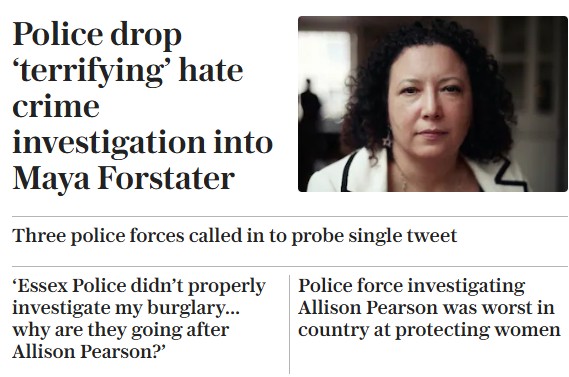
Allison Pearson, an award-winning writer, is being investigated by Essex Police for allegedly stirring up racial hatred in a social media post last November.

The scale of the investigation has now become clear, with officers from the Metropolitan Police, Sussex Police and Essex Police all having handled the complaint over the past year.

The Telegraph understands that the post was reported to the Metropolitan Police as a potential breach of the Malicious Communications Act in November last year. The case was then passed to Sussex Police, which marked it as a possible non-crime hate incident (NCHI) as well as a potential malicious communication.

Sussex Police passed it to Essex, where Pearson lives.

The TelegraphNon-Crime Hate Incident (NCHI) or Stirring Up Racial Hatred ?
Non Crime Hate Incident Headlines – The Telegraph

Essex Police sets up ‘gold group’ normally reserved for major crimes to lead Allison Pearson probe

Keir Starmer says police should focus on ‘what matters most’ – amid growing anger over police investigation into Allison Pearson’s tweet

It should be noted that Article 10 of the Human Rights Act 1998 gives the right to freedom of expression.

The Public Order Act 1986, Part III defines Racial Hatred. What is Christophobia ? What is Islamophobia ?

The BlackBelt Barrister published a video Police Will come for YOU Next which examines the right to Free Speech.

“Free speech encompasses the right to offend, and indeed to abuse another.” Para 43 Scottow v CPS [2020] EWHC 3421 (Admin)

Attack on Free Speech ? Black Belt Barrister

Incidents such as the Allison Pearson tweet are supposed to be part of a broader effort to address and monitor hate-related issues in society without necessarily involving criminal law and sanctions. They can still have implications for the individuals involved due to the recording of such incidents by the police.

Check out our articles on Policing by Consent, Are the Police for Hire ?, Police Impartiality, Police Surveillance, Police Professional Standards, Independent Office for Police Conduct (IOPC), Police Public Confidence and Engagement, Crime Reporting, What is a Police and Crime Commissioner ?, Sussex Police, Policing, Police News, Two Tiered Policing, Thought Police, Wasting Police Time, Police Community Support Officers (PCSO), Met Police, Free Speech Union, R v Sussex Justices and the highly questionable Sussex Family Justice Board.


The Ministry of Injustice is not the Ministry of Justice nor is it affiliated in any way with the justice system, legal profession, police or any other law enforcement agencies.

“Publicity is the very soul of justice. . . . It keeps the judge himself, while trying, under trial….Where there is no publicity there is no justice”

Jeremy Bentham – Mr Justice Cobb: ‘Justice must be seen to be done’

Latest Articles


Most Popular


You should always seek formal legal advice from a qualified and reputable lawyer (solicitor or barrister).

There are a number of links to Free and Paid For Legal Resources and Legal Organisations on the Free Legal Advice , Legal Aid and Pro Bono pages.

Categories
Judiciary Legal Professionals Police

What is a High Sheriff ?

The “High Sheriff” is an independent non-political Royal appointment for a single year only. There are 55 High Sheriffs serving the counties of England and Wales. The post is unpaid (except for a nominal court attendance allowance), and the general expenses of the office are borne personally by the holder.

There is a High Sheriff for each county in England and Wales, although the Shrieval Counties (“Shrieval” means anything to do with a Sheriff) no longer align with administrative areas, this creates a mix between the traditional counties and more recent local authority areas.

High Sheriffs – The Privy Council
  1. Historical Role: The office dates back to Anglo-Saxon times, originally appointed to enforce law and order in a shire (county). The ‘Shire Reeve’ was responsible to the king for the maintenance of law and order within the shire, or county, and for the collection and return of taxes due to the Crown. Of the 63 clauses in the Magna Carta of 1215, no less than 27 relate to the role of the Sheriff and from 1254 the High Sheriff supervised the election to Parliament of two Knights of the Shire. Over centuries, the role has evolved significantly.
  2. Legislation: The Sheriffs’ Declaration Act 1835 and Sheriffs Act 1887.
  3. Current Duties: Today, the High Sheriff has mostly ceremonial and social responsibilities rather than law enforcement duties:
  • To lend active support to the principal organs of the Constitution within their county – the Royal Family, the Judiciary, the Police and other law enforcement agencies, the emergency services, local authorities, and church and faith groups
  • To take an active part in supporting and promoting the voluntary sector and giving all possible encouragement to the voluntary organisations within a County, particularly those involved with crime reduction and social cohesion.
  • To ensure the welfare of visiting High Court Judges, to attend on them at Court and to offer them hospitality
  • To make a meaningful contribution to the High Sheriff’s County during the year of Office and to uphold and enhance the ancient Office of High Sheriff 
  • To support the Lord-Lieutenant on royal visits and on other occasions as appropriate
  1. Appointment: High Sheriffs are appointed annually but serve in a different year from when they are nominated due to a unique system.

It is the responsibility of each High Sheriff to provide the names of people suitable to serve in the future. These names are added to the list of Sheriffs, and every November at a ceremony in the High Court the Lord Chief Justice and three other judges formally add as many new names for each county as are needed to ensure that there are Sheriffs in nomination for each of the next three years. A Sheriff needs to own property in the county for which he or she is nominated. The following March The King, at a meeting of the Privy Council, formally selects one of the three nominated Sheriffs to serve for the next twelve months by literally pricking a hole through his or her name on the List with a bodkin.

High Sheriffs – The Privy Council
  1. Title: The title is “High Sheriff”, not “Sheriff”, which distinguishes it from historical or fictional roles like the American sheriff or the ancient English sheriff with broader law enforcement powers.
  2. Symbolism: High Sheriffs have traditional symbols like the Badge of Office and might carry a ceremonial sword, which represents their historical role in maintaining law and order.

The High Sheriffs’ Association of England and Wales was founded in 1971 to represent the interests of and give assistance to High Sheriffs in England and Wales. 

The position Of High Sheriff maintains a link to the past, preserving traditions while adapting to serve modern community needs. High Sheriffs often work to enhance community cohesion and support local law enforcement and emergency services in non-executive capacities.

Check out our articles on Policing, Police News, Policing by Consent, Two Tiered Policing, Wasting Police Time, Police and Crime Commissioner, Chief Constable Jo Shiner and the highly questionable Sussex Family Justice Board.


The Ministry of Injustice is not the Ministry of Justice nor is it affiliated in any way with the justice system, legal profession, police or any other law enforcement agencies.

“Publicity is the very soul of justice. . . . It keeps the judge himself, while trying, under trial….Where there is no publicity there is no justice”

Jeremy Bentham – Mr Justice Cobb: ‘Justice must be seen to be done’

Latest Articles


Most Popular


You should always seek formal legal advice from a qualified and reputable lawyer (solicitor or barrister).

There are a number of links to Free and Paid For Legal Resources and Legal Organisations on the Free Legal Advice , Legal Aid and Pro Bono pages.

Categories
Criminal Justice Police

Drug Dealing on the Street

Drugs are being openly sold on the streets by drug dealers with seemingly little to no action being taken by the Police to deal with this. The streets also stink of weed.

I gave up ringing 101 and attending local policing meetings. It’s pointless the police seem more than happy for a large group of men to openly deal on the street every single day of the week and have them and their customers urinating and defecating in the streets.

Discourteous woman on X

Drug misuse harms the health and wellbeing of many people. There are a number of different criminal offences which should restrict the supply and use of harmful substances.

It is illegal to possess, supply and produce controlled drugs. It is also illegal to import or export drugs, or to allow your premises to be used for drug production.

The legal restrictions placed on the use of controlled drugs are aimed at preventing drug misuse. The principal offences relating to the misuse of controlled drugs are contained in the Misuse of Drugs Act 1971 (“the Act”) and most of the offences dealt with in this guidance are created by the Act. The primary objective of the Act is the control of the use and distribution of dangerous and harmful drugs. The Act classifies the drugs according to their relative degree of overall harm from misuse.

CPS Legal Guidance Drug offences

Controlled drugs fall into three different categories, Class A, B or C, according to their danger or how harmful they are. The sentences for drug offences are different for each class of drugs. Class A drugs are the most harmful, and will lead to a greater sentence.

A drug dealer is an individual who illegally sells or distributes drugs. These drugs can range from illegal substances like cocaine, heroin, methamphetamine, or marijuana (in places where it’s not legally regulated) to prescription medications that are sold without a prescription or for non-medical use.

The Statute of Limitations establishes time limits within which legal actions can be brought against individuals or entities for various offenses. There is no time limit for prosecution in England and Wales for drug dealing offences.

BBC London produced a report The drug deals being done on our streets. Over 5 years later, nothing seems to have changed.

The drug deals being done on our streets – BBC London 19th Jan 2019

To do an injustice is to do yourself an injustice – it degrades you… and you can also commit injustice by doing nothing

Meditations by Marcus Aurellius

Met Police and Open Drug Dealing

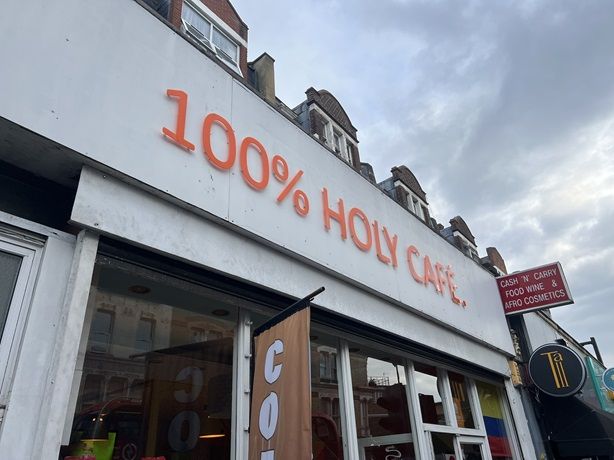
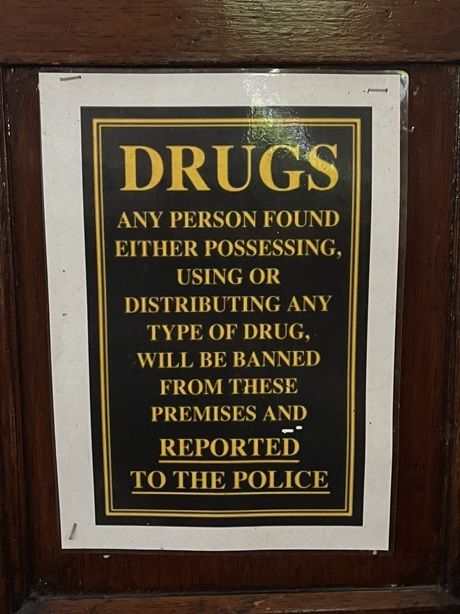
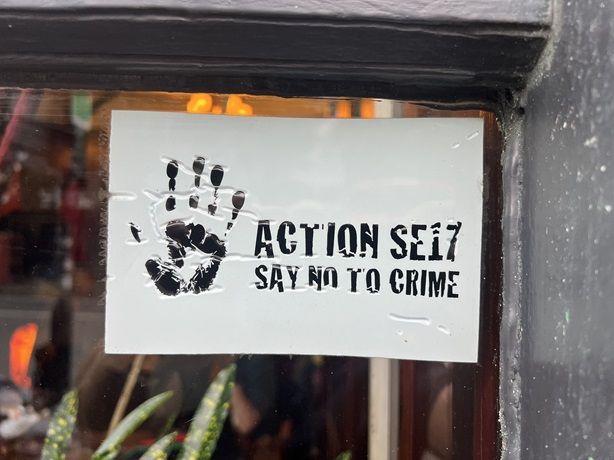
On Sunday 22nd September 2024 @ 17:40 whilst I was on the Walworth Road/Camberwell Road in SE17 close to the 100% Holy Café, I witnessed 3 drug deals being carried out brazenly in the street. I later witnessed another drug deal in a local pub by one of the same individuals.

Several Met Police cars drove past (all being driven one handed) and I attempted to flag one down. The officer in passenger seat made eye contact but they decided to ignore me. I assume the officers were coming from Walworth Police Station 12-28 Manor Place SE17 3RL.

One of the suspects was illegally riding a speed modified e-scooter and had their face covered. I reported the “crime” to the Met Contact Centre @metcc on X but no one has contacted me from the police.

I regularly travel through South London and I regularly see drug deals on the streets. I never see any Met Police officers on foot patrol. Met Police patrol cars just drive by seemingly oblivious to crimes being committed on the streets.

The latest HMICFRS inspection of the Metropolitan Police PEEL Assessment 2023–2025 was published on the 15th August 2024.

If you’re concerned about drug-related crime in your area or think someone may be a victim of drug exploitation, please call us on 101.

If it’s an emergency, please call 999. If you have a hearing or speech impairment, use our textphone service 18000. Or text us on 999 if you’ve pre-registered with the emergencySMS service

Met Police County Lines Drug Dealing

Sussex Police and Open Drug Dealing on the street

I live in Crawley West Sussex and I regularly see drug deals on the streets. I never see any Sussex Police officers on foot patrol (anytime) or in police cars at night.

The suspects are usually illegally riding a speed modified e-scooter or e-bikes and have their face covered. Home delivery of drugs by car also seems very popular in some parts of town.

Chief Superintendent Imran Asghar of Sussex Police was appointed in March 2024 and is responsible for Crawley & Mid-Sussex. On X he said that he is looking forward to working with officers/staff & communities in this region.

Superintendent Asghar EB821 can be contacted by email [email protected]. Maybe he would like to do something positive about drug crime on his “manor” ?

The latest HMICFRS inspection of Sussex Police PEEL 2021/22 was published on the 13th April 2023.

You should read the story about Sussex Police Chief Constable Jo Shiner and her controversial retirement and rehiring.

If you’re concerned about drug-related crime in your area or think someone may be a victim of drug exploitation, please call us on 101.

If it’s an emergency, please call 999. If you have a hearing or speech impairment, use our textphone service 18000. Or text us on 999 if you’ve pre-registered with the emergencySMS service

Sussex Police County Lines Drug Dealing
Drug Dealing on the Street on X

Check out our articles on Policing, Police News, Policing by Consent, Two Tiered Policing, Wasting Police Time, Met Police, Police and Crime Commissioner and a Police and Crime Panel, Sussex Police and the highly questionable Sussex Family Justice Board.


The Ministry of Injustice is not the Ministry of Justice nor is it affiliated in any way with the justice system, legal profession, police or any other law enforcement agencies.

“Publicity is the very soul of justice. . . . It keeps the judge himself, while trying, under trial….Where there is no publicity there is no justice”

Jeremy Bentham – Mr Justice Cobb: ‘Justice must be seen to be done’

Latest Articles


Most Popular


You should always seek formal legal advice from a qualified and reputable lawyer (solicitor or barrister).

There are a number of links to Free and Paid For Legal Resources and Legal Organisations on the Free Legal Advice , Legal Aid and Pro Bono pages.
Rule of Law - Open Justice - Policing By Consent