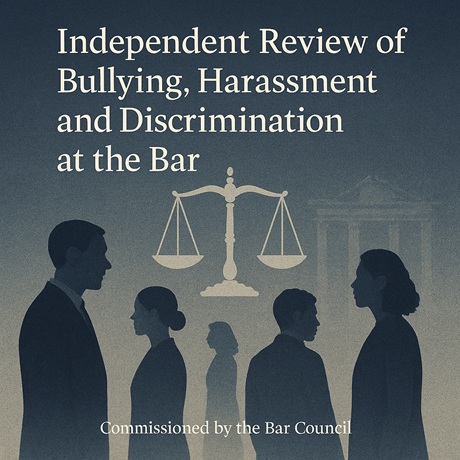
An Independent Review of Bullying, Harassment and Discrimination at the Bar was published on the on the 8th September 2025 by Baroness Harriet Harman KC . The review had been commissioned by the Bar Council in June 2024.
The review addresses the prevalence, causes, and impact of bullying, harassment, and sexual harassment at the Bar and proposes 36 recommendations, for the Bar Council, Judiciary and other bodies to consider to tackle these issues.
The report emphasises the need for “decisive and radical” reforms to address a “culture of impunity” and “collusive bystanding” that allows misconduct to persist.
This is a moment of reckoning for the Bar.
Baroness Harriet Harman KC
The BBC published an article He put his hand down my tights’: Sexual harassment widespread among barristers, review finds in relation to the Independent Review of Bullying, Harassment and Discrimination at the Bar report.
Prevalence of Misconduct
The review confirms systemic bullying, harassment, and sexual harassment within the Bar, occurring in chambers, courtrooms, and behind closed doors.
Over 170 written submissions and consultations with pupils, junior and senior barristers, and chambers staff revealed disturbing accounts, including groping, sexual propositions, and bullying by senior barristers and judges.
Research from 2023 showed 44% of barristers experienced or witnessed bullying, harassment, or discrimination over two years, with women from ethnic minorities particularly affected.
Junior barristers, pupils, and those on work experience are especially vulnerable due to power imbalances, with reporting perceived as “career suicide.”
Judicial Bullying
The report highlights “abundant, disturbing, and compelling” accounts of judicial bullying, including judges shouting, banging desks, or belittling barristers in court.
Certain judges are “widely known” for making barristers’ lives miserable, yet complaints are rare due to fear of repercussions.
The judiciary’s failure to acknowledge this issue contributes to a lack of accountability.
The Lady Chief Justice’s response to the Independent Review of Bullying, Harassment and Discrimination at the Bar was also published on the 8th September 2025.
While the majority of judges behave professionally and courteously, Baroness Harman’s review refers to too many examples of judicial bullying.
Such behaviour is unacceptable and should have no place in our justice system.
I am clear that the senior judiciary does not seek to excuse or minimise bullying by judges. I am absolutely committed to a modern, diverse and inclusive judiciary that upholds our values of integrity, fairness and respect to all.
We have clear standards of behaviour expected from all judicial office holders, which is supported by training and support for judges at all levels, particularly those with leadership responsibilities. We have been focussing on judicial conduct in and out of court for many years.
The Rt Hon the Baroness Carr of Walton-on-the-Hill, Lady Chief Justice of England and Wales
Culture of Impunity
A “culture of denial” and fear of career repercussions discourage victims from reporting, leaving perpetrators, particularly those in senior positions, unaccountable.
The complaints system lacks transparency and efficacy, with delays (e.g., the Jo Sidhu KC case took two years) and lenient sanctions undermining confidence.
Impact
Victims experience humiliation, isolation, and career damage, with some leaving the profession.
Misconduct undermines the Bar’s reputation and the rule of law, which relies on high ethical standards.
Judicial bullying can distort case outcomes, affecting justice delivery.
Key Recommendations
- Code of Conduct and Training (Recommendations 1–4, 12):
• Clarify the Bar Standards Board (BSB) Code of Conduct to explicitly address bullying, harassment, and sexual harassment, including personal vs. professional relationships.
• Mandate anti-bullying and anti-harassment training for all barristers. - Complaints System Overhaul (Recommendations 5–8, 15–20):
• Introduce time limits for processing complaints, provide victim support services, and ensure regular updates for complainants.
• Train BSB staff in handling vulnerable witnesses and review case handling, especially when criminal investigations are involved.
• Improve transparency and consistency in complaints processes across the Inns of Court. - Safeguarding Vulnerable Groups (Recommendation 11):
• Proscribe sexual relationships between barristers/employees and pupils, mini-pupils, or work experience students as serious misconduct. - Judicial Accountability (Recommendations 30–35):
• Remove time limits for complaints to the Judicial Conduct Investigations Office (JCIO).
• Introduce independent court monitors to observe judicial behavior and provide audio recordings of proceedings to professional court users.
• Include an independent person in judicial misconduct sanction decisions alongside the Lady Chief Justice and Lord Chancellor to address perceptions of leniency. - Commissioner for Conduct (Recommendation 36):
• Appoint a Commissioner for Conduct to oversee efforts to tackle bullying, harassment, and sexual harassment. - Sanctions and Deterrence (Recommendations 25–26, 29):
• Implement “career-limiting or career-ending” sanctions to deter misconduct, with prior findings considered in career progression (e.g., silk or judicial appointments).
• Chambers’ constitutions should outline sanctions for misconduct. - Online Abuse (Recommendation 24):
• Regulate online bullying, harassment, and sexual harassment, including inappropriate behavior on platforms like LinkedIn.
Conclusion
The report underscores that bullying, harassment, and sexual harassment are systemic issues at the Bar, driven by power imbalances and a lack of accountability.
It calls for transformative changes to protect victims, restore trust in the complaints system, and uphold the Bar’s ethical standards and reputation. The proposed reforms aim to shift the “jeopardy” from victims to perpetrators, ensuring a safer and more equitable working environment for all legal professionals
A Statement of Expected Behaviour sets standards expected of all judicial office holders. This is included in the Judicial Guide to Conduct and the Equal Treatment Bench Book.
Check out our related articles on Rule of Law, Open Justice, Is the Law Black and White ?, Abuse of Process, What Does Lady Justice Symbolise ?, McKenzie Friend, Can a Judge Direct a Jury to Find a Defendant Not Guilty ?, Law Society, Law Commission, McKenzie Friend Right of Audience, Solicitors, Solicitors Regulation Authority, Barristers, Bar Council of England and Wales, Bar Standards Board, Contra Mundum, R v Sussex Justices, Police Impartiality and the highly questionable Sussex Family Justice Board.
The Ministry of Injustice is not the Ministry of Justice nor is it affiliated in any way with the justice system, legal profession, police or any other law enforcement agencies.
“Publicity is the very soul of justice. . . . It keeps the judge himself, while trying, under trial….Where there is no publicity there is no justice”
Jeremy Bentham – Mr Justice Cobb: ‘Justice must be seen to be done’
Latest Articles ↓
- Presumption of Innocence
 The presumption of innocence is a basic principle of the… Read more: Presumption of Innocence
 - His Honour Judge Daniel Sawyer
 Judge Daniel Sawyer, known as His Honour Judge Daniel Sawyer,… Read more: His Honour Judge Daniel Sawyer
 - UK National Centre for Information Defence
 Prime Minister Andy Burnham used his first United Nations General… Read more: UK National Centre for Information Defence
 - Judges Behaving Badly and His Honour Judge Simon Oliver
 On the 27th August 2026 the Crown Prosecution Service announced… Read more: Judges Behaving Badly and His Honour Judge Simon Oliver
 - Jo Morris Barrister
 Jo Morris is a practising criminal barrister of Drystone Chambers… Read more: Jo Morris Barrister
 - Good Law Project
 The Good Law Project is a UK campaigning organisation that… Read more: Good Law Project
 - Police Federation of England and Wales (PFEW)
 The Police Federation of England and Wales (PFEW) is the… Read more: Police Federation of England and Wales (PFEW)
 - What is the Criminal Justice System (CJS) Common Platform ?
 The Criminal Justice System Common Platform (also known as HMCTS… Read more: What is the Criminal Justice System (CJS) Common Platform ?
 - Strategic Lawsuit Against Public Participation (SLAPPs)
 Strategic Lawsuits Against Public Participation, or SLAPPs, are legal actions… Read more: Strategic Lawsuit Against Public Participation (SLAPPs)
 - His Honour Judge Tony Baumgartner – Recorder of Westminster
 Judge Tony Alan Walter Baumgartner, known as His Honour Judge… Read more: His Honour Judge Tony Baumgartner – Recorder of Westminster
 - New Protocol for Legal Professionals to Raise Informal Concerns About Judges Behaviour
 On the 8th July 2026, the Courts and Tribunals Judiciary… Read more: New Protocol for Legal Professionals to Raise Informal Concerns About Judges Behaviour
 - The Policing Performance System
 In April 2026, His Majesty’s Inspectorate of Constabulary and Fire… Read more: The Policing Performance System
Most Popular ↓
You should always seek formal legal advice from a qualified and reputable lawyer (solicitor or barrister).
There are a number of links to Free and Paid For Legal Resources and Legal Organisations on the Free Legal Advice , Legal Aid and Pro Bono pages.
[post_title] was last updated on the 15th October 2026
