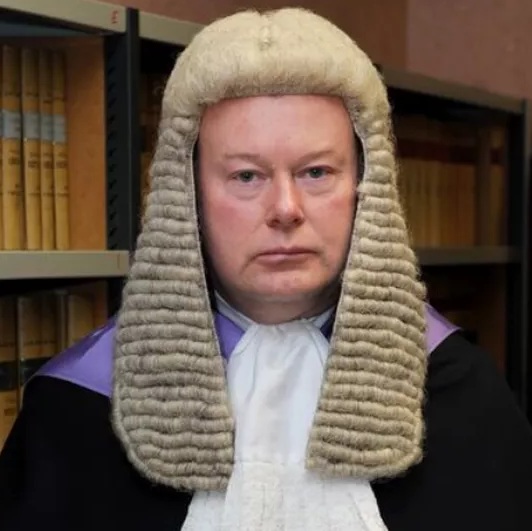
Sir Robert Maurice Jay, styled The Hon. Mr Justice Jay, is a prominent figure in the English judiciary, known for his intellectual rigor, sharp legal mind, and a career marked by both acclaim and controversy.
Born on the 20th September 1959, Mr Justice Jay has served as a High Court judge in the King’s Bench Division since June 2013, following a distinguished career as a barrister and his high-profile role as Leading Counsel to the Leveson Inquiry into press ethics.
Mr Justice Jay is married to Deborah, an author, and they have a daughter. He is known for his intellectual pursuits outside the courtroom, with interests in history, art, classical music (particularly Wagner’s Ring Cycle), chess, cookery, golf and cycling. These hobbies reflect the same meticulous and analytical approach that supposedly characterizes his legal work.
While Judge Jay’s legal acumen is widely respected, his judicial conduct has faced significant scrutiny, particularly in the high-profile libel case of Serafin v Malkiewicz and also wishing an al-Qaeda 7/7 terrorist kingpin ‘all the best’.
Early Life and Education
Robert Jay was born to Professor Barrie Samuel Jay, a consultant surgeon at Moorfields Eye Hospital, and Marcelle Ruby Jay, a geneticist. Educated at King’s College School in Wimbledon, Jay excelled academically, earning an Open Scholarship to New College, Oxford, where he obtained a first-class degree in jurisprudence.
A contemporary of actor Hugh Grant, Jay’s intellectual prowess was evident early on. He undertook pupillage under Simon D. Brown (later Baron Brown of Eaton-Under-Heywood) and was called to the Bar at Middle Temple in 1981.
Legal Career and Rise to Prominence
Jay’s early career as a barrister focused on public law, general common law, group litigation, and public inquiries. He was appointed Queen’s Counsel (now King’s Counsel) in 1998 and served as a Recorder from 1999 and a Deputy High Court Judge from 2008.
In 2011, he was elected Head of Chambers at 39 Essex Chambers, cementing his reputation as a leading legal mind. His appointment as Leading Counsel to the Leveson Inquiry (2011–2012) brought him into the public eye. The inquiry, which investigated the culture, practices, and ethics of the British press following the phone-hacking scandal, showcased Jay’s incisive questioning and command of complex legal and ethical issues. His use of esoteric vocabulary—words like “condign,” “pellucidly,” and “adumbrate”, and memorable asides, such as describing evidence as “light refracted through two intermediate prisms,” earned him both admiration and amusement.
In 2013, Jay was appointed a High Court judge, sitting in the King’s Bench Division, where he has presided over a range of cases, including defamation, fraud, and immigration appeals as a member of the Special Immigration Appeals Commission.
His judicial decisions have been praised for their intellectual depth, such as in the libel case of Serafin v Malkiewicz, where the Supreme Court commended his 70-page judgment as “intricately constructed and beautifully written.”
The Serafin v Malkiewicz Controversy
Despite his accolades, Mr Justice Jay’s judicial career has not been without controversy. The most significant criticism arose from his handling of the 2017 libel case Serafin v Malkiewicz, involving Jan Serafin, a Polish businessman and litigant in person, who sued the Polish-language magazine Nowy Czas over defamatory allegations. Jay dismissed Serafin’s claim after a seven-day trial, but his conduct during the proceedings drew sharp rebuke from higher courts.
The Court of Appeal, in a 2019 ruling, Serafin v Malkiewicz & Ors [2019] EWCA Civ 852 , described Mr Justice Jay’s behaviour as “threatening, overbearing, and, frankly, bullying” noting that he had “cast off the mantle of impartiality” by aggressively cross-examining Serafin and accusing him of lying. The court found that Jay’s interventions rendered the trial unfair, particularly given Serafin’s lack of legal representation and limited English proficiency.
The Supreme Court, in a unanimous 2020 ruling, Serafin (Respondent) v Malkiewicz and others (Appellants) UKSC/2019/0156, led by Lord Wilson, went further, stating that Jay had “harassed and intimidated” Serafin with “immoderate, ill-tempered and at times offensive language.” The trial was declared unfair, and a retrial was ordered, with the Supreme Court expressing “deep regret” that the justice system had failed both parties.
The Serafin case highlighted broader issues about judicial conduct toward litigants in person, particularly those navigating complex legal proceedings without representation. Critics argued that Jay’s approach failed to accommodate Serafin’s vulnerabilities, raising questions about impartiality and fairness in the judiciary.
The case also had implications for defamation law, as the Supreme Court clarified aspects of the public interest defense under the Defamation Act 2013, emphasizing that journalists need not always seek pre-publication comment from claimants.
Controversy Surrounding Mr Justice Jay’s Remarks in Haroon Aswat Case
On September the 8th 2025, a report by The Sun “Judge sparks fury after wishing 7/7 kingpin ‘all the best’ as he prepares to walk free despite fears he’s still a threat” sparked outrage after it revealed that High Court judge Sir Robert Jay, styled Mr Justice Jay, wished “all the best” to Haroon Aswat, a convicted terrorist linked to al-Qaeda, during a hearing at London’s Royal Courts of Justice.
Aswat, a 50-year-old British man from Batley, West Yorkshire, is due to be released from a psychiatric hospital and return to live with his family, prompting significant concern from counter-terrorism officials and the public. This article examines the details of the case, Jay’s controversial remarks, and the broader implications, drawing on available information and critically assessing the situation.
Background on Haroon Aswat
Haroon Rashid Aswat, born on September 22, 1974, in Yorkshire to a Muslim family with roots in Gujarat, India, has a long history of association with extremist activities. In the 1990s, he was linked to radical cleric Abu Hamza al-Masri and the Finsbury Park Mosque, where he helped organize groups to engage in terrorism in Jammu and Kashmir and Bosnia. Aswat was convicted in the United States in 2015 for conspiring to establish a terrorist training camp in Oregon in 1999, alongside Abu Hamza, to train recruits for al-Qaeda. He pleaded guilty to terrorism charges and was sentenced to 20 years, later reduced to seven years due to time served in UK custody.
Aswat’s connection to the July 7, 2005, London bombings, which killed 52 people and injured over 770, has been particularly contentious. Although never charged in connection with the attacks, police traced 20 calls from the suicide bombers to a phone linked to Aswat. He has also claimed involvement in both the 7/7 bombings and the 9/11 attacks in the US, describing himself as a “terrorist” and “foot soldier” of al-Qaeda who does not “shy away from responsibility.” These statements, made while in US custody, raised alarms about his ongoing extremist ideology.
Aswat was deported to the UK in 2022 after serving his sentence and has since been detained under the Mental Health Act at Bethlem Royal Hospital (often referred to as Bedlam) due to a diagnosis of paranoid schizophrenia. His release, expected in the near future following effective psychiatric treatment, has sparked concern due to a legal loophole preventing full risk assessments for psychiatric patients.
The Hearing and Mr Justice Jay’s Remarks
During a High Court hearing on the 1st April 2025, Mr Justice Jay approved a terrorist notification order for Aswat, requiring him to regularly inform police of details such as his address, foreign travel, and vehicle registration. This order was intended to allow authorities to monitor Aswat, who has been assessed by police, including Detective Inspector Karen Bradley, as posing a “risk to national security.” Despite these concerns, no formal terrorist risk assessment has been conducted since his return to the UK, largely due to restrictions on assessing individuals under psychiatric care.
According to a court transcript obtained by The Sun, Jay concluded the hearing with remarks that have drawn widespread criticism:
“I have to wish you all the best and say to you that the way forward is to keep on your medication, listen to the advice you are going to get, and keep out of the sort of things you were doing.”
These comments, directed at a man with a history of terrorist activities and expressed extremist views, were perceived as overly lenient and inappropriate particularly given warnings from counter-terrorism officials.
Detective Chief Superintendent Gareth Rees of the Metropolitan Police’s Counter Terrorism Command highlighted Aswat’s positive reflections on his time with al-Qaeda and his aspirations to reconnect with the group, underscoring the ongoing threat he poses.
Public and Official Reaction
The remarks triggered a firestorm of criticism. The Sun and Daily Mail reported public and official “fury,” with Shadow Justice Secretary Robert Jenrick stating,
“This despicable man was behind one of the most deadly attacks in modern history. He should never experience freedom again.”
Jenrick’s comments reflect a broader sentiment that Aswat’s release, particularly without robust surveillance such as GPS monitoring or an ankle tag, is a failure of the justice system. A 2022 psychiatric report by Dr. Richard Taylor noted that Aswat continued to express “violent extremist Islamic ideology” despite being mentally stable, further fueling concerns about his release.
The Home Office responded by emphasising that “protecting the British public is the very first priority” and that “robust counter-terrorism risk management measures” are in place. However, the absence of a full risk assessment and the reliance on a notification order—rather than more stringent monitoring—has raised doubts about the adequacy of these measures. A government source claimed Aswat would be subject to “robust monitoring” for 30 years, but critics argue this falls short given his history and the legal constraints on surveillance due to his psychiatric status.
Image of Mr Justice Jay : Getty Images
Check out our articles on Rule of Law, Open Justice, Judges Salaries and Fees, Dodgy Judges, Mr Justice Williams, His Honour Judge Melbourne Inman KC, His Honour Judge Richardson, His Honour Now His Dishonour, His Honour Judge Michael Slater, His Honour Judge Martin Davis, HHJ Farquhar, Do you Have to Bow to a Judge ?, Can you Email a Judge ?, Can you Criticise a Judge ? and the highly dubious Sussex Family Justice Board.
The Ministry of Injustice is not the Ministry of Justice nor is it affiliated in any way with the justice system, legal profession, police or any other law enforcement agencies.
“Publicity is the very soul of justice. . . . It keeps the judge himself, while trying, under trial….Where there is no publicity there is no justice”
Jeremy Bentham – Mr Justice Cobb: ‘Justice must be seen to be done’
Latest Articles ↓
- Presumption of Innocence
 The presumption of innocence is a basic principle of the… Read more: Presumption of Innocence
 - His Honour Judge Daniel Sawyer
 Judge Daniel Sawyer, known as His Honour Judge Daniel Sawyer,… Read more: His Honour Judge Daniel Sawyer
 - UK National Centre for Information Defence
 Prime Minister Andy Burnham used his first United Nations General… Read more: UK National Centre for Information Defence
 - Judges Behaving Badly and His Honour Judge Simon Oliver
 On the 27th August 2026 the Crown Prosecution Service announced… Read more: Judges Behaving Badly and His Honour Judge Simon Oliver
 - Jo Morris Barrister
 Jo Morris is a practising criminal barrister of Drystone Chambers… Read more: Jo Morris Barrister
 - Good Law Project
 The Good Law Project is a UK campaigning organisation that… Read more: Good Law Project
 - Police Federation of England and Wales (PFEW)
 The Police Federation of England and Wales (PFEW) is the… Read more: Police Federation of England and Wales (PFEW)
 - What is the Criminal Justice System (CJS) Common Platform ?
 The Criminal Justice System Common Platform (also known as HMCTS… Read more: What is the Criminal Justice System (CJS) Common Platform ?
 - Strategic Lawsuit Against Public Participation (SLAPPs)
 Strategic Lawsuits Against Public Participation, or SLAPPs, are legal actions… Read more: Strategic Lawsuit Against Public Participation (SLAPPs)
 - His Honour Judge Tony Baumgartner – Recorder of Westminster
 Judge Tony Alan Walter Baumgartner, known as His Honour Judge… Read more: His Honour Judge Tony Baumgartner – Recorder of Westminster
 - New Protocol for Legal Professionals to Raise Informal Concerns About Judges Behaviour
 On the 8th July 2026, the Courts and Tribunals Judiciary… Read more: New Protocol for Legal Professionals to Raise Informal Concerns About Judges Behaviour
 - The Policing Performance System
 In April 2026, His Majesty’s Inspectorate of Constabulary and Fire… Read more: The Policing Performance System
Most Popular ↓
You should always seek formal legal advice from a qualified and reputable lawyer (solicitor or barrister).
There are a number of links to Free and Paid For Legal Resources and Legal Organisations on the Free Legal Advice , Legal Aid and Pro Bono pages.
[post_title] was last updated on the 15th October 2026