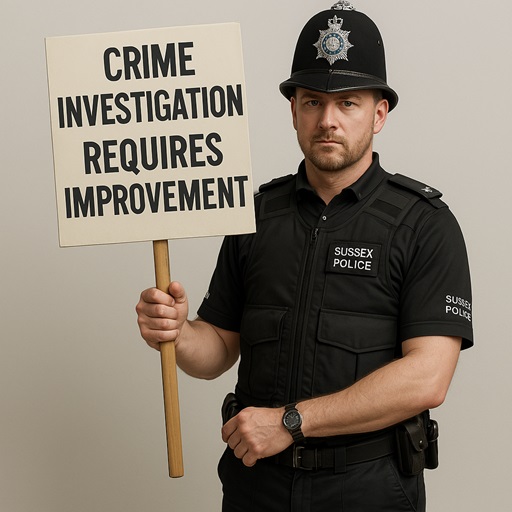
The Police Effectiveness, Efficiency, and Legitimacy (PEEL) assessment for Sussex Police, conducted by His Majesty’s Inspectorate of Constabulary and Fire & Rescue Services (HMICFRS) for 2023-2025, evaluated the force’s performance across various policing functions.
The report highlights both strengths and areas for improvement, grading Sussex Police on key areas such as preventing crime, protecting vulnerable people, leadership, and resource management. Below is a summary of the key findings and recommendations.
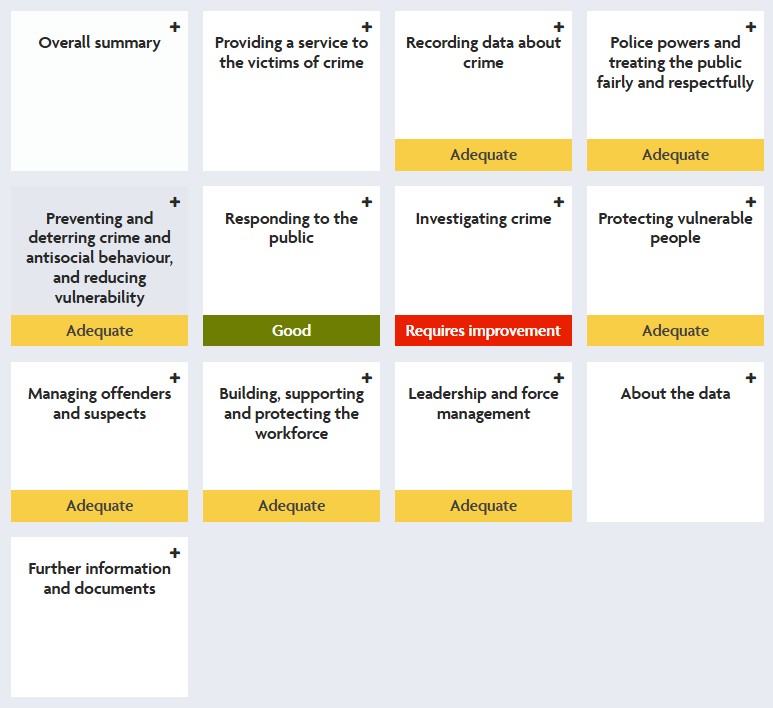
Read the Sussex Police Report Online or Download below.
The chief of Sussex Police (Jo Shiner KPM) said she is ‘proud of the positive changes’ that have been highlighted in the latest inspection report – but the force has been told it still needs to improve the quality of its crime investigations.
Sussex Police is mostly ‘adequate’ but force told it needs to improve the quality of its crime investigations – Sussex World
Key Findings
- Preventing and Deterring Crime
- Sussex Police demonstrates a reasonable performance in preventing crime but requires improvement in its approach to tackling anti-social behavior (ASB). The force has effective processes for identifying crime trends and allocating resources but struggles with consistent community engagement to prevent ASB.
- The report notes that the force’s neighborhood policing teams are stretched, impacting their ability to proactively address local issues.
- Protecting Vulnerable People
- The force performs adequately in safeguarding vulnerable individuals, including victims of domestic abuse and children at risk. However, response times to incidents involving vulnerability are inconsistent, and there are delays in risk assessments for some cases.
- Sussex Police has improved its response to missing persons but needs better training for staff to identify hidden vulnerabilities effectively.
- Investigating Crime
- Sussex Police shows mixed performance in crime investigation. While serious crimes like homicide and sexual offenses are generally well-handled, lower-level crimes, such as theft, often lack thorough investigation due to resource constraints.
- The force has made progress in reducing backlogs of digital forensic examinations, but further investment is needed to maintain this improvement.
- Overall Sussex Police Investigating Crime Requires improvement
- Responding to the Public
- The force’s call-handling performance is a concern, with longer-than-average wait times for non-emergency calls. Emergency (999) response times are within acceptable standards, but the force struggles to meet demand during peak periods.
- Sussex Police has introduced initiatives to improve call management, but these are yet to yield consistent results.
- Leadership and Workforce
- Leadership within Sussex Police is rated as good, with clear efforts to promote a positive culture and support staff well-being. The force has robust processes for professional development and diversity training.
- However, workforce morale is affected by high workloads, particularly in response policing teams, and there is a need for better succession planning to address staffing gaps.
- Efficiency and Resource Management
- Sussex Police is graded as requiring improvement in efficiency. While the force has made strides in financial planning, it faces challenges in optimising resources due to increasing demand and limited budgets.
- The report praises the force’s collaboration with other agencies, such as local councils, but notes that partnerships could be better leveraged to address complex issues like ASB and youth crime.
- Public Trust and Legitimacy
- The force performs well in maintaining public trust, with strong community outreach programs and transparent complaint-handling processes. However, stop-and-search practices require improvement to ensure fairness and proportionality, particularly for minority groups.
- Sussex Police has made efforts to address disproportionality in policing but needs to enhance data analysis to monitor outcomes effectively.
Areas for Improvement
HMICFRS identified several areas where Sussex Police must improve:
- Anti-Social Behavior: Develop a more proactive strategy to tackle ASB, including better engagement with communities and partnerships.
- Call Handling: Invest in technology and training to reduce non-emergency call wait times and improve demand management.
- Investigation Quality: Ensure consistent standards for investigating lower-level crimes and reduce delays in digital forensics.
- Stop-and-Search: Enhance oversight and training to ensure stop-and-search is conducted fairly and proportionately.
- Workforce Support: Address workload pressures and improve succession planning to maintain operational resilience.
Positive Highlights
- Sussex Police excels in leadership development and fostering a positive workplace culture.
- The force’s collaboration with other agencies, such as in tackling serious organised crime, is a strength.
- Improvements in handling missing persons cases and reducing digital forensic backlogs show progress in critical areas.
Other Sussex Police Articles
Conclusion
The 2023-2025 PEEL assessment paints a mixed picture of Sussex Police’s performance. While the force demonstrates strengths in leadership, community trust, and tackling serious crime, it faces challenges in resource allocation, call handling, and addressing anti-social behaviour.
HMICFRS recommends that Sussex Police prioritise improvements in these areas to enhance overall effectiveness and public service.
Check out our articles on Sussex Police, Policing by Consent, Police Impartiality, Are the Police for Hire ?, Police Public Confidence and Engagement, Police Professional Standards Department, IOPC, Crime Reporting, What is a Police and Crime Commissioner ?, Policing, Police News, Two Tiered Policing, Thought Police, Police Digital Service, Knowledge Hub – Police Digital Service, Wasting Police Time, Police Community Support Officers (PCSO), Met Police, Chief Constable Jo Shiner, R v Sussex Justices and the highly questionable Sussex Family Justice Board.
The Ministry of Injustice is not the Ministry of Justice nor is it affiliated in any way with the justice system, legal profession, police or any other law enforcement agencies.
“Publicity is the very soul of justice. . . . It keeps the judge himself, while trying, under trial….Where there is no publicity there is no justice”
Jeremy Bentham – Mr Justice Cobb: ‘Justice must be seen to be done’
Latest Articles ↓
- Presumption of Innocence
 The presumption of innocence is a basic principle of the… Read more: Presumption of Innocence
 - His Honour Judge Daniel Sawyer
 Judge Daniel Sawyer, known as His Honour Judge Daniel Sawyer,… Read more: His Honour Judge Daniel Sawyer
 - UK National Centre for Information Defence
 Prime Minister Andy Burnham used his first United Nations General… Read more: UK National Centre for Information Defence
 - Judges Behaving Badly and His Honour Judge Simon Oliver
 On the 27th August 2026 the Crown Prosecution Service announced… Read more: Judges Behaving Badly and His Honour Judge Simon Oliver
 - Jo Morris Barrister
 Jo Morris is a practising criminal barrister of Drystone Chambers… Read more: Jo Morris Barrister
 - Good Law Project
 The Good Law Project is a UK campaigning organisation that… Read more: Good Law Project
 - Police Federation of England and Wales (PFEW)
 The Police Federation of England and Wales (PFEW) is the… Read more: Police Federation of England and Wales (PFEW)
 - What is the Criminal Justice System (CJS) Common Platform ?
 The Criminal Justice System Common Platform (also known as HMCTS… Read more: What is the Criminal Justice System (CJS) Common Platform ?
 - Strategic Lawsuit Against Public Participation (SLAPPs)
 Strategic Lawsuits Against Public Participation, or SLAPPs, are legal actions… Read more: Strategic Lawsuit Against Public Participation (SLAPPs)
 - His Honour Judge Tony Baumgartner – Recorder of Westminster
 Judge Tony Alan Walter Baumgartner, known as His Honour Judge… Read more: His Honour Judge Tony Baumgartner – Recorder of Westminster
 - New Protocol for Legal Professionals to Raise Informal Concerns About Judges Behaviour
 On the 8th July 2026, the Courts and Tribunals Judiciary… Read more: New Protocol for Legal Professionals to Raise Informal Concerns About Judges Behaviour
 - The Policing Performance System
 In April 2026, His Majesty’s Inspectorate of Constabulary and Fire… Read more: The Policing Performance System
Most Popular ↓
You should always seek formal legal advice from a qualified and reputable lawyer (solicitor or barrister).
There are a number of links to Free and Paid For Legal Resources and Legal Organisations on the Free Legal Advice , Legal Aid and Pro Bono pages.
[post_title] was last updated on the 15th October 2026
