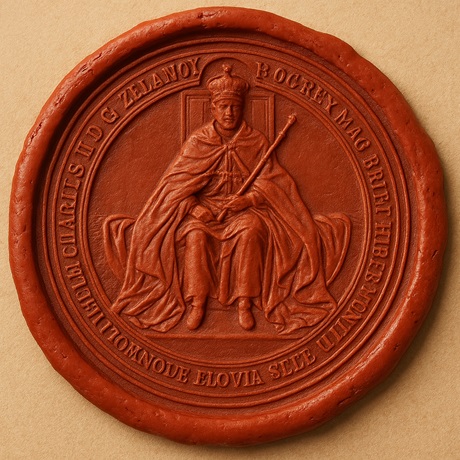
Letters patent are a legal document authorised by the king, usually on ministerial advice. Letters patent can make public appointments, confer honours, grant city status or signify Royal Assent to legislation.
On the 3rd November 2025, King Charles III issued a Letters Patent under the Great Seal of the Realm, formally removing the titles from his brother formerly known as Prince Andrew to simply Andrew Mountbatten Windsor.
THE KING has been pleased by Letters Patent under the Great Seal of the Realm dated 3 November 2025 to declare that Andrew Mountbatten Windsor shall no longer be entitled to hold and enjoy the style, title or attribute of ‘Royal Highness’ and the titular dignity of ‘Prince’.”
The Gazette – Letters Patent published 5th November 2025
Definition and Core Characteristics
Letters Patent are open letters from the Sovereign, addressed to all subjects rather than a specific individual. The term derives from the Latin litterae patentes, meaning “open letters” reflecting their public nature when they were historically unfurled for proclamation, contrasting with sealed “Letters Close” intended for private recipients.
Issued under the Great Seal, which is affixed by the Clerk of the Crown in Chancery at the House of Lords, these documents confer rights, privileges, or offices. They do not require parliamentary approval for most purposes, embodying the royal prerogative.
Examples include the appointment of bishops, the establishment of universities, or the elevation of individuals to the peerage.
Historical Context
The use of Letters Patent dates to the medieval period, when monarchs relied on them to delegate authority amid a growing realm. Early instances include Henry III’s grants in the 13th century. By the Tudor era, they facilitated explorations, such as Queen Elizabeth I’s 1578 patent to Sir Humphrey Gilbert for North American colonisation.
Over centuries, their scope expanded and contracted with political shifts. The Bill of Rights 1689 curtailed certain prerogatives, yet Letters Patent endured for non-legislative acts. Notable 19th- and 20th-century examples include the creation of life peerages under the Life Peerages Act 1958, which modernised the House of Lords without abolishing hereditary titles.
Modern Applications
Today, Letters Patent retain practical utility across several domains:
- Peerages and Honours: Most new peers are created via Letters Patent, as seen in appointments to the Lords. Hereditary peerages, though rare post-1999 reforms, follow the same process.
- Royal Charters: Corporations, universities, and professional bodies—such as the BBC or the University of Manchester—receive charters via Letters Patent, granting legal personality and privileges.
- Ecclesiastical and Judicial Appointments: Bishops’ elections are confirmed through this mechanism, while certain judges and officials are installed similarly.
- Territorial and International Matters: They proclaim changes to Crown dependencies or issue passports in the Sovereign’s name.
Parliament and Legislation
According to What are letters patent ? published on the House of Commons website on the 15th September 2025, Letters patent are classed as primary legislation
Acts of Parliament are primary legislation and are statutes passed by Parliament with the assent of the Sovereign. Letters Patent, by contrast, are exercises of the royal prerogative and do not constitute primary legislation.
They are administrative or constitutive instruments, not statutory law. Thus, they correctly fall outside the category of primary legislation and are properly described as prerogative instruments (though the term “secondary instruments” is sometimes used loosely in this context).
Because Letters Patent are issued under the royal prerogative, the Sovereign retains the inherent power to revoke or amend them, provided no statute restricts that authority. For example :-
A peerage created by Letters Patent may be surrendered or disclaimed under the Peerage Act 1963, but in the absence of statute, the Crown could theoretically revoke a grant (though this is now politically and constitutionally unthinkable for peerages).
Royal charters (granted by Letters Patent) can be amended or revoked by further Letters Patent, as seen historically with chartered bodies like the BBC or universities.
Where Parliament has legislated, the prerogative is curtailed. For instance:
The Life Peerages Act 1958 governs the creation of life peers by Letters Patent.
The House of Lords Act 1999 removed most hereditary peers, limiting the effect of hereditary Letters Patent issued before that date.
The Succession to the Crown Act 2013 altered succession rules, overriding any contrary prerogative implications.
Thus, the Sovereign’s power to issue, amend, or revoke Letters Patent is real but constrained by statute where Parliament has intervened.
How are Letters Patent issued ?
The procedure is meticulous and rooted in tradition:
- Drafting: The relevant government department (e.g., the Cabinet Office for honours) prepares a draft warrant.
- Approval: The Prime Minister or responsible minister signs the warrant, advising the Sovereign.
- Sealing: The warrant proceeds to the Crown Office at the House of Lords, where the Clerk of the Crown affixes the Great Seal—a wafer impressed with the Sovereign’s image.
- Publication: For peerages, details appear in the London Gazette. The document is then enrolled for public record.
The Great Seal of the Realm is the official seal of the monarch, used to approve and authenticate important state documents like letters patent and royal proclamations. It symbolizes the monarch’s sovereign authority and is a historical emblem of their role as Head of State, dating back to Edward the Confessor in the eleventh century. Each new monarch has a new, unique seal created for their reign.

The Lord High Chancellor of Great Britain is the formal keeper and administrator of the Great Seal of the Realm. The current Lord Chancellor is the Rt Hon David Lammy MP.
Check out the related articles on the Government Legal Department (GLD), Attorney General, Solicitor General, Lord Chancellor, Justice Secretary, Rule of Law, Open Justice, Law, Is the Law Black and White ?, Government Legal Department, Crown Prosecution Service (CPS), Abuse of Process, What Does Lady Justice Symbolise ?, McKenzie Friend, Can a Judge Direct a Jury to Find a Defendant Not Guilty ?,Law Society, Law Commission, McKenzie Friend Right of Audience, Solicitors, Solicitors Regulation Authority, Barristers, Bar Council of England and Wales, Bar Standards Board, R v Sussex Justices, Police Impartiality and the highly questionable Sussex Family Justice Board.
The Ministry of Injustice is not the Ministry of Justice nor is it affiliated in any way with the justice system, legal profession, police or any other law enforcement agencies.
“Publicity is the very soul of justice. . . . It keeps the judge himself, while trying, under trial….Where there is no publicity there is no justice”
Jeremy Bentham – Mr Justice Cobb: ‘Justice must be seen to be done’
Latest Articles ↓
- His Honour Judge Daniel Sawyer
 Judge Daniel Sawyer, known as His Honour Judge Daniel Sawyer,… Read more: His Honour Judge Daniel Sawyer
 - UK National Centre for Information Defence
 Prime Minister Andy Burnham used his first United Nations General… Read more: UK National Centre for Information Defence
 - Judges Behaving Badly and His Honour Judge Simon Oliver
 On the 27th August 2026 the Crown Prosecution Service announced… Read more: Judges Behaving Badly and His Honour Judge Simon Oliver
 - Jo Morris Barrister
 Jo Morris is a practising criminal barrister of Drystone Chambers… Read more: Jo Morris Barrister
 - Good Law Project
 The Good Law Project is a UK campaigning organisation that… Read more: Good Law Project
 - Police Federation of England and Wales (PFEW)
 The Police Federation of England and Wales (PFEW) is the… Read more: Police Federation of England and Wales (PFEW)
 - What is the Criminal Justice System (CJS) Common Platform ?
 The Criminal Justice System Common Platform (also known as HMCTS… Read more: What is the Criminal Justice System (CJS) Common Platform ?
 - Strategic Lawsuit Against Public Participation (SLAPPs)
 Strategic Lawsuits Against Public Participation, or SLAPPs, are legal actions… Read more: Strategic Lawsuit Against Public Participation (SLAPPs)
 - His Honour Judge Tony Baumgartner – Recorder of Westminster
 Judge Tony Alan Walter Baumgartner, known as His Honour Judge… Read more: His Honour Judge Tony Baumgartner – Recorder of Westminster
 - New Protocol for Legal Professionals to Raise Informal Concerns About Judges Behaviour
 On the 8th July 2026, the Courts and Tribunals Judiciary… Read more: New Protocol for Legal Professionals to Raise Informal Concerns About Judges Behaviour
 - The Policing Performance System
 In April 2026, His Majesty’s Inspectorate of Constabulary and Fire… Read more: The Policing Performance System
 - What is the Judicial College ?
 The Judicial College serves as the central pillar of professional… Read more: What is the Judicial College ?
Most Popular ↓
You should always seek formal legal advice from a qualified and reputable lawyer (solicitor or barrister).
There are a number of links to Free and Paid For Legal Resources and Legal Organisations on the Free Legal Advice , Legal Aid and Pro Bono pages.
[post_title] was last updated on the 6th October 2026
