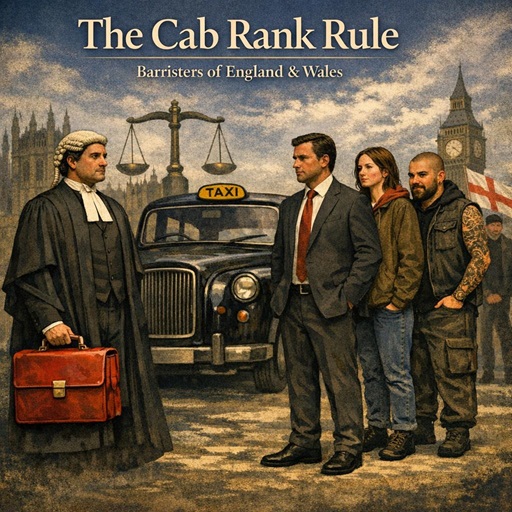
The cab rank rule constitutes a fundamental ethical obligation for barristers practising in England and Wales and is enshrined in the Bar Standards Board (BSB) Handbook at rule rC29.
Pursuant to rC29, where a self-employed barrister (or, in specified circumstances, an authorised individual within a BSB entity or a BSB entity itself) receives instructions from a professional client such as a solicitor and those instructions are appropriate having regard to the barrister’s experience, seniority, and field of practice, the barrister must accept them.
This obligation applies irrespective of:
- the identity of the client;
- the nature of the case;
- any personal beliefs the barrister may hold concerning the client’s character, reputation, motives, cause, conduct, guilt, or innocence; or
- any disapproval of the client’s political, moral, social, or other views or causes.
The rule serves to promote access to justice, uphold the rule of law, safeguard barrister independence, and prevent discrimination in the acceptance of professional instructions.
It ensures that representation is available even in controversial, unpopular, or morally challenging matters. The principle is commonly analogised to a taxi at a cab rank, which must accept the next passenger regardless of their identity or destination (subject to reasonable limitations).
The obligation applies principally to self-employed barristers instructed via professional clients. It does not extend in the same manner to direct public access instructions, to solicitors, or to employed barristers outside independent practice.
Rule rC29 is expressly made subject to the exceptions in rC30. These include circumstances where for example:
- the barrister is required to refuse the instructions under rule rC21 (rC30.1); or
- acceptance would necessitate working outside ordinary hours, cancelling existing commitments, exceeding available professional indemnity insurance limits, or involve other specified grounds (such as foreign work in certain cases or refusal of standard contractual terms).
- you are a King’s Counsel, and the acceptance of the instructions would require you to act without a junior in circumstances where you reasonably consider that the interests of the client require that a junior should also be instructed;
Rule rC21 mandates refusal (or, if already accepted, cessation and return) of instructions in various situations, including where:
- the work would require action contrary to law or the Handbook;
- the barrister lacks requisite authorisation, competence, or experience (including in relation to vulnerable clients);
- there is insufficient time to prepare adequately (subject to limited exceptions for urgent matters);
- a conflict of interest exists;
- the barrister’s independence would be compromised (rC21.10, linked to Core Duty CD4); or
- other specified professional obligations would be breached.
Cab Rank Application to Pro Bono Work
The cab rank rule does not require barristers to accept pro bono (unpaid) instructions.
In the article Barrister Starmer led ‘witch-hunt’ against Iraq veterans, Sir Keir Starmer KC chose to work for free (pro bono) alongside the now Attorney General Lord Hermer and the now disgraced solicitor Phil Shiner on a human rights claim in 2007 that reshaped the law governing troops in war zones.
While the current BSB Handbook does not contain an explicit standalone exception for inadequate remuneration, established BSB guidance and interpretations—rooted in prior provisions of the Code of Conduct (e.g., paragraphs 603–606)—confirm that barristers are not obliged to accept instructions where no proper professional fee is offered or where remuneration is inadequate, including unpaid pro bono work.
The rule is predicated on professional (remunerated) practice and is designed to secure representation in paid cases—particularly those involving controversial clients or causes where funding is available but barristers might otherwise decline due to personal views. It does not impose a duty to provide gratuitous services.
Barristers are encouraged to undertake pro bono work voluntarily, and many do so through established schemes such as Advocate (the Bar Pro Bono Unit), which facilitates substantial pro bono assistance annually. Such contributions reflect professional ethos, charitable commitment, and public service, but they remain discretionary rather than mandatory under the cab rank principle.
In conclusion, the cab rank rule compels acceptance of appropriate paid instructions from professional clients irrespective of personal views, subject to the exceptions in rC30 (including those arising under rC21). It remains a vital safeguard of access to justice and barrister independence, while explicitly not extending to compel unpaid or inadequately remunerated engagements.
Read the reviews of Junior Sussex Barrister Gavin Howe and Legal 500 Junior Barrister Eleanor Battie.
Check out our related articles on Rule of Law, Open Justice, What is Law, Is the Law Black and White ?, Branches of Law, Bullying, Harassment and Discrimination at the Bar, Blackbelt Barrister, The Secret Barrister, Barristers, Direct Access Barrister, Professional Ethics Exam for Barristers, Barristers Behaving Badly, Inns of Court, Council of the Inns of Court, Bar Standards Board, Bar Tribunal and Adjudication Services, Bar Council, Innocent until Proven Guilty and the highly questionable Sussex Family Justice Board.
The Ministry of Injustice is not the Ministry of Justice nor is it affiliated in any way with the justice system, legal profession, police or any other law enforcement agencies.
“Publicity is the very soul of justice. . . . It keeps the judge himself, while trying, under trial….Where there is no publicity there is no justice”
Jeremy Bentham – Mr Justice Cobb: ‘Justice must be seen to be done’
Latest Articles ↓
- His Honour Judge Daniel Sawyer
 Judge Daniel Sawyer, known as His Honour Judge Daniel Sawyer,… Read more: His Honour Judge Daniel Sawyer
 - UK National Centre for Information Defence
 Prime Minister Andy Burnham used his first United Nations General… Read more: UK National Centre for Information Defence
 - Judges Behaving Badly and His Honour Judge Simon Oliver
 On the 27th August 2026 the Crown Prosecution Service announced… Read more: Judges Behaving Badly and His Honour Judge Simon Oliver
 - Jo Morris Barrister
 Jo Morris is a practising criminal barrister of Drystone Chambers… Read more: Jo Morris Barrister
 - Good Law Project
 The Good Law Project is a UK campaigning organisation that… Read more: Good Law Project
 - Police Federation of England and Wales (PFEW)
 The Police Federation of England and Wales (PFEW) is the… Read more: Police Federation of England and Wales (PFEW)
 - What is the Criminal Justice System (CJS) Common Platform ?
 The Criminal Justice System Common Platform (also known as HMCTS… Read more: What is the Criminal Justice System (CJS) Common Platform ?
 - Strategic Lawsuit Against Public Participation (SLAPPs)
 Strategic Lawsuits Against Public Participation, or SLAPPs, are legal actions… Read more: Strategic Lawsuit Against Public Participation (SLAPPs)
 - His Honour Judge Tony Baumgartner – Recorder of Westminster
 Judge Tony Alan Walter Baumgartner, known as His Honour Judge… Read more: His Honour Judge Tony Baumgartner – Recorder of Westminster
 - New Protocol for Legal Professionals to Raise Informal Concerns About Judges Behaviour
 On the 8th July 2026, the Courts and Tribunals Judiciary… Read more: New Protocol for Legal Professionals to Raise Informal Concerns About Judges Behaviour
 - The Policing Performance System
 In April 2026, His Majesty’s Inspectorate of Constabulary and Fire… Read more: The Policing Performance System
 - What is the Judicial College ?
 The Judicial College serves as the central pillar of professional… Read more: What is the Judicial College ?
Most Popular ↓
You should always seek formal legal advice from a qualified and reputable lawyer (solicitor or barrister).
There are a number of links to Free and Paid For Legal Resources and Legal Organisations on the Free Legal Advice , Legal Aid and Pro Bono pages.
[post_title] was last updated on the 23rd September 2026
