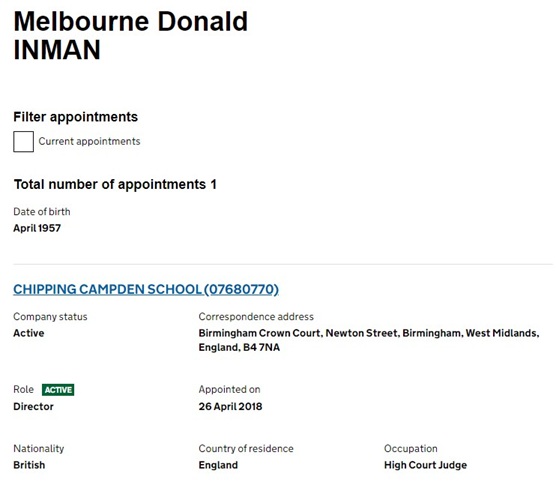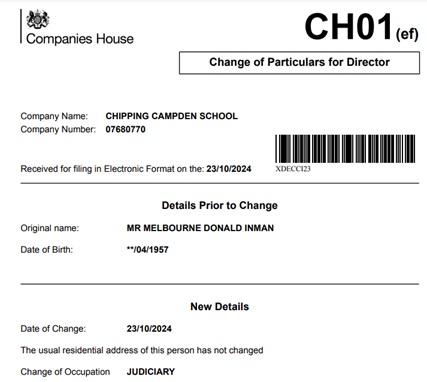
The Judiciary of England and Wales use Microsoft 365 for email using the ejudiciary.net domain. This domain is connected to the Internet and accepts email via MX ejudiciary-net.mail.protection.outlook.com. This is public information.

The rule of law is a fundamental constitutional principle which underpins an open, fair and peaceful society, where citizens and businesses can prosper. Our judges and magistrates are its cornerstone.
Lady Chief Justice on the public ejudiciary.net page
I sent an email lawfully requesting information about his “occupation” to His Honour Judge Melbourne Inman KC copying the The Lady Chief Justice of England and Wales (LCJ) on the 21st October 2024.
To: [email protected]
Cc: [email protected]
Subject: HHJ Melbourne Inman KC – Media Enquiry
Importance: HighDear Judge
cc The Right Honourable The Lady Chief Justice of England and Wales
I asked the Judiciary Press Office for comment (as below) on Friday 18th October 2024 but they have not replied.
Could you please answer the following questions :-
- Are you a Circuit Judge or High Court Judge ?
- Are you authorised to sit as a High Court Judge ?
- Should your occupation at Companies House be shown as High Court Judge ?
An article was published at noon on the 18th October 2024 https://ministryofinjustice.co.uk/his-honour-judge-melbourne-inman-kc/. It has received a considerable amount of worldwide attention.
The Lady Chief Justice states as a co-signatory of the document Judicial Discipline – Misconduct and recommending sanctions (https://www.complaints.judicialconduct.gov.uk/rulesandregulations/MisconductandRecommendingSanctions)
“As Lord Chancellor and Lady Chief Justice, we are jointly responsible for judicial discipline………The public has a right to expect that on the rare occasions when judicial office holders do not meet the high standards of conduct expected of them, action will be taken.”
I do not believe that the JCIO will accept a complaint concerning “misrepresentation” hence the cc to The Right Honourable The Lady Chief Justice to deal with and action.
Regards
Email to HHJ Inman and The Lady Chief Justice
An autoreply was received from the LCJ’s former High Court email address.
From: Archived Mail Address – Carr LJ <[email protected]>
Subject: Automatic reply: HHJ Melbourne Inman KC – Media EnquiryDame Sue Carr has now been appointed as the Lady Chief Justice of England and Wales, please direct any queries to [email protected]
So yes you can email a judge…however
Sending threatening or malicious messages using a public electronic communication, such as via email, may amount to an offence. Do not do it.
The relevant legislation of England and Wales includes :-
Malicious Communications Act 1988 Section 1
Communications Act 2003 Section 127
Part 10 of the Online Safety Act 2023
Protection from Harassment Act 1997
Computer Misuse Act 1990
The Crown Prosecution Service (CPS) publish legal guidance on Communications Offences.
Judicial Email Format
Judges are by their very nature public figures. Open justice is a fundamental principle at the very heart of the justice system and vital to the rule of law.
‘It is not merely of some importance but is of fundamental importance that justice should not only be done, but should manifestly and undoubtedly be seen to be done’
R v Sussex Justices – Lord Hewart
Judicial email addresses, including High Court Judges, are widely published on the internet and easily found by a simple Google search. This article only contains publicly and readily available information.
The format for most judicial email addresses are as follows :-
- [email protected] – Deputy District Judge
- [email protected] – District Judge
- [email protected] – Recorder
- [email protected] – Recorder with KC
- [email protected] – Circuit Judge
- [email protected] – Circuit Judge with KC
- [email protected] – Upper Tribunal Judge
- [email protected] – President of the Family Division
- [email protected] – High Court Master
- [email protected] – High Court Judge
- [email protected] – High Court Judge
- [email protected] – High Court Judge
- [email protected] – President King’s Bench Division
- [email protected] – President Family Division
Sent an Email to the Wrong Person ?
“Publicity is the very soul of justice. . . . It keeps the judge himself, while trying, under trial….Where there is no publicity there is no justice”
Jeremy Bentham – Mr Justice Cobb: ‘Justice must be seen to be done’
Check out our articles on Dodgy Judges, Judges Salaries and Fees, Can you Criticise a Judge, Criminal Justice Secure eMail (CJSM), Do you Have to Bow to a Judge ?, His Honour Now His Dishonour, His Honour Melbourne Inman KC, His Honour Judge Jeremy Richardson KC, His Honour Judge Michael Slater, His Honour Judge Martin Davis, HHJ Farquhar and the highly dubious Sussex Family Justice Board.
The Ministry of Injustice is not the Ministry of Justice nor is it affiliated in any way with the justice system, legal profession, police or any other law enforcement agencies.
“Publicity is the very soul of justice. . . . It keeps the judge himself, while trying, under trial….Where there is no publicity there is no justice”
Jeremy Bentham – Mr Justice Cobb: ‘Justice must be seen to be done’
Latest Articles ↓
- Presumption of Innocence
 The presumption of innocence is a basic principle of the… Read more: Presumption of Innocence
 - His Honour Judge Daniel Sawyer
 Judge Daniel Sawyer, known as His Honour Judge Daniel Sawyer,… Read more: His Honour Judge Daniel Sawyer
 - UK National Centre for Information Defence
 Prime Minister Andy Burnham used his first United Nations General… Read more: UK National Centre for Information Defence
 - Judges Behaving Badly and His Honour Judge Simon Oliver
 On the 27th August 2026 the Crown Prosecution Service announced… Read more: Judges Behaving Badly and His Honour Judge Simon Oliver
 - Jo Morris Barrister
 Jo Morris is a practising criminal barrister of Drystone Chambers… Read more: Jo Morris Barrister
 - Good Law Project
 The Good Law Project is a UK campaigning organisation that… Read more: Good Law Project
 - Police Federation of England and Wales (PFEW)
 The Police Federation of England and Wales (PFEW) is the… Read more: Police Federation of England and Wales (PFEW)
 - What is the Criminal Justice System (CJS) Common Platform ?
 The Criminal Justice System Common Platform (also known as HMCTS… Read more: What is the Criminal Justice System (CJS) Common Platform ?
 - Strategic Lawsuit Against Public Participation (SLAPPs)
 Strategic Lawsuits Against Public Participation, or SLAPPs, are legal actions… Read more: Strategic Lawsuit Against Public Participation (SLAPPs)
 - His Honour Judge Tony Baumgartner – Recorder of Westminster
 Judge Tony Alan Walter Baumgartner, known as His Honour Judge… Read more: His Honour Judge Tony Baumgartner – Recorder of Westminster
 - New Protocol for Legal Professionals to Raise Informal Concerns About Judges Behaviour
 On the 8th July 2026, the Courts and Tribunals Judiciary… Read more: New Protocol for Legal Professionals to Raise Informal Concerns About Judges Behaviour
 - The Policing Performance System
 In April 2026, His Majesty’s Inspectorate of Constabulary and Fire… Read more: The Policing Performance System
Most Popular ↓
You should always seek formal legal advice from a qualified and reputable lawyer (solicitor or barrister).
There are a number of links to Free and Paid For Legal Resources and Legal Organisations on the Free Legal Advice , Legal Aid and Pro Bono pages.