Categories
Family Law Legal Analysis

What is the Family Justice Council (FJC) ?

The Family Justice Council (FJC) is a non-departmental public body in the United Kingdom that plays a crucial role in improving family court outcomes.

A list of members is published on the FJC website. The Chair is Sir Andrew McFarlane, President of the Family Division.

The link to the Code of Practice for FJC Members does not work. The FJC have been emailed to obtain a copy.

The Family Justice Council will operate independently of the Family Justice Board but will, as a critical friend to the Family Justice Board; provide it with expert advice, from an inter-disciplinary perspective, on the operation and reform of the family justice system in England and Wales.

Family Justice Council Terms of Reference

I am not sure that the FJC would or should have been friends with the Sussex Family Justice Board. A highly dubious family justice cartel that operates in Sussex.

  1. Purpose and Function of the FJC:
    • The FJC’s primary mission is to promote an inter-disciplinary approach to family justice. It recognizes that family law involves various aspects, including legal, social, and emotional considerations.
    • It monitors the family justice system across the UK, keeping a close eye on its functioning, challenges, and areas for improvement.
    • By advising on reforms and providing guidance, the FJC aims to enhance the overall experience for families navigating the court system.
  2. Composition and Influence:
    • The FJC benefits from input from 30 locally based Family Justice Committees (FJCs) spread throughout the country. These committees provide valuable insights and perspectives from diverse regions.
    • As an advisory body, the FJC collaborates with the Ministry of Justice to ensure that family justice policies and practices align with the best interests of families.
    • It also contributes to the work of the Family Justice Board and the Single Family Court, fostering cooperation and coherence within the family justice system.
  3. Areas of Focus:
    • The FJC addresses a wide range of issues, including child custody, divorce, adoption, and domestic violence. Its recommendations aim to streamline processes, improve access to justice, and safeguard the well-being of families.
    • It actively engages with legal professionals, social workers, psychologists, and other experts to create a holistic understanding of family law challenges.
    • Through its policy papers and consultations, the FJC advocates for evidence-based reforms that benefit families and promote fairness.
  4. Website:
    • The FJC maintains a dedicated website where it shares news, policy updates, and consultation outcomes. This platform serves as a valuable resource for legal practitioners, researchers, and the public.
    • Whether it’s addressing expert evidence quality or exploring innovative approaches, the FJC’s work is transparently documented on its website.

Family Justice Council minutes of meetings are also published on their website.

The Family Justice Council will hold its tenth Open Meeting on Monday 22 July 2024 from 11.00am until 1.30pm.  The meeting will be held remotely via MS Teams.

The open meeting provides an opportunity for members of the public to see first-hand the Council at work. Guests will be able to observe the meeting, which will conclude with a question-and-answer session. All questions will need to be submitted to the Council in advance.

To register to attend the meeting and to submit a question to the Council, please complete the following form: FJC Open Meeting Registration form

Family Justice Council Latest News

The Family Justice Council can be contacted :

Family Justice Council
WG26
Royal Courts of Justice
Strand
London
WC2A 2LL

Email: The Family Justice Council Secretariat ([email protected])

Check out our related articles on Civil Justice Council, Rule of Law, Innocent until Proven GuiltyOpen Justice, R v Sussex Justices and the highly questionable Sussex Family Justice Board.


The Ministry of Injustice is not the Ministry of Justice nor is it affiliated in any way with the justice system, legal profession, police or any other law enforcement agencies.


Latest Articles


Most Popular


You should always seek formal legal advice from a qualified and reputable lawyer (solicitor or barrister).

There are a number of links to Free and Paid For Legal Resources and Legal Organisations on the Free Legal Advice , Legal Aid and Pro Bono pages.
Categories
Family Law Law

Sussex Family Justice Board

  • Is the Sussex Family Justice Board membership biased in favour of the 1 Crown Office Row barristers chambers based in Brighton Sussex ?
  • How are Judicial Observers selected as this appears unduly biased towards members of the Brighton judiciary ?
  • Why were these judges listed as board members as this is clearly incompatible with the independent position of the judiciary ?
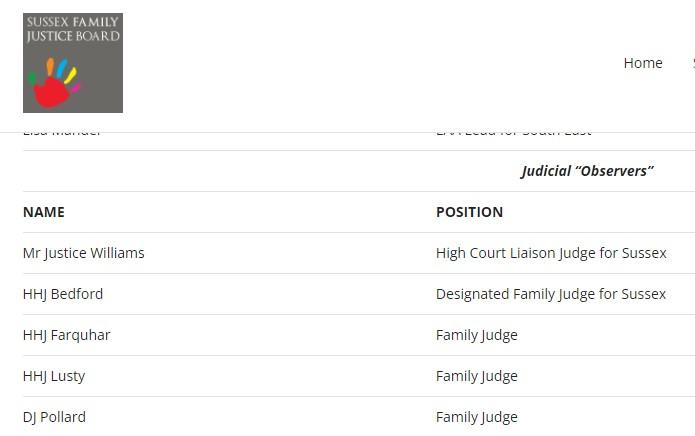
    • Mr Justice Williams – Former Family Division Liaison Judge for the South Eastern Circuit (Kent, Surrey, Sussex & Thames Valley) 
    • HHJ Bedford – Designated Family Judge for Sussex
    • HHJ Farquhar – Lead Judge of the Kent, Surrey & Sussex Financial Remedies Court (FRC)
    • HHJ Lusty – Family Judge
    • DJ Pollard – Family Judge
  • Who are the Sussex Family Justice Board accountable to ?
  • A treasurer is listed as a board member. Where does the money come from and where are the accounts ?
  • Does the Sussex Family Justice Board website comply with UK law ?
  • What is the Cafcass involvement with the Sussex Family Justice Board ?
  • Is “Justice” being done in secret by the Sussex Family Justice Board ?
  • Are there any grounds for suspicion that there has been an improper interference with the course of justice by the Sussex Family Justice Board ? R v Sussex Justices, Ex parte McCarthy [1924] 1 KB 256

There are significant concerns of bias, secrecy and judicial independence, which relate to the operation of the Sussex Family Justice Board.

‘Family justice boards and the like everywhere now panicking as they finally realise what happens on the internet stays on the internet forever!’

Twitter and the Sussex Family Justice Board

Update 21st March 2023 : Sir Andrew McFarlane who is the President of the Family Division [email protected] has been contacted for his response.

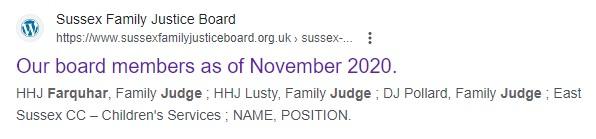
Update 3rd April 2023 : HHJ Farquhar denies he has ever been a member of the Sussex Family Justice Board despite clear evidence that shows he has been a member of the SFJB for at least 5 years.

Update 24th April 2023 : HHJ Farquhar, HHJ Lusty and DJ Pollard have mysteriously vanished from the list of board members published on the Sussex Family Justice Board website.

A large number of pages and links have also been removed from the SFJB website. This is believed to have happened on the 18th April 2023 at 20:37.

Is this a cynical attempt at a cover up ? Who removed them and why ?

Update 5th June 2024 : The Sussex Family Justice Board website is offline. Has this highly dubious family justice cartel in Sussex finally been shut down for good by the Ministry of Injustice ?

Were the Lady Chief Justice, Lord Chancellor or President of the Family Division involved in its demise ? I wonder what the Treasurer did with the money ?

Update 28th June 2024: The Sussex Family Justice Board website is back online.

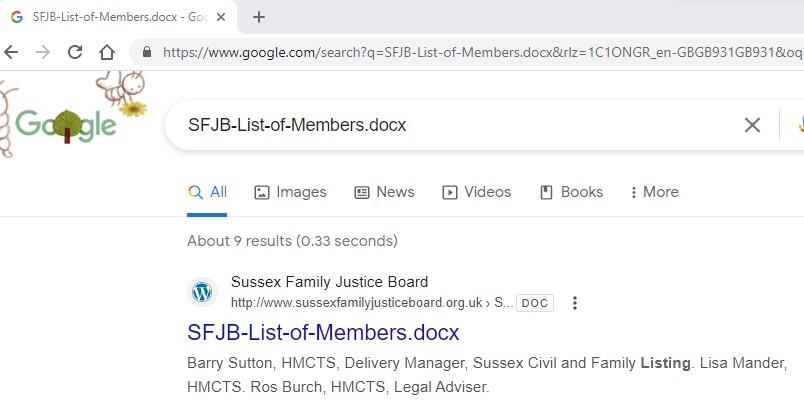
SFJB-List-of-Members.docx dated September 2018 was found in the Google cache and clearly shows that HHJ Bedford, HHJ Farquhar and DJ Pollard were board members.

Update 9th June 2023FOI request sent to Ministry of Justice

Update 18th June 2023 – All Sussex Judges and One High Court Judge have now vanished from the SFJB website.

Update 3rd July 2023 – Complaint filed.

Update 4th July 2023Ministry of Justice response to FOI request about Sussex Family Justice Board

  • The MoJ is not responsible for the Sussex Family Justice Board. 
  • The MoJ does not fund the Sussex Family Justice Board. 
  • The MoJ does not audit the Sussex Family Justice Board. 
  • The MoJ does not have a Terms of Reference document for the Sussex Family 
    Justice Board. 
  • The MoJ are not the correct authority to ask about this matter. Anything published regarding local roles, responsibilities and processes are locally determined and published by the relevant Local Family Justice Board(s). You may wish to contact Sussex Family Justice Board. Information on how to contact them can be found at: https://www.sussexfamilyjusticeboard.org.uk/
  • To advise and assist you, please note that Local Family Justice Boards are not public authorities under the Freedom of Information Act (FOIA). They are not named 
    in schedule 1 of FOIA or in an order of the Secretary of State, and are not a wholly owned company, so do not meet the definition under section 3 of FOIA and thus are not subject to Freedom of Information Requests.   
230609011 – FReedom of Information Request (FOI) Ministry of Justice

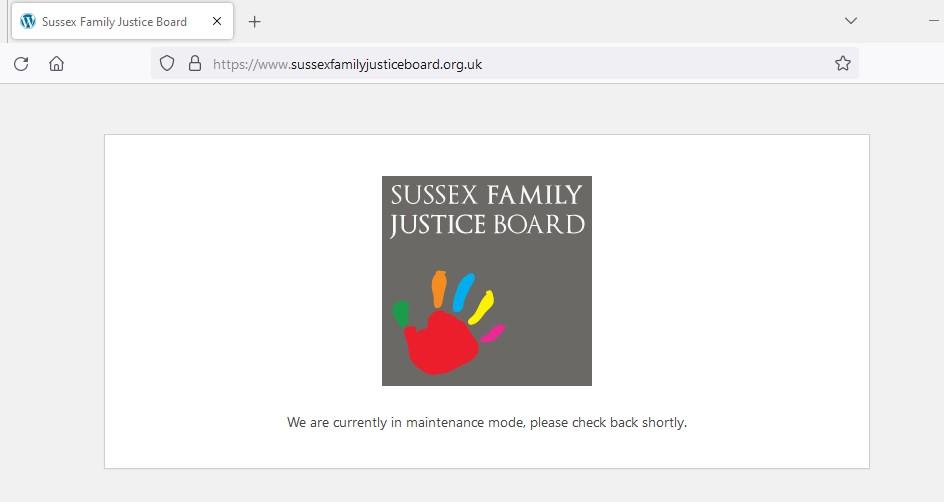
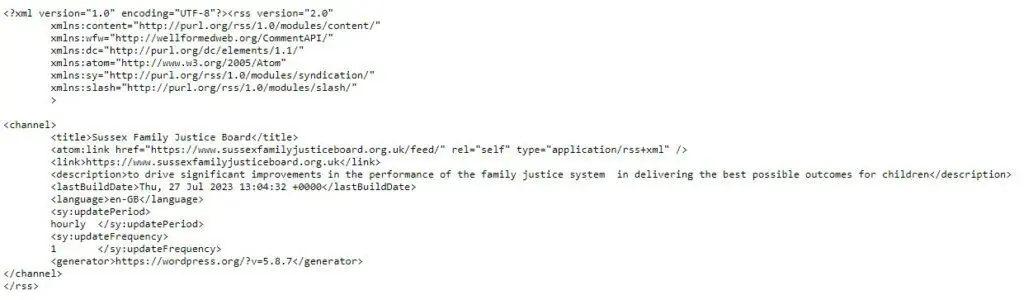
Update 7th August 2023 – The Sussex Family Justice Board website is now in maintenance mode (since 27th July 2023). Has the family justice cartel in Sussex finally been shut down for good ??

Sussex Family Justice Board (SFJB) RSS Feed XML <lastBuildDate>Thu, 27 Jul 2023 13:04:32 +0000</lastBuildDate>

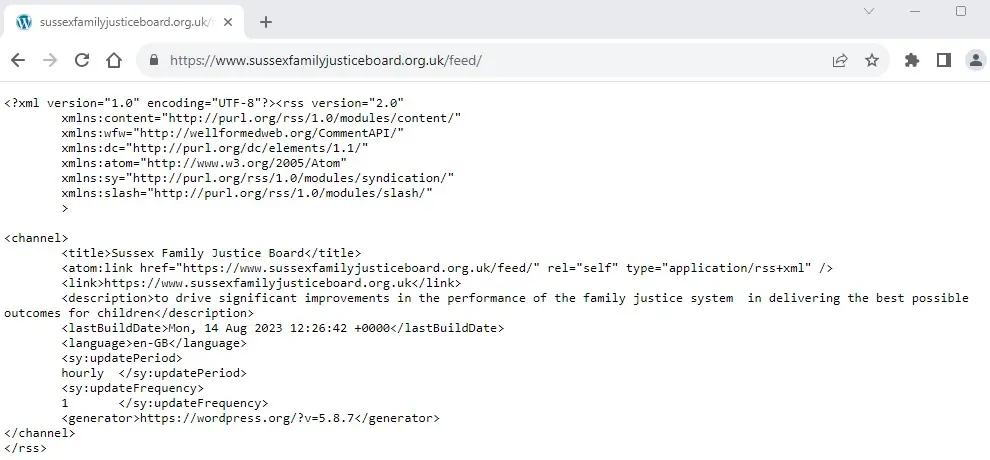
Update 14th August 2023 – The Sussex Family Justice Board website is now partially back up as of 14th August 12:26. There are now 11 pages in total according to the SFJB XML Sitemap. Notably a Privacy policy is still missing !

*PLEASE NOTE THIS WEBSITE IS CURRENTLY UNDERGOING IMPORTANT UPDATES*

The Sussex Family Justice Board is a subsidiary of the National Family Justice Board and works collaboratively to improve the performance and efficiency of the local family justice system.

Please note that this website is up to date as at June 2023; it will be reviewed periodically by members of the Sussex Family Justice Board but we cannot guarantee that it is up-to-date at the time of reading.

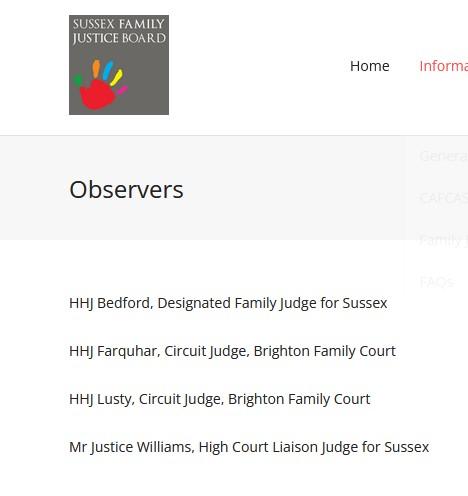
Sussex Family Justice Board 14th August 2023

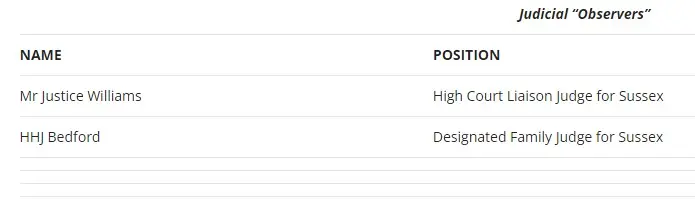
Four Sussex judges are now listed as observers and the board has a number of new members including 1-6 Crown Office Row ! Is HHJ Farquhar aware that he is now an observer ?

Sussex Family Justice Board Observers 14th August 2023
sussex family justce board rss feed 14th august 2023
Sussex Family Justice Board (SFJB) RSS Feed XML Mon, 14 Aug 2023 12:26:42 +0000

The National sponsor of the SFJB is listed as Tom Glynn Policy Unit Ministry of Justice. What is the real involvement of the MoJ in the SFJB ?

Fortunately, a copy of the Sussex Family Justice Board website was legally taken on the 19th March 2023 using HTTrack software and is safely and securely stored by the MOI as evidence.

A Google Search on the 3rd April 2023 returned the following :-

Google Search 3rd April 2023

A Bing Search on the 3rd April 2023 returned the following :-

Bing Search 3rd April 2023

The Sussex Family Justice Board website showed :-

Sussex Family Justice Board Members 3rd April 2023
Sussex Family Justice Board Judicial Board Members 3rd April 2023

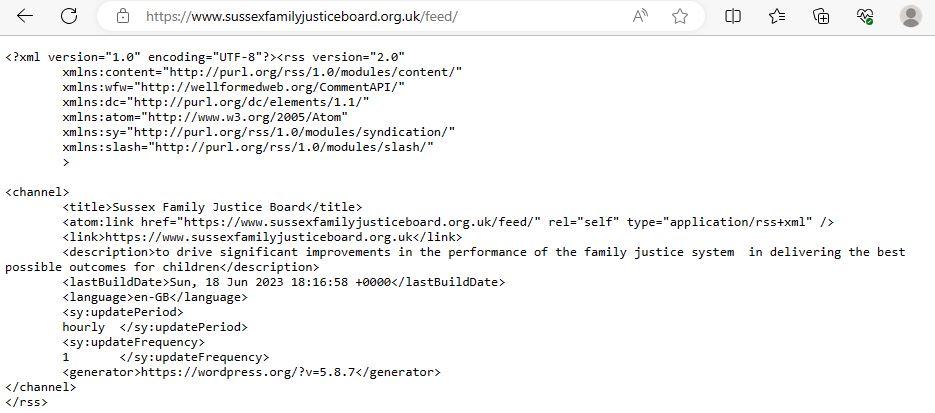
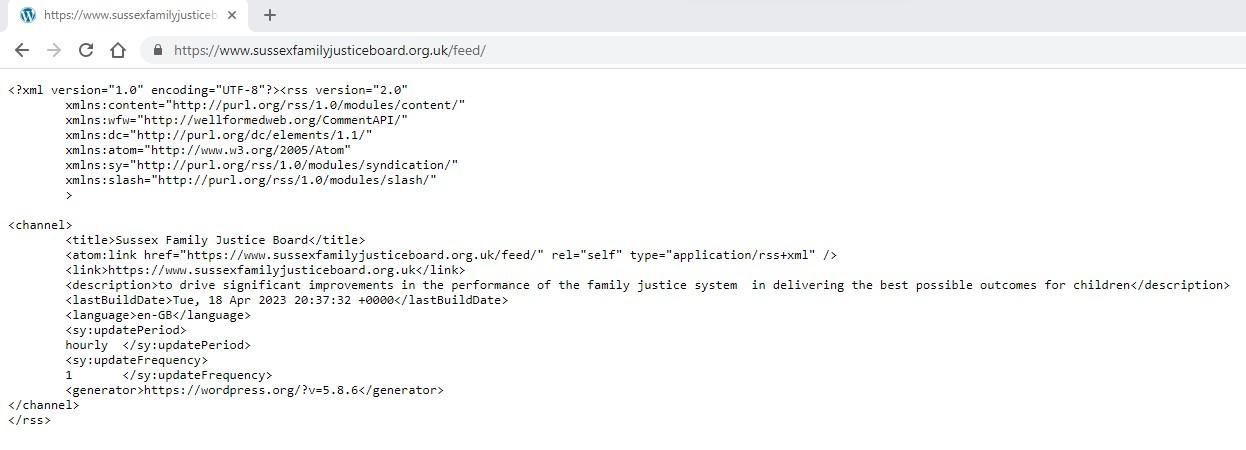
The Sussex Family Justice Board website, according to their public RSS Feed, was updated on the 18th April 2023 at 20:37.

Sussex Family Justice Board (SFJB) RSS Feed XML <lastBuildDate>Tue, 18 Apr 2023 20:37:32 +0000</lastBuildDate>

HHJ Farquhar, HHJ Lusty and DJ Pollard have mysteriously been removed as board members.

Sussex Family Justice Board Judicial Board Members as of 22nd April 2023

The Sussex Family Justice Board website, according to their public RSS Feed, was yet again updated on the 18th June 2023 at 18:16:58. No judges are now listed as board members. It is assumed that all judges were removed as board members on this date.

Is this another cynical attempt at a cover up ? Who removed them and why ?

Sussex Family Justice Board (SFJB) RSS Feed XML <lastBuildDate>Tue, 18 June 2023 18:16:58 +0000</lastBuildDate>
SFJB-List-of-Members.docx dated September 2018

The open justice principle “that justice must be seen to be done as well as done” is a fundamental principle of the UK legal system.

“…there is a significant and important public interest in our society having and maintaining confidence in the work of the Family Court. Conversely, a largely closed system, where the public are given no account of how the court operates, leads to accusations that this is ‘secret’ justice and that the approach of the court is unsound, unfair or downright wrong….”

Sir Andrew McFarlane – President of the Family Division in his document Confidence and Confidentiality: Transparency in the Family Courts published 28th October 2021

The Guide to Judicial Conduct – Revised March 2018 (Updated September 2020) is clear about bias, in particular :-

“They should also bear in mind that too close a social relationship with a practitioner who is regularly involved in litigation before the officeholder’s court may create a perception of bias.”

Contact with the Legal Profession – The Guide to Judicial Conduct

It is extremely perverse and worrying that a board that supposedly promotes justice has a website that does not comply with UK law.

Multiple requests for information using the Sussex Family Justice Board Contact Us page have not resulted in any response.

A Freedom of Information (FOI) Request Information about the Sussex Family Justice Board (LFJB) was therefore made on the 17th March 2023 on WhatDoTheyKnow ?

Dear Sussex Local Family Justice Board,

Do you have a Terms of Reference document for the Sussex Family Justice Board similar to the Family Justice Board?

gov.uk Family Justice Board

Do you publish minutes and if so where ?

How are members of the Sussex Family Justice Board selected or elected ?

How does the Sussex Family Justice Board ensure there is no bias in the selection or election of board members ?

Do you have an updated members list as the list published and dated November 2020 appears out of date ?

Sussex Family Justice Board

Do 1 Crown Office Row (1COR) still sponsor the Sussex Family Justice Board website ?

1COR sponsor Sussex Family Justice Board

Who is legally responsible for the Sussex Family Justice Board website as this does appear to comply with UK law ?

How are the Judicial Observers selected as this appears biased towards the Brighton judiciary ?

How is the Sussex Family Justice Board funded ?

Do the Sussex Family Justice Board publish accounts and if so where ?

Are roles and responsibilities of the board and other policy documents published and if so where ?

Is the Sussex Family Justice Board audited by the Ministry of Justice or any other government or independent bodies ?

Please provide all relevant documents.

Yours faithfully,

Rev Dominic Watts

Ministry of Injustice
https://ministryofinjustice.co.uk

Information about the Sussex Family Justice Board (LFJB)

The Family Justice Board is the primary forum for setting direction for the family justice system and overseeing performance.

“The judge is not a member of the board as to be so would be incompatible with the independent position of the judiciary.”

Judiciary and the local justice system

Check out our articles on Sussex PoliceChief Constable Jo Shiner Sussex Police, HHJ FarquharHHJ Bedford and Fraud in the Justice System.

Read the reviews of Gavin Howe Barrister

“He is awful, underhanded and should not be practising law!”

“Family justice boards” and the like everywhere now panicking as they finally realise what happens on the internet stays on the internet forever!

Twitter
10:39 PM · Mar 18, 2023 14.9K Views
32.6K Views
14.7K Views

Check out our related articles on Rule of Law, Open Justice, Is the Law Black and White ?, Family Justice Board, Civil Justice Council, Youth Justice Board, Abuse of Process, What Does Lady Justice Symbolise ?, McKenzie Friend, Wasted Costs Order, Can a Judge Direct a Jury to Find a Defendant Not Guilty ?, Law Society, Law Commission, McKenzie Friend Right of Audience, Solicitors, Solicitors Regulation Authority, Barristers, Bar Council of England and Wales, Bar Standards Board, Contra Mundum, R v Sussex Justices and Police Impartiality .


The Ministry of Injustice is not the Ministry of Justice nor is it affiliated in any way with the justice system, legal profession, police or any other law enforcement agencies.


Latest Articles


Most Popular


You should always seek formal legal advice from a qualified and reputable lawyer (solicitor or barrister).

There are a number of links to Free and Paid For Legal Resources and Legal Organisations on the Free Legal Advice , Legal Aid and Pro Bono pages.
Categories
Family Law Law

McKenzie Friend

The term McKenzie Friend stems from the landmark case of McKenzie v McKenzie in 1970 (McKenzie v McKenzie [1970] 3 WLR 472 CA), where a husband sought assistance from a non-legally qualified friend to represent him in court during divorce proceedings.

Can a McKenzie Friend Help You in Court? Everything* You Need to Know!Alan Robertshaw Barrister

The Court of Appeal, in their judgment made in 1970, recognised that litigants, especially those without legal representation, could benefit from such support. Consequently, the role of McKenzie Friends was officially acknowledged, allowing individuals to accompany and assist Litigants in Person (LIP) in court.

In 2005 the Court of Appeal, in the matter of the children of Mr O’Connell, Mr Whelan and Mr Watson, further clarified the role of McKenzie friends.

Article 6 of the ECHR is engaged in any application by a litigant in person for the assistance of a McKenzie friend. Furthermore, in our judgment, two clear propositions stand out from the authorities as they apply to family proceedings.

These are:

(1) that the presumption in favour of the litigant being allowed the assistance of a McKenzie friend is a strong one; and

(2) that such a request should not be refused without good reason, even where the proceedings relate to a child and are being heard in private.

[2005] EWCA Civ 759 – LORD JUSTICE THORPE and LORD JUSTICE WALL

Article 6 of the Human Rights Act 1998 makes it unlawful for a public authority to act in a way that is incompatible with a person’s rights under the European Convention on Human Rights.

Role and Responsibilities of McKenzie Friends

McKenzie Friends are volunteers, friends, family members, or sometimes paid advisors, who assist litigants in various ways. They are not lawyers, but their involvement can be valuable.

A McKenzie Friend can help litigants by providing emotional support, taking notes during proceedings, offering practical advice, and helping with case preparation.

However, it is essential to note that McKenzie Friends cannot address the court directly or act as legal representatives.

Practice Guidance: McKenzie Friends (Civil and Family Courts)

In July 2010, the role of McKenzie Friends was formalised through the issuance of Practice Guidance by the then Master of the Rolls and the President of the Family Division.

The guidance aims to ensure a consistent and fair approach across the civil and family courts when dealing with McKenzie Friends. This Practice Guidance is essential in establishing the parameters and responsibilities of McKenzie Friends in court proceedings.

Guidance from the President’s Office- McKenzie Friends

A guidance document was published by the then President of the Family Division in 2005.

The Courts and Tribunal Judiciary list both guidance documents on their McKenzie Friend webpage.

Reforming the courts’ approach to McKenzie Friends

A consultation paper entitled Reforming the courts’ approach to McKenzie Friends was published by the Lord Chief Justice in February 2016.

A Consultation Response Reforming the courts’ approach to McKenzie Friends was published by the Lord Chief Justice in February 2019

Notice of McKenzie Friend

Here is a an example Notice of McKenzie friend which should be completed and handed to the usher before the hearing starts. If you are attending a remote hearing, then you should email the court before the start of the hearing.

There is no legal requirement to share this form with the other party (Family or Civil Proceedings).

(2) Paragraph (1) applies to any communication in which any representation is made to the court on a matter of substance or procedure but does not apply to communications that are purely routine, uncontentious and administrative.

FAMILY PROCEDURE RULE 5.7 – PART 5: FORMS, START OF PROCEEDINGS AND COMMUNICATION WITH THE COURT

This practice direction supplements Part 5 of the Family Procedure Rules 2010

1. Rule 5.7(1) FPR 2010 makes provision in relation to the requirement to disclose and, if in writing, to copy any communication with the court to the other parties or their representatives. Exceptions to the requirement are specified in rule 5.7(2), (3) and (7) FPR 2010. This practice direction supplements rule 5.7(7) FPR 2010.

FAMILY PRACTICE DIRECTION 5C – COMMUNICATIONS WITH THE COURT

Court Refusal of the Request for Assistance from a McKenzie Friend

The purpose of allowing a litigant in person the assistance of a McKenzie friend is to further the interests of justice by achieving a level playing field and ensuring a fair hearing.

We endorse the proposition that the presumption in favour of allowing a litigant in person the assistance of a McKenzie friend is very strong, and that such a request should only be refused for compelling reasons.

Furthermore, should a judge identify such reasons, (s)he must explain them carefully and fully to both the litigant in person and the would-be McKenzie friend.

[2005] EWCA Civ 759 – LORD JUSTICE THORPE and LORD JUSTICE WALL

Check out our related articles on Rule of Law, Open Justice, Is the Law Black and White ?, What Does Lady Justice Symbolise ?, McKenzie Friends Rights of Audience, Can a Judge Direct a Jury to Find a Defendant Not Guilty ?, Law Society, Law Commission, Solicitors, Solicitors Regulation Authority, Barristers, Bar Council of England and Wales, Bar Standards Board, Contra Mundum, R v Sussex Justices, Police Impartiality and the highly questionable Sussex Family Justice Board.


The Ministry of Injustice is not the Ministry of Justice nor is it affiliated in any way with the justice system, legal profession, police or any other law enforcement agencies.


Latest Articles


Most Popular


You should always seek formal legal advice from a qualified and reputable lawyer (solicitor or barrister).

There are a number of links to Free and Paid For Legal Resources and Legal Organisations on the Free Legal Advice , Legal Aid and Pro Bono pages.
Categories
Family Law

What is the Family Court ?

The Family Court and Family Justice System in England and Wales is responsible for resolving a wide range of family disputes and providing solutions to the most complex and sensitive issues that can arise between family members. The system is designed to protect the welfare of children and provide a fair and just resolution for all parties involved.

What is the Family Court and Family Justice System?

The Family Court is a division of the court system in England and Wales that deals exclusively with family law matters. It has jurisdiction over a wide range of cases, including divorce, child custody, adoption, domestic violence, and child protection.

The Family Justice System is a broader term that refers to the entire network of agencies and professionals involved in resolving family disputes, including the Family Court, social services, mediation services, and the Children and Family Court Advisory and Support Service (CAFCASS).

When and how was the Family Court founded?

The Family Court was created in 2014 as part of a major overhaul of the family justice system in England and Wales as a result of the Children and Families Act 2014.

The aim of the reform was to consolidate the existing family courts, which were previously known as the Family Proceedings Court, County Court, and High Court, into a single unified court. The new court would handle all family law cases and provide a simpler, more streamlined process for families in crisis.

The creation of the Family Court brought all family law cases under one roof, and provided a consistent and specialist approach to resolving family disputes. The court is led by a designated family judge, who has expertise in family law and is responsible for overseeing all family cases in the court.

By what authority do the Family Court exist ?

The Family Court is a statutory court, meaning it has been established by an Act of Parliament. The court is governed by the Family Procedure Rules, which set out the procedures and rules that must be followed in family law cases.

The Family Justice System operates under a range of legislation, including the Children Act 1989, the Children and Families Act 2014, the Family Law Act 1996, and the Matrimonial Causes Act 1973.

What are Family Judges ?

“When disputes need to be decided by the Family Court, depending on the type of case, they are dealt with by either Family Panel Lay Magistrates or District Judge (Magistrates’ court) or by a District, Circuit or High Court Judge.

Family magistrates and Family judges are specially trained by the Judicial College to deal with issues affecting families, including training on domestic abuse and coercive and controlling behaviour. They receive regular updating training to ensure their expertise in family law remains up to date.”

Family Judges Courts and Tribunals Judiciary

What is the Family Court process?

The Family Court process can vary depending on the type of case being heard, but generally involves the following stages:

  1. Pre-proceedings: This is where social services become involved in a family’s life due to concerns about the welfare of a child. At this stage, efforts are made to address the issues and prevent the need for court proceedings.
  2. Mediation: Mediation is often recommended as a way to resolve family disputes without the need for court proceedings. This involves a neutral third party who helps the parties to reach an agreement.
  3. Application: If mediation is unsuccessful or not appropriate, one or both parties may apply to the court for an order. This involves completing an application form and paying a fee.
  4. First hearing: The first hearing is an opportunity for the court to consider the issues and decide what further steps are necessary. This may include the appointment of a CAFCASS officer, who will carry out an assessment of the child’s welfare.
  5. Further hearings: Depending on the nature of the case, there may be further hearings to consider evidence and make decisions. This may involve the appointment of expert witnesses, such as psychologists or social workers.
  6. Final hearing: The final hearing is where the court makes a final decision about the case. This may involve the making of a court order, which sets out what should happen next.

The family justice system exists to help families resolve disputes arising in respect of family matters quickly and with the minimum of disruption to those involved.

Courts and Tribunals Judiciary Family Law Courts

Who are CAFCASS ?

The Children and Family Court Advisory and Support Service CAFCASS is an independent organization that provides advice to the family court on matters relating to children and families. Its role is to ensure that the best interests of the child are taken into account when decisions are being made by the court. CAFCASS officers work with families to gather information about the child’s circumstances and make recommendations to the court on issues such as custody and access.

CAFCASS officers may also be asked to prepare a report for the court, known as a Section 7 report. This report provides the court with an assessment of the child’s needs and the factors that should be taken into account when making decisions about custody and access.

Family Law Legislation

There have been a number of key pieces of legislation that have shaped the family justice system in England and Wales. These include:

  • The Children Act 1989: This act sets out the legal framework for the protection and welfare of children in England and Wales. It established the principle that the best interests of the child should be the primary consideration in all decisions made by the court.
  • The Family Law Act 1996: This act introduced significant changes to the family justice system, including the establishment of the family court and the introduction of new measures to promote non-court-based dispute resolution such as mediation.
  • The Adoption and Children Act 2002: This act introduced significant changes to adoption law in England and Wales, including the creation of the Adoption and Children Act Register and new provisions for step-parent adoption.
  • The Children and Families Act 2014: This act introduced a range of reforms to the family justice system, including changes to the law on child arrangements, the introduction of a 26-week time limit for care proceedings, and the requirement for separating parents to attend mediation before making an application to the court.

Family Solicitors and Family Barristers

A family solicitor is a qualified legal practitioner in family law responsible for preparing legal documentation, representing and/or defending a client’s legal interests.

Family barristers are qualified legal professionals in family law who specialise in advocacy and litigation.

The family court and family justice system in England and Wales play a vital role in resolving disputes between family members and promoting the best interests of children.

While the process can be complex and stressful, the system is designed to be child-focused and to provide a fair and impartial process for all parties involved.

The key legislation that governs the family justice


The Ministry of Injustice is not the Ministry of Justice nor is it affiliated in any way with the justice system, legal profession, police or any other law enforcement agencies.


Latest Articles


Most Popular


You should always seek formal legal advice from a qualified and reputable lawyer (solicitor or barrister).

There are a number of links to Free and Paid For Legal Resources and Legal Organisations on the Free Legal Advice , Legal Aid and Pro Bono pages.
Categories
Family Law Law

Mediation and Dispute Resolution

Family law is an area of law that deals with legal issues arising from family relationships, such as divorce, child custody, child support, adoption, and other matters related to family dynamics.

In the UK, mediation is an alternative dispute resolution (ADR) process that can be used in family law cases to resolve disputes outside of court. In this article, we will explore the benefits and disadvantages of mediating family law disputes in the UK and how ADR fits into the UK legal system.

Mediation is a form of dispute resolution where parties to a dispute work with a neutral third party, called a mediator, to reach a mutually acceptable agreement. The process is voluntary, confidential, and flexible. Parties can agree on any solution that works for them, and the mediator helps them to craft an agreement that meets their needs and interests.

Mediators are not all regulated and their activities are not controlled in any way. Anyone can call themselves a mediator although some mediators do have professional qualifications.

The Law Society Family Mediation Accreditation is a recognised quality standard for practitioners who carry out mediation.

The Law Society is a member organisation of the Family Mediation Council (FMC)

One of the benefits of mediation in family law disputes in the UK is that it can be less expensive than going to court. Litigation can be costly, with legal fees, court costs, and other expenses adding up quickly. Mediation can often be completed in a few sessions, which can save parties time and money.

Another benefit of mediation is that it can be less adversarial than going to court. Family law disputes can be emotionally charged, and litigation can exacerbate tensions between parties. Mediation provides a safe and structured environment for parties to express their concerns and work towards a resolution. The mediator can help to defuse conflicts and keep the conversation focused on problem-solving.

Mediation can also be less time-consuming than going to court in the UK. Litigation can take months or even years to resolve, depending on the complexity of the case and the court’s schedule. Mediation can often be completed in a few sessions, which can be scheduled at times that are convenient for the parties.

Mediation can be less formal than going to court. In court, parties must follow strict rules of procedure and evidence. Mediation allows parties to have more control over the process and to craft a solution that works for them. Parties can be creative in their solutions and are not bound by legal precedent or strict rules of evidence.

Mediation can also be a more private and confidential process than going to court. Court proceedings are open to the public, and court records can be accessed by anyone. Mediation is a confidential process, and the mediator cannot disclose what is said in the sessions without the parties’ consent.

Despite these benefits, there are also some disadvantages to mediating family law disputes in the UK.

One disadvantage is that the mediator cannot impose a decision on the parties. Unlike a judge, the mediator does not have the power to make a ruling that is legally binding. If parties cannot reach an agreement in mediation, they may still need to go to court to resolve their dispute.

Another disadvantage of mediation in the UK is that parties may not have access to legal advice during the process. While parties can consult with attorneys outside of the mediation sessions, they may not have their attorney present during the mediation itself. This can put parties at a disadvantage if they are not familiar with the law or the UK legal system.

Mediation also requires a certain level of cooperation between the parties. If one party is unwilling to participate in mediation or is uncooperative during the process, mediation may not be successful. In such cases, parties may need to resort to litigation to resolve their dispute.

In addition to traditional mediation, there are several other types of alternative dispute resolution (ADR) that can be used in UK law disputes. These include arbitration, collaborative law, and negotiation.

Arbitration is a process where parties to a dispute present their case to a neutral third party, called an arbitrator, who makes a legally binding decision. Like mediation, arbitration can be less expensive and less formal than going to court. However, the arbitrator’s decision is final and legally binding, which means parties may lose their right to appeal or challenge the decision.

Collaborative law is a process where parties work together with their lawyers and other professionals, such as financial advisors or mental health professionals, to reach a mutually acceptable agreement. This process is often used in divorce cases in the UK and can be less adversarial than going to court. However, like mediation, collaborative law requires a certain level of cooperation between the parties.

Negotiation is a process where parties to a dispute work together to reach an agreement without the involvement of a neutral third party. This can be done through informal discussions or formal negotiations. Negotiation can be less expensive and less formal than going to court, but it also requires a certain level of cooperation between the parties.

In the UK, ADR is encouraged by the courts and is often used as a first step in resolving disputes. The Family Procedure Rules 2010 and various amendments require parties to attend a Mediation Information and Assessment Meeting (MIAM) before they can apply to the court for certain types of family law disputes.

The following Family Rules and Practice Directions apply :-

Family Procedure Rules PART 3 – NON-COURT DISPUTE RESOLUTION

Family Practice Direction PRACTICE DIRECTION 3A – FAMILY MEDIATION INFORMATION AND ASSESSMENT MEETINGS (MIAMS)

The purpose of the MIAM is to inform parties about the benefits of mediation and other forms of ADR and to assess whether mediation or another form of ADR is appropriate for the case.

If parties do not reach an agreement through mediation or other forms of ADR, they may still need to go to court to resolve their dispute. However, even if the case goes to court, parties may be required to attempt mediation or other forms of ADR before the court will hear their case. This is known as “compulsory ADR” and is intended to encourage parties to resolve their dispute without the need for court intervention.

Mediation and other forms of ADR are not just limited to family law disputes in the UK. They can also be used to resolve disputes in other areas of law, such as civil law.

Civil law disputes can include a wide range of issues, such as breach of contract, negligence, property disputes, and employment disputes. Mediation and other forms of ADR can be used to resolve these disputes, as well as family law disputes.

Civil Procedure Rules and Practice Directions

In civil law disputes, parties may choose to use mediation as a way to resolve their dispute before going to court. This can be a less expensive, less formal, and less time-consuming option than going to court. Mediation can also allow parties to maintain a more amicable relationship, which can be important in business or employment disputes where ongoing relationships may be necessary.

Other forms of ADR, such as arbitration and negotiation, can also be used in civil law disputes. Arbitration can be a more formal and legally binding alternative to mediation, but it can also be less expensive and less time-consuming than going to court. Negotiation, like in family law disputes, involves parties working together to reach a mutually acceptable agreement without the involvement of a neutral third party.

The UK legal system encourages the use of ADR in civil law disputes as well. The Civil Procedure Rules 1998 require parties to consider ADR before going to court. This means that parties must show that they have considered ADR, such as mediation or arbitration, before going to court.

If parties do not reach an agreement through ADR, they may still need to go to court to resolve their dispute. However, even if the case goes to court, parties may be required to attempt mediation or other forms of ADR before the court will hear their case. This is intended to encourage parties to resolve their dispute without the need for court intervention, which can be a more costly and time-consuming option.

However, mediation requires a certain level of cooperation between the parties, and the mediator cannot impose a legally binding decision on the parties. Other forms of ADR, such as arbitration, collaborative law, and negotiation, may also be used to resolve family law and civil law disputes.

The UK legal system rightly encourages the use of ADR and may require parties to attempt mediation or other forms of ADR before going to court.

In conclusion, mediation and other forms of ADR can be effective tools for resolving family law and civil law disputes in the UK. Mediation can be less expensive, less adversarial, less time-consuming, less formal, and more private than going to court.


The Ministry of Injustice is not the Ministry of Justice nor is it affiliated in any way with the justice system, legal profession, police or any other law enforcement agencies.


Latest Articles


Most Popular


You should always seek formal legal advice from a qualified and reputable lawyer (solicitor or barrister).

There are a number of links to Free and Paid For Legal Resources and Legal Organisations on the Free Legal Advice , Legal Aid and Pro Bono pages.
Categories
Criminal Justice Family Law Law

Legal Aid

Legal aid is a government-funded program that provides financial assistance to individuals who cannot afford legal representation in court. In the United Kingdom, legal aid is administered by the Legal Aid Agency, which is an executive agency of the Ministry of Justice.

Legal aid in the UK is available for both criminal and civil cases. Criminal legal aid is available for individuals who are facing criminal charges and cannot afford to pay for legal representation. Civil legal aid is available for a wide range of cases, including family law, housing, immigration, and employment law.

In order to be eligible for legal aid, an individual must meet certain criteria.

You could for example get legal aid if:

  • you or your family are at risk of abuse or serious harm, for example domestic violence or forced marriage
  • you’re at risk of homelessness or losing your home
  • you’ve been accused of a crime, face prison or detention
  • you’re being discriminated against
  • you need family mediation
  • you’re adding legal arguments or bringing a case under the Human Rights Act

If you qualify for legal aid and your problem is covered by it, you could get:

  • advice on your rights and options
  • help with negotiations and paperwork
  • help if you’re accused of a crime, for example advice at a police station
  • a solicitor or barrister to get your case ready and speak on your behalf in court and some tribunals

You might be able to get legal aid for problems like:

  • homelessness or losing your home, or if it’s in serious disrepair
  • protecting yourself or your child from abuse or harassment, for example domestic violence or forced marriage
  • poor quality care you or a family member are getting due to age, disability or special educational needs
  • needing advice on finances, children or divorce if you’ve been in an abusive relationship
  • a child in your family being at risk of being taken into care
  • family mediation, for example if you’re separating or getting a divorce
  • discrimination
  • challenging the way the government has made a decision about you
  • seeking asylum or if you’ve been the victim of human trafficking
  • being arrested, charged or questioned by the police
  • needing advice if a family member’s death is going to a coroner’s inquest
  • appealing a decision made by the social security tribunal about your benefits to the Upper Tribunal, Court of Appeal or Supreme Court

How to claim

Check if you can get legal aid in England or Wales.

Search for a legal aid solicitor if you’re in Scotland or Northern Ireland.

Your legal adviser or family mediator will apply for legal aid on your behalf. If you qualify, the government will pay their costs directly.

Once an individual has been granted legal aid, they will be assigned a solicitor who will represent them in court. The solicitor will be responsible for preparing their case, representing them in court, and negotiating settlements or plea bargains on their behalf.

However, it is worth noting that the availability of legal aid in the UK has been significantly reduced in recent years due to funding cuts. This means that many individuals who would have previously been eligible for legal aid may no longer be able to access it. In addition, the scope of civil legal aid has been narrowed, with many areas of law no longer covered by the program.

Despite these challenges, legal aid remains an important tool for ensuring that everyone has access to justice, regardless of their financial circumstances. It provides crucial support for those who cannot afford legal representation, and helps to ensure that the justice system is fair and equitable for all.

Check out our related articles on Rule of Law, Open Justice, What is Law, Is the Law Black and White ?, Branches of Law, Bullying, Harassment and Discrimination at the Bar, The Secret Barrister, Barristers, Direct Access Barrister, Barristers Behaving Badly, Inns of Court, Council of the Inns of Court, Bar Standards Board, Bar Tribunal and Adjudication Services, Bar Council, Innocent until Proven Guilty and the highly questionable Sussex Family Justice Board.


The Ministry of Injustice is not the Ministry of Justice nor is it affiliated in any way with the justice system, legal profession, police or any other law enforcement agencies.


Latest Articles


Most Popular


You should always seek formal legal advice from a qualified and reputable lawyer (solicitor or barrister).

There are a number of links to Free and Paid For Legal Resources and Legal Organisations on the Free Legal Advice , Legal Aid and Pro Bono pages.

Categories
Family Law Legal Professionals

Family Barristers

Family law is the branch of law that deals with family-related issues, such as divorce, child custody, and adoption. Family Barristers who specialise in family law are often called upon to provide sensitive and compassionate advice and representation to clients who are going through difficult personal situations.

In family law cases, family barristers are typically instructed by solicitors on behalf of their clients. The solicitor will handle the administration of the case and prepare the necessary legal documents, while the barrister will provide expert advice and representation in court proceedings.

Family Barristers must have a deep understanding of the complex emotional and legal issues that arise in family disputes. They must also have excellent advocacy skills, as they will be required to present complex legal arguments to judges and juries in court while being sensitive to the emotional needs of their clients.

You can find a family barrister using The Bar Council Find a Barrister website which will help you to find a barrister to represent you, either through a solicitor or through the direct access scheme.

Barristers are legal professionals who specialise in advocacy and litigation. They play a vital role in the legal system, representing clients in court and providing legal advice. Barristers can be classified into two types: direct access barristers and traditional barristers.

Most barristers are self-employed, individual practitioners who may work as a solo practitioner or, more commonly, in groups of offices known as barristers chambers.

In England, “called to the bar” is a term used to describe the formal admission of a person to practice as a barrister in the courts of England and Wales. It is a ceremony where a person who has completed the necessary education and training, which typically includes obtaining a qualifying law degree, completing the Bar Professional Training Course (BPTC), and undertaking a period of pupillage, is officially recognized as a barrister and granted the right to practice in the courts.

The ceremony involves the person being called to the bar by the Inn of Court to which they belong, which is one of the four professional associations for barristers in England and Wales. During the ceremony, the person will typically make a declaration of allegiance and professionalism, and they will then sign the roll of barristers. After being called to the bar, the person can then appear in court and provide legal representation to clients.

The Inns of Court in London are the professional associations for barristers in England and Wales. There are four Inns of Court – Gray’s Inn, Lincoln’s Inn, Inner Temple and Middle Temple.

A limited number of senior barristers receive ‘silk’ – becoming King’s Counsel (KC) – as a mark of outstanding ability. They are normally instructed in very serious or complex cases. Most senior judges once practised as KCs

The Bar Council which is the independent, practising Bar of England and Wales is more than 16,500 strong and plays a crucial role in upholding the principles of government accountability under law and vindication of legal rights through the courts.

The Bar Standards Board (BSB) regulates barristers and specialised legal services businesses in England and Wales in the public interest.

The BSB Handbook 4.8 contains the rules about how barristers must behave and work. It also contains the Code of Conduct for barristers.

Reporting a Concern about a Barrister such as Gavin Howe of the Sussex Barristers Chambers known as 1 Crown Office Row (1COR) is straightforward at the Bar Standards Board website using the Online Reporting Form.

You can also report your concern about a barrister by using the Word version of the form and then sending it by email to [email protected] or by post to: The Bar Standards Board, 289-293 High Holborn, London, WC1V 7HZ.

Many family law barristers are members of the Family Law Bar Association (FLBA) which is the specialist Bar Association for family barristers and has over 1700 members.

The Criminal Bar Association (CBA) exists to represent the views and interests of approximately 2,400 specialist criminal barristers in England & Wales.

The London Common Law & Commercial Bar Association (LCLCBA) has approximately 1500 members and is open to any member of the Bar of England & Wales whose practice is predominantly civil law within the High Court, including the Commercial Court, the County Court and/or tribunals in and around London.

The Chancery Bar Association (ChBA) has over 1300 members who practise Chancery law.

The Fraud Lawyers Association (FLA) was established in 2012. Its members are drawn from leading firms and chambers.

The FLA aims to provide a forum to represent experienced lawyers (solicitors, barristers, and legal executives) practising in the areas of civil and criminal fraud. 

Barristers

Traditional barristers are barristers who work through solicitors. They are instructed by solicitors on behalf of clients and provide legal advice, prepare legal documents and represent clients in court proceedings. Traditional barristers are experts in their field and are often called upon to provide specialist advice and representation in complex and high-profile cases.

To become a traditional barrister, individuals must complete the necessary education and training. This includes obtaining a qualifying law degree or a degree in another subject followed by a one-year conversion course. After completing their degree, they must undertake the Bar Professional Training Course (BPTC) and complete a one-year pupillage with a senior barrister. After completing pupillage, they can apply for tenancy and become a self-employed barrister.

Traditional barristers have a close working relationship with solicitors, who instruct them on behalf of clients. Solicitors handle the administration of cases and the preparation of legal documents, while barristers provide advice and representation in court proceedings. This division of labour allows barristers to specialise in advocacy and litigation, while solicitors specialise in legal research and document preparation.

Direct Access Barristers

Direct access barristers are barristers who can be instructed directly by members of the public without the need for a solicitor. This means that clients can contact a direct access barrister directly and receive legal advice and representation without going through a solicitor. Direct access barristers have undergone the same training and qualification process as traditional barristers, but they have also completed additional training to enable them to work directly with clients.

Direct access barristers are useful for clients who have a good understanding of their legal case and who can manage some aspects of their case themselves. Clients can choose to instruct a direct access barrister for a particular aspect of their case or for the entire case, depending on their needs and budget. However, direct access barristers are not suitable for all cases, particularly those that are complex or involve a significant amount of legal work.

The use of direct access barristers has become increasingly popular in recent years, as it offers clients greater flexibility and cost-effectiveness. Clients can choose to instruct a direct access barrister for a particular aspect of their case or for the entire case, depending on their needs and budget. This can result in significant cost savings for clients, as they do not need to pay for the services of a solicitor in addition to a barrister.

However, there are some limitations to the use of direct access barristers. Direct access barristers are not suitable for all cases, particularly those that are complex or involve a significant amount of legal work. Clients who are not familiar with the legal system may also find it difficult to navigate the process of instructing a direct access barrister and may benefit from the assistance of a solicitor.

Barristers Summary

In summary, both traditional and direct access barristers play important roles in the legal system in the UK. Traditional barristers work closely with solicitors to provide clients with high-quality legal advice and representation, while direct access barristers offer clients greater flexibility and cost-effectiveness by allowing them to instruct a barrister directly without the need for a solicitor.

Types of Law covered by Barristers

Civil Law

Civil law is the branch of law that deals with disputes between individuals or organisations, such as contract disputes, property disputes, and personal injury claims. Barristers who specialise in civil law are often called upon to provide expert advice and representation in complex and high-value cases.

In civil law cases, barristers are typically instructed by solicitors on behalf of their clients. The solicitor will handle the administration of the case and prepare the necessary legal documents, while the barrister will provide expert advice and representation in court proceedings.

Barristers who specialise in civil law must have a deep understanding of the legal principles and rules that govern civil disputes. They must also have excellent advocacy skills, as they will be required to present complex legal arguments to judges and juries in court.

Criminal Law

Criminal law is the branch of law that deals with offences against the state or society, such as theft, assault, and murder. Barristers who specialise in criminal law are often called upon to provide expert advice and representation in complex and high-profile criminal cases.

In criminal law cases, barristers are typically instructed by solicitors on behalf of their clients. The solicitor will handle the administration of the case and prepare the necessary legal documents, while the barrister will provide expert advice and representation in court proceedings.

Barristers who specialise in criminal law must have a deep understanding of the legal principles and rules that govern criminal offences. They must also have excellent advocacy skills, as they will be required to present complex legal arguments to judges and juries in court.

Check out our articles on Barristers, Direct Access BarristersFour Inns of CourtBar Standards BoardBar Standards Board Justice ?SolicitorsRule of Law and the highly questionable Sussex Family Justice Board.


The Ministry of Injustice is not the Ministry of Justice nor is it affiliated in any way with the justice system, legal profession, police or any other law enforcement agencies.


Latest Articles


Most Popular


You should always seek formal legal advice from a qualified and reputable lawyer (solicitor or barrister).

There are a number of links to Free and Paid For Legal Resources and Legal Organisations on the Free Legal Advice , Legal Aid and Pro Bono pages.
Categories
Family Law Law Legal Professionals

Family Solicitors

Family solicitors in England and Wales are legal professionals who specialise in providing legal advice and representation in matters relating to family law.

These family solicitors are experts in dealing with complex family law issues and provide support to individuals and families who are going through a difficult time in their lives.

Family law solicitors can assist with a range of family law issues, including divorce, separation, child custody, adoption, and domestic violence. They provide legal advice and guidance on the legal process involved in these matters and represent clients in court hearings and negotiations.

One of the primary roles of family law solicitors is to help individuals and families navigate the legal system during a difficult time in their lives. This can include helping clients understand their legal rights and obligations, explaining the legal process and options available, and providing emotional support throughout the legal process.

In cases of divorce and separation, family solicitors can help clients understand their options for resolving disputes and reaching a fair settlement. This can involve negotiating a settlement with the other party, or representing clients in court hearings if necessary. Solicitors can also assist with issues related to child custody and access, such as helping clients understand their rights as parents and advocating for their interests in court.

In cases of adoption, family law solicitors can assist with the legal process of adopting a child. This can include providing legal advice on the adoption process, preparing adoption paperwork, and representing clients in court hearings.

Domestic violence is another area where family solicitors can provide legal support. They can assist victims of domestic violence in obtaining restraining orders and providing legal advice on how to protect themselves and their children. They can also represent clients in court hearings related to domestic violence.

Family law solicitors can also provide legal support to same-sex couples and families. They can assist with issues related to civil partnerships, same-sex marriage, and adoption by same-sex couples.

In England and Wales, family solicitors are regulated by the Solicitors Regulation Authority (SRA), which ensures that they meet certain professional standards and ethical guidelines. The SRA also provides a complaints procedure for clients who are dissatisfied with the services provided by their solicitor.

If you are considering hiring a family law solicitor in England or Wales, it is important to choose a solicitor who has experience in dealing with your specific issue. You may also want to consider factors such as the solicitor’s reputation, availability, and fees.

Choosing the right family law solicitor is crucial to ensuring that you receive the best possible legal representation and outcome for your case.

Here are some tips on how to avoid a bad family solicitor:

  1. Do your research: Take the time to research family law solicitors in your area before making a decision. Look for solicitors who specialize in the area of family law that your case relates to, and read reviews and testimonials from previous clients.
  2. Check qualifications: Check that the solicitor you are considering is qualified and licensed to practice law in England and Wales. You can check the Solicitors Regulation Authority (SRA) website to confirm their credentials.
  3. Ask for referrals: Ask friends, family, and colleagues if they have any recommendations for family law solicitors they have used and had a positive experience with.
  4. Meet with the solicitor: Arrange a consultation with the solicitor to discuss your case and gauge whether you feel comfortable working with them. Ask them about their experience, approach to your case, and their fees.
  5. Look for red flags: Be wary of solicitors who promise guaranteed outcomes or unrealistic results, or who pressure you into making decisions quickly. Also, be cautious of solicitors who don’t listen to your concerns or who don’t communicate clearly and effectively.
  6. Consider their availability: Check whether the solicitor you are considering is available to take on your case and whether they have the resources to provide the level of support you require.
  7. Check their fees: Ensure that you understand the solicitor’s fees and how they will be charged. Be wary of solicitors who offer extremely low fees, as this may indicate that they are inexperienced or may not provide high-quality representation.

By following these tips, you can help avoid a bad family law solicitor and ensure that you choose a solicitor who will provide you with the support and guidance you need during a difficult time.

Remember that it’s essential to choose a solicitor who you feel comfortable working with and who you trust to represent your best interests.

In conclusion, family law solicitors in England and Wales provide vital legal support to individuals and families who are going through a difficult time. They can assist with a range of family issues, including divorce, separation, child custody, adoption, and domestic violence.

By providing legal advice and representation, family solicitors can help clients navigate the legal system and reach a fair and equitable outcome.

You can find a family solicitor using The Law Society Find A Solicitor free service.


The Ministry of Injustice is not the Ministry of Justice nor is it affiliated in any way with the justice system, legal profession, police or any other law enforcement agencies.


Latest Articles


Most Popular


You should always seek formal legal advice from a qualified and reputable lawyer (solicitor or barrister).

There are a number of links to Free and Paid For Legal Resources and Legal Organisations on the Free Legal Advice , Legal Aid and Pro Bono pages.
Categories
Family Law Law

What is Family Law ?

Family law is a branch of law that deals with domestic relationships, including marriage, civil partnerships, divorce, adoption, and child custody. Family law is essential in protecting the rights of family members and ensuring that their welfare is taken care of.

The four most significant statutes that govern family law in the United Kingdom are the Family Law Act 1996 , Children Act 1989 , Matrimonial Causes Act 1973 and Divorce, Dissolution and Separation Act 2020. This article will explore these acts in detail, their importance in family law, and their impact on society.

‘The family court system in the United Kingdom, hidden behind the protective cloak of anonymity is the most pernicious and unaccountable legal entity in the west.’

Family Court System – Laurence Fox

The Family Law Act 1996 is an Act of Parliament in the United Kingdom that outlines the legal framework for family matters such as divorce, domestic violence, and child custody. The Act was designed to modernize and simplify family law, promote the resolution of family disputes through mediation and encourage cooperation between parents in cases involving children.

The Family Law Act 1996 has had a significant impact on family law in the UK, modernising the legal framework and promoting more cooperative and amicable approaches to resolving family disputes.

The Children Act 1989 is a significant statute in family law, which outlines the rights and responsibilities of parents and guardians concerning their children. The act was introduced with the primary aim of promoting the welfare of children and ensuring that their interests are safeguarded. The act applies to all children under the age of 18, and it establishes a framework that guides decisions made by courts, local authorities, and other bodies regarding children’s welfare. The act provides guidelines on issues such as parental responsibility, adoption, and care proceedings.

One of the most significant provisions of the Children Act is parental responsibility. This refers to the legal rights and obligations that parents have concerning their children’s upbringing. The act stipulates that both parents have equal parental responsibility unless a court order states otherwise. Parental responsibility includes making decisions about the child’s education, medical care, and religion. The act also recognizes that parental responsibility can be held by a person who is not the biological parent, such as a step-parent or legal guardian.

Another important aspect of the Children Act is adoption. The act establishes a framework for adoption procedures and sets out the requirements for potential adopters. The act places the welfare of the child as the paramount consideration in adoption proceedings. The act also recognizes the need for children to maintain a relationship with their birth family, and it encourages the use of open adoption arrangements where appropriate.

The Children Act also provides guidelines on care proceedings. Care proceedings occur when a local authority intervenes to protect a child’s welfare, and it becomes necessary to remove the child from their home. The act sets out the procedures that must be followed during care proceedings, including the involvement of parents and guardians in decision-making and the appointment of a children’s guardian to represent the child’s interests.

The Matrimonial Causes Act 1973 is another significant statute in family law. The act governs divorce proceedings and outlines the grounds for divorce. The act provides that a marriage may be dissolved on the grounds of adultery, unreasonable behavior, desertion, separation for at least two years with the consent of both parties, or separation for at least five years without the consent of the other party. The act also provides guidelines on the financial arrangements that must be made during divorce proceedings.

One of the most significant aspects of the Matrimonial Causes Act is the concept of a ‘no-fault’ divorce. Under the current law, a couple must provide evidence of one of the grounds for divorce, which often leads to hostility and acrimony. The government recently introduced the Divorce, Dissolution, and Separation Act 2020, which will come into effect in 2022, and will allow couples to divorce without having to provide evidence of one of the grounds.

Another important aspect of the Matrimonial Causes Act is the financial arrangements that must be made during divorce proceedings. The act provides that both parties have a duty to provide full disclosure of their financial position and assets. The act also provides guidelines on the factors that should be considered when determining financial settlements, including the income, earning capacity, and needs of both parties, as well as any children’s welfare.

The Divorce, Dissolution and Separation Act 2020 is a recent piece of legislation in the United Kingdom that makes significant changes to the process of obtaining a divorce or dissolution of a civil partnership. The Act received Royal Assent on June 25, 2020, and came into force in England and Wales in April 2022.

In conclusion, family law is an essential branch of law that deals with domestic relationships, including marriage, civil partnerships, divorce, adoption, and child custody.

The Family Justice System exists to help families avoid disputes as far as possible but also, if disputes or problems should arise, to enable them to resolve those problems quickly and with the minimum of pain caused to those involved.

If at all possible the parties are encouraged to resolve their disputes out of court, for example through mediation – on the grounds that they are more likely to stick to any agreement if they themselves have had a role in formulating it.

When disputes do come to the courts, the cases are dealt with by magistrates and judges specially trained to deal with issues affecting families. These disputes often involve very difficult circumstances, for example relationship breakdown or child contact. Judges and magistrates work to make the circumstances of family disputes less adversarial and hearings can often be quite informal with, for example, all parties sitting around a table.

The Courts under The Family Procedure Rules 2010 and numerous subsequent amendments have a number of Family Procedure Rules which are regularly updated. Family Procedure Rules and Practice Directions.

Family law practice directions and rules in the UK serve several purposes, including:

  1. Providing guidance: Practice directions and rules provide guidance to judges, lawyers, and court staff on the proper procedures to follow in family law cases. This helps to ensure that cases are handled fairly, efficiently, and effectively.
  2. Promoting consistency: By establishing uniform procedures and requirements, practice directions and rules help to promote consistency in family law cases across different courts and jurisdictions.
  3. Protecting the interests of children: Many family law cases involve the welfare and best interests of children. Practice directions and rules help to ensure that these interests are protected by setting out procedures for child custody, access, and support, as well as by providing guidance on how to handle cases involving child abuse or neglect.
  4. Ensuring access to justice: Practice directions and rules help to ensure that everyone has access to justice by setting out procedures for low-cost or no-cost legal services, such as legal aid or pro bono representation.
  5. Promoting efficiency: By setting out procedures for case management, disclosure, and evidence, practice directions and rules help to promote efficiency in family law cases. This can help to reduce the time and costs involved in resolving disputes and help to ensure that cases are heard and decided in a timely manner.

Overall, family law practice directions and rules play a critical role in promoting fairness, consistency, and efficiency in family law cases in the UK.

The Family Justice Board was set up to improve the performance of the family justice system and to ensure the best possible outcomes for children who come into contact with it.

All Family Law Forms can be downloaded from the gov.uk website.

Family solicitors and Family Barrist


The Ministry of Injustice is not the Ministry of Justice nor is it affiliated in any way with the justice system, legal profession, police or any other law enforcement agencies.


Latest Articles


Most Popular


You should always seek formal legal advice from a qualified and reputable lawyer (solicitor or barrister).

There are a number of links to Free and Paid For Legal Resources and Legal Organisations on the Free Legal Advice , Legal Aid and Pro Bono pages.
Categories
Family Law Law

Litigants in Person

Litigants in person (LIP) in England and Wales are individuals who are representing themselves in a legal proceeding, without the assistance of a lawyer or other legal professional. Litigants in person can participate in any type of legal case, including civil cases, criminal cases, and family law cases.

Litigants in Person may request the assistance of a McKenzie friend during a court hearing.

The use of litigants in person has become increasingly common in recent years, due in part to cuts in legal aid and the rising cost of legal representation. While litigants in person have the right to represent themselves in court, they often lack the legal knowledge and expertise of trained lawyers, which can make the legal process more difficult for them.

The court system in England and Wales has attempted to make the legal process more accessible to litigants in person, by providing information and guidance through court staff, online resources, and simplified court procedures. However, litigants in person should be aware that the legal system can be complex and challenging to navigate without legal representation.

In England and Wales, judges are expected to treat litigants in person with respect and fairness, while also upholding the principles of justice and the rule of law. The treatment of litigants in person should be guided by the following principles:

Equality

Litigants in person should be treated equally to those who have legal representation. Judges should not assume that a litigant in person is less able to present their case effectively or that their case is less important.

Impartiality

Judges should remain impartial and objective in their dealings with litigants in person, regardless of the litigant’s background, education or personal circumstances.

Assistance

Judges may offer assistance to litigants in person where appropriate, such as explaining court procedures or summarizing legal arguments. However, judges must be careful not to give legal advice, as this is the role of a lawyer.

Communication

Judges should ensure that they communicate clearly and effectively with litigants in person, avoiding legal jargon or technical language where possible. Judges should also be patient and courteous, particularly where the litigant in person is unrepresented and may be nervous or anxious.

Procedural fairness

Judges should ensure that the litigant in person is given a fair opportunity to present their case and that the legal process is conducted fairly, with due regard for the principles of natural justice.

In summary, while judges are not expected to provide legal advice or act as an advocate for litigants in person, they are expected to treat them with respect and fairness, and to ensure that the legal process is conducted fairly and impartially.


The Ministry of Injustice is not the Ministry of Justice nor is it affiliated in any way with the justice system, legal profession, police or any other law enforcement agencies.


Latest Articles


Most Popular


You should always seek formal legal advice from a qualified and reputable lawyer (solicitor or barrister).

There are a number of links to Free and Paid For Legal Resources and Legal Organisations on the Free Legal Advice , Legal Aid and Pro Bono pages.
Rule of Law - Open Justice - Policing By Consent