Categories
Legal Analysis

Solicitors from Hell

Solicitors from Hell (www.solicitorsfromhell.co.uk) was a website that gained notoriety for allowing users to post negative reviews and complaints about solicitors and legal professionals.

Created by Rick Kordowski, the site became a platform for airing grievances and sharing experiences related to legal services. However, it also faced legal challenges due to its controversial content.

Mr. Justice Tugendhat ordered the immediate removal of the entire Solicitors from Hell website in November 2011, but it is still available on the Wayback Machine from the Internet Archive.

The Internet Archive (archive.org) is believed to be hosted outside of England and Wales and is therefore not subject to the injunction.

It should be noted – What happens on the internet stays on the internet forever !

The last version of the Solicitors from Hell (www.solicitorsfromhell.co.uk) website was captured by the Internet Archive on the 12th November 2011.

https://solicitorsfromhell.co.uk now leads to a blank WordPress site.

Please Note : This article is for educational purposes and contains information freely available on the Internet. Solicitors are regularly named or shamed on the Internet.

Background and Purpose of the Website

  • The Solicitors from Hell website was established in 2005. It allowed individuals to anonymously share their experiences with specific solicitors and law firms.
  • Contributors were required to pay a fee (ranging from £1 to £100) based on the prominence of their posting.
  • The website also charged solicitors a £299 “administration fee” to have their names removed from the site.
  • The website aimed to expose wrongdoing and “blacklist” firms and solicitors to avoid.

The Website’s Impact

The Solicitors From Hell website allowed users to anonymously share their experiences with specific solicitors and law firms. While some saw it as a valuable resource for holding legal professionals accountable, others criticized it for its lack of verification and potential for defamation.

  • Being included on a website purporting to list “solicitors from hell” was considered defamatory in itself.
  • The website caused serious damage to the reputations of solicitors, firms, and others listed, resulting in loss, embarrassment, anxiety, and distress.
  • By publishing and republishing such material, the website operator knowingly harassed those listed, as the information was widely disseminated via search engines.

Legal Battles

  1. High Court Victory for Rick Kordowski
    • Rick Kordowski, the founder of Solicitors From Hell, faced numerous lawsuits related to the website. In most cases, he lost.
    • Rick Kordowski was sued 18 times in relation to the Solicitors from Hell website he founded.
    • However, there was one unexpected victory.
    • In December 2014, Mr. Kordowski successfully applied to set aside a judgment in default and an injunction imposed on him by Mr. Justice Stuart-Smith. Representing himself, he argued that he had nothing to do with the construction and publication of certain websites, including a Solicitors From Hell successor referred to as XYZ.net.
    • Although it was “highly improbable” that Mr. Kordowski had no involvement with XYZ.net, the judge acknowledged that his arguments could succeed. The court concluded that he had a “real prospect of successfully defending the claim”.
  2. Interim Injunctions Against the Website Owner
    • In October 2010, a second High Court judge issued an interim injunction banning Rick Kordowski from publishing or republishing defamatory material about a lawyer from a London firm. This was the second time in less than a month that a court had issued such an order against him.
  3. Defamatory Statements and Damages
    • A law firm, described as “shameless, corrupt, fraudulent, dishonest, unethical, incompetent, and oppressive,” sued the operators of a spin-off of the Solicitors From Hell website. The judge ruled that the comments made were defamatory, and damages were awarded.
  4. Class Action Lawsuit
    • Brett Wilson LLP brought a claim on behalf of the Law Society, Hine Solicitors, and Kevin McGrath against Rick Kordowski. The lawsuit aimed to address the impact of the Solicitors From Hell website on legal professionals.
    • Mr. Justice Tugendhat handed down a judgment in a claim brought by Brett Wilson LLP on behalf of the Law Society, Hine Solicitors, and Kevin McGrath against Rick Kordowski, the operator and publisher of the Solicitors from Hell website.
    • Mr. Justice Tugendhat ordered the immediate removal of the entire Solicitors from Hell website.
    • An injunction granted on November 2, 2011, preventing the defendant from transferring data related to the website, continued.
    • Further orders prohibited the defendant from publishing or establishing similar websites inviting negative comments about legal professionals, where such comments could lead to harassment or unlawful processing of personal data.

The class action highlighted the delicate balance between freedom of expression and the potential harm caused by unverified online content related to legal professionals.

The Solicitors From Hell website stirred controversy and legal battles, highlighting the delicate balance between freedom of expression and the potential harm caused by unverified online content. While it provided an outlet for grievances, it also faced criticism for its lack of accountability.

  • Do you think solicitors and other legal professionals should be held to account ?
  • Was the Solicitors From Hell website published in the public interest ?
  • Would the legal profession succeed, in the Courts in 2024, to stifle legitimate criticism and concerns ?
  • Was your solicitor or legal professional ever listed on Solicitors From Hell ?

Check out our articles on Solicitors, Mayo Wynne Baxter Solicitors, Solicitors Regulation Authority (SRA), Solicitors Disciplinary Tribunal (SDT), Barristers, Direct Access Barristers, Bar Standards Board, Bar Council, Law Society, Legal Services Board, Rule of Law and the highly questionable Sussex Family Justice Board.


The Ministry of Injustice is not the Ministry of Justice nor is it affiliated in any way with the justice system, legal profession, police or any other law enforcement agencies.


Latest Articles


Most Popular


You should always seek formal legal advice from a qualified and reputable lawyer (solicitor or barrister).

There are a number of links to Free and Paid For Legal Resources and Legal Organisations on the Free Legal Advice , Legal Aid and Pro Bono pages.


Categories
Law Legal Analysis

R v Sussex Justices

“It is not merely of some importance but is of fundamental importance that justice should not only be done, but should manifestly and undoubtedly be seen to be done”

Lord Hewart

In the case of R v Sussex Justices, Ex parte McCarthy [1924] 1 KB 256, Mr. McCarthy was convicted of dangerous driving by two justices of the peace sitting in petty sessions.

It later emerged that one of the justices had a personal interest in the outcome of the case, as he was the chairman of the local road transport committee and was therefore responsible for road safety in the area.

This raised concerns of bias, as the justice’s involvement in road safety could have influenced his decision-making in the case.

Mr. McCarthy sought to have his conviction quashed on the grounds of bias, and the case eventually reached the King’s Bench Division of the High Court of Justice.

In his judgment made almost 100 years ago, Lord Chief Justice Hewart established the principle that :-

It is not merely of some importance, but is of fundamental importance that justice should not only be done, but should manifestly and undoubtedly be seen to be done.

Lord Hewart

This principle became known as the rule against bias, and it established that justice must not only be impartial, but must also be seen to be impartial.

In other words, a decision-maker must be free from any personal interest or bias that could affect their judgment, and the appearance of impartiality is just as important as the reality of impartiality.

Nothing is to be done that creates even a suspicion that there has been an improper interference with the course of justice.

Lord Hewart

The significance of the Rex (The King) v Sussex Justices case lies in its establishment of the principle of natural justice and the rule against bias.

The case set an important precedent for future cases, and it remains a cornerstone of the UK legal system to this day.

The case also highlighted the importance of procedural fairness and transparency in the legal system, which ensures that justice is not only done, but is also seen to be done.

COMMON LAWS OF ENGLAND – THE KING v. SUSSEX JUSTICES Ex parte McCARTHY

November 9 1923 [1924] – KINGS BENCH DIVISION

Justices – Possibility of Bias – Justices’ Clerk interested professionally in Civil Proceedings arising out of Subject Matter of Complaint.

Arising out of a collision between a motor vehicle belonging to the applicant and one belonging to W., a summons was taken out by the police against the applicant for having driven his motor vehicle in a manner dangerous to the public. At the hearing of the summons the acting clerk to the justices was a member of the firm of solicitors who were acting for W. in a claim for damages against the applicant for injuries received in the collision. At the conclusion of the evidence the justices retired to consider their decision, the acting clerk retiring with them in case they should desire to be advised on any point of law. The justices convicted the applicant, and it was stated on affidavit that they came to that conclusion without consulting the acting clerk, who in fact abstained from referring to the case:-

  Held: the the conviction must be quashed, as it was improper for the acting clerk, having regard to his firm’s relation to the case, to be present with the justices when they were considering their decision.

RULE NISI for a writ of certiorari to bring up, for the purpose of being quashed, a conviction of McCarthy, the applicant for the rule, for having driven a motor car on a certain highway in a manner which was dangerous to the public, having regard to all the circumstances of the case.

On August 22, 1923, a collision took place between a motor cycle driven by the applicant and a motor cycle and side-car driven by one Whitworth, and it was alleged that the latter and his wife sustained injuries in the collision. In respect of those injuries Messrs. Langham, Son & Douglas, solicitors, Hastings, by a letter dated August 28, 1923, made a claim on behalf of Whitworth against the applicant for damages, and the police, after making inquiries into the circumstances of the collision, applied for and obtained a summons against the applicant for driving his motor cycle in a manner dangerous to the public.

At the hearing of that summons on September 22, 1923, the applicant’s solicitor, who stated in his affidavit that he had no knowledge of the officials of the court, inquired whether Mr. F. G. Langham, the clerk to the justices and a member of the said firm of Langham, Son & Douglas, was then sitting as a clerk, and was informed that he was not, but had been appointed a deputy for that day.

The case was then heard, and at the conclusion of the evidence the justices retired to consider their decision, the deputy clerk retiring with them. When the justices returned into the court they intimated that they had decided to convict the applicant, and they imposed a fine of 10 shillings and costs.

Thereupon the applicant’s solicitor brought to the notice of the justices the fact, of which he said he had only become aware when the justices retired, that the deputy clerk was a brother of Mr. F, G. Langham, Son & Douglas, and so was interested as solicitor for Whitworth in the civil proceedings arising out of the collision in respect of which they had convicted the applicant.

The solicitor in his affidavit stated that had he known the above facts he would have taken the objection before the case began. This rule was thereafter obtained on the ground that it was irregular for the deputy clerk in the circumstances to retire with the justices when considering their decision.

In their affidavit the justices stated that the clerk to the justices, Mr F. G. Langham, was on holiday at the date of the hearing and had no knowledge of the proceeding, that in his absence his brother and partner Mr F. G. Langham acted as his deputy, that no formal objection was taken to the latter acting, that at the conclusion of the evidence the justices retired, the deputy clerk retiring with them in the usual way, taking with him the notes of the evidence in case they should be required, or in case the justices should desire to be advised upon any point of law, that in fact the justices came to their decision to convict the applicant without consulting the deputy clerk, who scrupulously abstained from referring to the case, and that the justices were not in any way biased by the fact that a member of the deputy clerk’s firm had written the said letter before action.

The justices added that it appeared to them that the applicant’s solicitor must have had knowledge of the deputy clerk’s connection with the firm of Langham, Son & Douglas, and that he waived any formal objection; and that is a formal objection has been taken at the commencement of the proceedings the justices would have followed their usual course in such circumstances by adjourning the hearing and requesting the clerk to arrange with one of his colleagues from a neighbouring division to act at the adjourned hearing.

Russell Davies for the justices showed cause. However undesirable it may have been in the circumstances for the deputy clerk to retire with the justices when they were considering their decision, the fact that he did so does not invalidate the conviction, seeing that he took no part in the justices’ deliberations.

[LORD HEWART C.J. In a recent unreported case,* this Court quashed a conviction where the chief constable, who was then prosecuting, retired with the justices]

There it was not the duty of the chief constable to retire with the justices; here it was the duty of the deputy clerk to do so in case the justices should desire to consult him upon any point of law. If, however, there was any irregularity in the proceedings, the applicant, through his solicitor; must be taken to have waived it.

*[He referred to Regina v Brakenridge (1) (1884) 48 J.P. 203]

W. T. Moncton for the superintendent of police, who had been served with the rule. H. D. Samuels in support of the rule was not called upon.

LORD HEWART C.J. stated the grounds of the rule and continued: It is clear that the deputy clerk was a member of the firm of solicitors engaged in the conduct of the proceedings for damages against the applicant in respect of the same collision as that which gave rise to the charge that the justices were considering. It is said, and, no doubt, truly, that when the gentleman retired in the usual way with the justices, taking with him the notes of the evidence in case the justices might desire to consult him, the justices came to a conclusion without consulting him, and that he scrupulously abstained from referring to the case in any way.

But while that is so, a long line of cases shows that it is not merely of some importance but is of fundamental importance that justice should not only be done, but should manifestly and undoubtedly be seen to be done.

The question therefore is not whether in this case the deputy clerk made an observation of offered any criticism where he might not properly have made or offered; the question is whether he was so related to the case in its civil aspect as to be unfit to act as clerk to the justices in the criminal matter.

The answer to that question depends not upon what actually was done but upon what might appear to be done. Nothing is to be done that creates even a suspicion that there has been an improper interference with the course of justice.

Speaking for myself, I accept that statements contained in the justices’ affidavit, but they show very clearly that the deputy clerk was connected with the case in a capacity which made it right that he should scrupulously abstain from referring to the matter in any way, although he retired with the justices; in other words, his one position was such that he could not, if he had been required to do so, discharge the duties which his other position involved. His twofold position was a manifest contradiction.

In those circumstances I am satisfied that this conviction must be quashed, unless it can be shown that the applicant or his solicitor was aware of the point that might be taken, refrained from taking it, and took his chance of an acquittal on the facts, and then, on a conviction being recorded, decided to take the point. On the facts I am satisfied that being no waiver of the irregularity, and, that being so, the rule must be made absolute and the conviction quashed.

LUSH J. I agree. It must be clearly understood that if justices allow their clerk to be present at their consultation when either he of his firm is professionally engaged in those proceedings or in other proceedings involving the same subject matter, it is irrelevant to inquire whether the clerk did or did not give advice and influence the justices.

What is objectionable is his presence at the consultation, when he is in a position necessarily make in impossible for him to give absolutely impartial advice. I have no doubt that these justices did not intend to do anything irregular or wrong, but they have placed themselves in an impossible position by allowing the clerk in those circumstances to retire with them into their consultation room. The result, there being no waiver, is that the conviction must be quashed.

SANKEY J. I agree.

Rule absolute; conviction quashed.

Solicitors for the applicant: W. C. Crocker

Solicitors for justices: Pettitt & Ramsey, for Langham Son & Douglas, Hastings.

Solicitors for police superintendent: Taylor, Willcocks & Co., for Lawson Lewis, Eastbourne.

J.S.H.

Check out our related articles on Rule of Law, Open Justice, Is the Law Black and White ?, Lady Chief Justice, Lord Chancellor, What Does Lady Justice Symbolise ?, Can a Judge Direct a Jury to Find a Defendant Not Guilty ?, Law Society, Law Commission, Solicitors, Solicitors Regulation Authority, Barristers, Bar Council of England and Wales, Bar Standards Board, Contra Mundum, R v Sussex Justices, Police Impartiality and the highly questionable Sussex Family Justice Board.


The Ministry of Injustice is not the Ministry of Justice nor is it affiliated in any way with the justice system, legal profession, police or any other law enforcement agencies.


Latest Articles


Most Popular


You should always seek formal legal advice from a qualified and reputable lawyer (solicitor or barrister).

There are a number of links to Free and Paid For Legal Resources and Legal Organisations on the Free Legal Advice , Legal Aid and Pro Bono pages.

Categories
Legal Analysis

What does Lady Justice Symbolise ?

Lady Justice, often depicted as a graceful figure holding a sword, scales, and sometimes wearing a blindfold, is an iconic symbol of the judicial system.

Her image evokes a sense of impartiality, fairness, and the pursuit of justice. Through the ages, Lady Justice has come to embody the ideals of a just society, representing the principles upon which legal systems are built.

In this article, we will explore the history, meaning, and significance of Lady Justice, focusing on the symbolism behind her scales, sword, and blindfold.

Historical Origins and Evolution

The origins of Lady Justice can be traced back to ancient Greek and Roman civilizations. In Greece, she was known as “Themis,” the daughter of Uranus (Heaven) and Gaia (Earth). Themis was the personification of divine law, order, and justice.

The Romans adopted this concept and named her “Justitia” – the goddess of Justice within Roman mythology. Over time, her imagery and symbolism evolved to what we now recognise as Lady Justice.

The Scales of Justice

One of the most prominent features of Lady Justice is the scales she holds in her hand. The scales symbolize the weighing of evidence and arguments in a court of law. They represent the need for a balanced and impartial consideration of facts and arguments before reaching a fair judgment. Lady Justice reminds us that justice must be meted out objectively, based on the merits of each case.

The Sword

Lady Justice also holds a sword. The sword represents the power and authority of the judiciary to enforce the law and protect society. It signifies the role of justice in upholding the rule of law and maintaining order. The sword reminds us that justice has the strength to cut through falsehoods, expose the truth, and hold accountable those who have violated the law.

The Blindfold

Lady Justice’s blindfold, if depicted, is a powerful symbol of impartiality and the fair application of the law. By covering her eyes, she demonstrates her commitment to judge each case solely on its merits, without bias or favouritism. The blindfold represents the ideal that justice should be blind to factors such as wealth, status, race, or gender. It ensures that all individuals, regardless of their background, are treated equally under the law.

It has been said that the addition of the blindfold in the 16th century was intended to show Lady Justice as blind to the injustice carried on before her.

The Fight Against Injustice

Lady Justice stands as a potent symbol in the ongoing struggle against injustice. Throughout history, societies have faced numerous instances of injustice, where the principles of fairness and equity have been disregarded. There have been many cases where the blindfold has been lifted, and justice has been influenced by prejudice, political pressure, or systemic biases.

Lady Justice serves as a constant reminder of the importance of upholding these principles and working towards a just society. She encourages us to fight against corruption, discrimination, and inequality, and to advocate for the rights of the marginalised and oppressed.

‘Injustice anywhere is a threat to justice everywhere’

Dr Martin Luther King, Jr

Lady Justice, with her scales, blindfold, and sword, represents the pillars of fairness, equity, and the pursuit of justice. Her image has evolved over time, reflecting the ideals of different civilizations.

Lady Justice serves as a constant reminder of the need for a balanced consideration of evidence, an unbiased application of the law, and the power of justice to combat injustice.

As society continues to strive for a just and equitable future, Lady Justice will remain an emblematic figure, inspiring us to fight for a world where fairness and equity prevail.

Check out our related articles on Rule of Law, Innocent until Proven GuiltyOpen Justice, R v Sussex Justices and the highly questionable Sussex Family Justice Board.


The Ministry of Injustice is not the Ministry of Justice nor is it affiliated in any way with the justice system, legal profession, police or any other law enforcement agencies.


Latest Articles


Most Popular


You should always seek formal legal advice from a qualified and reputable lawyer (solicitor or barrister).

There are a number of links to Free and Paid For Legal Resources and Legal Organisations on the Free Legal Advice , Legal Aid and Pro Bono pages.
Categories
Legal Analysis

What is a Public Spaces Protection Order (PSPO)?

A Public Spaces Protection Order (PSPO) is a powerful tool introduced in 2014 under the Anti-Social Behaviour, Crime and Policing Act 2014. These orders empower local authorities to address anti-social behaviour (ASB) in specific public spaces within their jurisdictions. PSPOs aim to ensure that public spaces can be enjoyed without interference from anti-social behaviour.

Legislative Background

The Anti-Social Behaviour, Crime and Policing Act 2014 brought several new tools and powers for local councils and their partners to combat ASB. These tools replaced and streamlined previous measures, emphasizing the impact of behaviour on both communities and vulnerable individuals. PSPOs are one such tool available under this act.

Key Features of PSPOs

  • Wide-Ranging and Flexible: PSPOs grant local authorities broad and flexible powers to address specific nuisances in designated public spaces.
  • Targeted Approach: PSPOs focus on particular behaviours that negatively impact the quality of life for people in those spaces.
  • Replacing Previous Measures: PSPOs replace earlier measures such as designated public place orders, gating orders, and dog control orders.

Purpose of PSPOs

PSPOs are not about restricting responsible use of public spaces or preventing young people from socializing. Instead, they provide councils with an additional instrument to tackle persistent issues that harm their communities. When used appropriately, proportionately, and with local support, PSPOs can effectively prevent anti-social behaviour.

PSPO Validity

Public Spaces Protection Order (PSPO) can last for up to three years. After this initial period, it must be reviewed. If the review supports an extension and other requirements are met, the PSPO may be extended for an additional three years. There is no limit on the number of times an order can be reviewed and renewed

Example PSPO

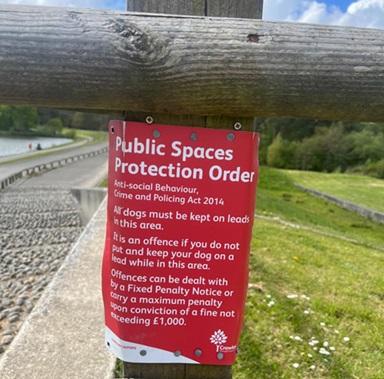
The image used in this article was taken at Tilgate Park in Crawley West Sussex. There is a PSPO in place that states all dogs must be kept on a lead.

Dog control – Tilgate Park Public Spaces Protection Order (PDF, 10.22 MB)

Dog control – Tilgate Park Public Spaces Protection Order map (JPG, 258.98 KB)

Practical Guidance

Local areas contemplating the introduction of a PSPO should consider the following steps:

  1. Assess the Need: Identify specific anti-social behavior issues affecting the locality.
  2. Consult with Stakeholders: Engage with residents, businesses, and community groups to understand their concerns.
  3. Draft the PSPO: Define the prohibited behaviors and geographical area.
  4. Statutory Guidance: Read the Home Office’s statutory guidance on the Anti-social Behaviour, Crime and Policing Act 2014.

Relevant Guidance

For more detailed information, refer to the following resources:

Remember, PSPOs can be a positive tool when used judiciously to enhance community safety and well-being.

Check out our related articles on Wasted Costs Order, Defendant’s Costs Order, Norwich Pharmacal Orders, Rule of Law, Open Justice, Is the Law Black and White ?, Abuse of Process, What Does Lady Justice Symbolise ?, McKenzie Friend, Can a Judge Direct a Jury to Find a Defendant Not Guilty ?,Law Society, Law Commission, McKenzie Friend Right of Audience, Solicitors, Solicitors Regulation Authority, Barristers, Bar Council of England and Wales, Bar Standards Board, Contra Mundum, R v Sussex Justices, Police Impartiality and the highly questionable Sussex Family Justice Board.


The Ministry of Injustice is not the Ministry of Justice nor is it affiliated in any way with the justice system, legal profession, police or any other law enforcement agencies.


Latest Articles


Most Popular


You should always seek formal legal advice from a qualified and reputable lawyer (solicitor or barrister).

There are a number of links to Free and Paid For Legal Resources and Legal Organisations on the Free Legal Advice , Legal Aid and Pro Bono pages.

Categories
Legal Analysis

What is a Judgment ?

A judgment, also known as a judicial decision or court ruling, is the final decision made by a court of law in a legal case or dispute. It represents the court’s official decision on the matters brought before it and typically resolves the legal issues in question.

It is the culmination of legal proceedings, where a judge evaluates evidence, arguments and applicable laws to arrive at a verdict. Whether it’s a criminal case, family dispute, civil dispute or administrative matter, a judgment carries significant consequences for the parties involved.

A judgment may include various elements such as:

  1. Findings of Fact: The court’s determination of what events or circumstances occurred in the case.
  2. Conclusions of Law: The legal principles applied by the court to the facts of the case to reach a decision.
  3. Decision or Disposition: The specific outcome or ruling of the case, which could include a verdict of guilty or not guilty (in a criminal case), or a judgment for the plaintiff or defendant (in a civil case).
  4. Orders: Any specific actions or remedies ordered by the court as part of the judgment, such as monetary damages, injunctions, or other relief.

A court judgment is typically written and issued by a judge or a panel of judges. It is a formal and legally binding document that concludes the legal proceedings in the case, although it may be subject to appeal or modification under certain circumstances.

Sometimes, judgment is reserved, which means withholding a final opinion until more information is available. It acknowledges the complexity of issues and avoids premature conclusions.

These are the latest judgments published by the Courts and Tribunals Judiciary of England and Wales.

  • Neutral Citation Number: [2026] EWCA Crim 743Case No: 202600364 B5202502766 A5202402517 A5202402523 A1202600365 B4202600360 B4 IN THE COURT OF APPEAL (CRIMINAL DIVISION)ON APPEAL FROM THE CROWN COURT AT PORTSMOUTHHis Honour Judge HetheringtonT20067152 ON APPEAL FROM THE CROWN COURT AT NOTTINGHAMMr Recorder MaindsT20070694 ON APPEAL FROM THE CROWN COURT AT NOTTINGHAMHis Honour Judge BennettT20087266, T20087241 & […] The post R -v- […]
  • At the Central Criminal Court 12 June 2026 Sentencing remarks of HHJ Lucraft KC Rex -v- Nerijus Kuneckis The post R -v- Nerijus Kuneckis appeared first on Courts and Tribunals Judiciary.
  • Claim number: AC-2025-LON-003270 In the High Court of JusticeKing’s Bench DivisionAdministrative Court 12 June 2026 Before: The Hon. Mr Justice Chamberlain Between: The King on the application ofAndrew Emory Tate Tristan Tate -v- Director of Public Prosecutions and Chief Constable of Bedfordshire Police Order Of the Court’s own motion; In the light of (i) the […] The post Andrew Tate […]
  • At Birmingham Crown Court 12 June 2026 Sentencing remarks of Mrs Justice Brunner Between: R -v- Sarah Ngaba The post R -v- Sarah Ngaba appeared first on Courts and Tribunals Judiciary.
  • Neutral Citation Number: [2026] EWCA Civ 720Case No: CA-2025-001526 In the Court of Appeal (Civil Division)on appeal from the Upper Tribunal (Tax and Chancery Chamber)Mr Justice Meade and Judge Ashley Greenbank[2025] UKUT 00100 (TCC) 12 June 2026 Before: Sir Colin Birss, Chancellor of the High Court Lord Justice Arnold Lady Justice Falk Between: The Commissioners […] The post HMRC -v- […]

The Ministry of Injustice is not the Ministry of Justice nor is it affiliated in any way with the justice system, legal profession, police or any other law enforcement agencies.


Latest Articles


Most Popular


You should always seek formal legal advice from a qualified and reputable lawyer (solicitor or barrister).

There are a number of links to Free and Paid For Legal Resources and Legal Organisations on the Free Legal Advice , Legal Aid and Pro Bono pages.
Categories
Legal Analysis

What is an Adverse Inference ?

Adverse inference is a legal principle that plays a significant role in various areas of law, including criminalcivil, and family law. It arises when a party remains silent or withholds evidence, leading the court to draw a negative inference.

The CPS publish important guidance on the law and practice surrounding adverse inferences from a Defendant’s silence in certain circumstances. To avoid the drawing of an adverse inference, some Defendants will read out a pre-prepared statement and then refuse to answer any further questions.

Section 34 of the Criminal Justice and Public Order Act (CJPOA) 1994

  • Section 34 of the Criminal Justice and Public Order Act (CJPOA) 1994 allows an inference to be drawn if a suspect remains silent when questioned under caution before being charged and subsequently relies on a relevant fact in court.
  • If a suspect declines to answer questions during questioning, this alone does not trigger an adverse inference. However, when the suspect later seeks to provide an account or explanation, the adverse inference provision comes into play.
  • The term “fact” in Section 34 has a broad meaning, covering any alleged fact that is in issue and put forward as part of the defence case. Even if the defendant does not give or call evidence, a specific case presented by the defence advocate to a prosecution witness can be considered a relevant fact.

Sections 35 to 37 of the CJPOA 1994

  • Section 35: Deals with the effect of a defendant’s silence at trial. It allows the court to draw an adverse inference if the defendant remains silent during the trial.
  • Section 36: Addresses the effect of a defendant’s refusal or failure to account for objects, substances, or marks.
  • Section 37: Covers the effect of a defendant’s refusal or failure to account for their presence at a particular place.

Section 38 of the CJPOA 1994 – Interpretation and Savings

  1. Definitions:
    • Legal Representative: Refers to a person authorized under the Legal Services Act 2007 for activities related to the exercise of a right of audience or the conduct of litigation.
    • Place: Encompasses buildings, vehicles, vessels, aircraft, and any other location.
  2. Offences Charged:
    • References to an “offence charged” include any other offense for which the accused could lawfully be convicted based on the same charge.
  3. Inferences and Proceedings:
    • Proceedings Against the Accused: An adverse inference cannot solely lead to transferring proceedings to the Crown Court, finding a case to answer, or convicting the accused.
    • Refusal to Grant Applications: A judge cannot refuse applications solely based on an inference drawn from the accused’s failure to answer questions (as mentioned in sections 34, 36, or 37).
  4. Preserving Other Legal Provisions:
    • Admissibility of Evidence: Sections 34, 35, 36, or 37 do not affect provisions that render certain answers or evidence inadmissible against the accused or others.
    • Court’s Discretion: Courts retain the power to exclude evidence at their discretion, regardless of whether it involves furnishing information, making discoveries, producing documents, or other forms of evidence.

Section 38 ensures that adverse inferences are drawn judiciously, respecting legal rights and maintaining fairness in criminal proceedings.

Preconditions for Drawing an Adverse Inference

Before an adverse inference can be drawn, the following conditions must be met:

Certainly! Let’s explore the six necessary conditions that must be satisfied before an adverse inference can be drawn in circumstances where there has been a failure to mention a relevant fact when questioned. These conditions are crucial in legal proceedings, particularly when considering a defendant’s silence. Here they are:

  1. Pre-interview Disclosure:
    • The defendant must have been informed of the allegations against them before any questioning.
    • This ensures that the defendant is aware of the specific charges they are facing.
  2. Legal Advice to Be Silent:
    • The defendant must have received legal advice regarding their right to remain silent.
    • Legal professionals must ensure that the defendant understands their options and the potential consequences of remaining silent.
  3. The Defendant Waiving Legal Privilege:
    • If the defendant voluntarily waives their legal privilege (i.e., chooses to speak), their silence during questioning can be used against them.
    • This condition ensures that the defendant’s silence is a deliberate choice rather than a lack of understanding.
  4. Prepared and Self-Serving Statements:
    • The court considers whether the defendant’s statements were prepared or self-serving.
    • If the defendant selectively chooses to mention certain facts while remaining silent about others, this can impact the inference drawn.
  5. Failure to Mention a Relevant Fact:
    • The alleged failure must relate to not mentioning a fact that is relevant to the case.
    • The defendant’s silence regarding a crucial detail can be significant in assessing their credibility.
  6. Reasonable Expectation to Mention When Questioned:
    • The defendant’s silence should pertain to a fact that, under the circumstances, they could reasonably have been expected to mention when questioned.
    • If the omission is material and relevant, an adverse inference may be drawn.

These conditions help ensure fairness and balance in legal proceedings, allowing courts to consider a defendant’s silence in a well-defined context.

Case Law Examples

  • In Webber [2004] 1 All ER 770, the House of Lords held that the word “fact” as given in Section 34 should be given a broad meaning. It covered any alleged fact which was in issue and put forward as part of the defence case. Therefore, a specific case put by a Defendants advocate to a prosecution witness can be a fact relied on, even if the Defendant does not give or call evidence.
  • In M [2012] 1 Cr App R 26, it was held that the judge had incorrectly allowed the jury to draw an adverse inference from a failure by the appellant to mention relevant facts in interview when there was no basis for drawing one. There, the officers who interviewed the appellant mistakenly asked him about the alleged rape on the wrong date. The appellant subsequently relied on facts relevant to the date that the alleged rape was said to have occurred. The Court found that it was difficult to see how in those circumstances the appellant could have reasonably been expected to say more.
  • In Lee [2015] EWCA Crim 420, it was held that the judge had correctly allowed the jury to draw adverse inferences from the Defendants silence in interview following his arrest for an assault on his partner. Although the police did not have the specific details of the allegations at that stage, the questions were clearly directed to trying to discover whether or by whom the partner had been assaulted.

Civil Law

  • Evidence Withheld: In civil proceedings, parties may withhold evidence within their possession or control.
  • Negative Inference: If a party fails to produce relevant evidence, the court may infer that the evidence would have been unfavourable to that party’s position.
  • Example: If a claimant fails to provide crucial documents related to their claim, the court may infer that those documents would not support their case.

Family Law

  • Child Custody Cases: In family law, adverse inference can arise in child custody disputes.
  • Parental Behaviour: If a parent refuses to provide relevant information about their parenting abilities or fails to disclose relevant facts, the court may infer negatively.
  • Example: If a parent avoids discussing their history of substance abuse during custody proceedings, the court may draw an adverse inference.

Adverse inference ensures that parties are transparent and forthcoming in legal proceedings. Whether in criminal, civil, or family law, the principle encourages honesty and accountability. Legal professionals must navigate these provisions carefully to uphold justice and fairness.


The Ministry of Injustice is not the Ministry of Justice nor is it affiliated in any way with the justice system, legal profession, police or any other law enforcement agencies.


Latest Articles


Most Popular


You should always seek formal legal advice from a qualified and reputable lawyer (solicitor or barrister).

There are a number of links to Free and Paid For Legal Resources and Legal Organisations on the Free Legal Advice , Legal Aid and Pro Bono pages.
Categories
Legal Analysis

What is a Lucas Direction ?

A Lucas Direction, stemming from the case of R v Lucas (Ruth) [1981] EWCA Crim J0519-8, is a legal principle used in criminal trials to guide the jury on how to consider the evidence of lies told by a defendant. The case of Regina v Lucas (Ruth) is a landmark decision that established the criteria under which a lie can be considered as evidence of guilt.

The case involved Iyabode Ruth Lucas, who was convicted at Reading Crown Court on two counts of being knowingly concerned in the fraudulent evasion of the prohibition of the importation into the UK of a controlled drug, namely cannabis, contrary to the Misuse of Drugs Act 1971. The conviction was based on her arrival from Nigeria at Gatwick and Heathrow airports with significant quantities of cannabis. The appeal focused on whether the trial judge gave a correct direction on the question of corroboration of the evidence provided by an accomplice.

The Court of Appeal, led by Lord Lane LCJ, held that the mere fact that a defendant has lied is not in itself evidence of guilt. People may lie for various reasons, such as shame, panic, or the desire to cover for someone else. Therefore, a Lucas Direction instructs the jury that they can only consider a lie as evidence supporting guilt if certain conditions are met:

The lie must be deliberate.
The lie must relate to a material issue.
The lie must be told after the crime.
The lie must be told before there is a strong suspicion of guilt.
The jury must be satisfied that the lie was told to conceal guilt, and even then, it is not conclusive proof of guilt but merely an additional piece of evidence to be weighed with all other evidence in the case.

Lucas Direction Conditions

The Lucas Direction is significant because it protects defendants from being unjustly convicted based solely on their lies. It ensures that the jury understands that not all lies are indicative of guilt and that they must carefully consider the context and reasons for the lie before drawing any inferences.

The principles from Regina v Lucas (Ruth) have been cited in numerous subsequent cases and have become an integral part of jury instructions in criminal trials. It reflects the careful balance that must be struck in the justice system between the prosecution’s need to prove guilt and the protection of the rights of the accused.

In summary, the Lucas Direction serves as a safeguard against wrongful convictions and underscores the importance of a fair trial. It is a reminder that while the truth is paramount in the pursuit of justice, the reasons behind a person’s actions, including their lies, must be thoroughly examined and understood. The legacy of Regina v Lucas (Ruth) continues to influence the administration of justice, ensuring that juries are properly directed on how to approach evidence of lies in the context of a criminal trial.


The Ministry of Injustice is not the Ministry of Justice nor is it affiliated in any way with the justice system, legal profession, police or any other law enforcement agencies.


Latest Articles


Most Popular


You should always seek formal legal advice from a qualified and reputable lawyer (solicitor or barrister).

There are a number of links to Free and Paid For Legal Resources and Legal Organisations on the Free Legal Advice , Legal Aid and Pro Bono pages.
Categories
Judiciary Legal Analysis

Can you Criticise a Judge ?

In short, the answer is yes anyone can criticise a judge or court.

The judiciary and courts are quite rightly not immune to public criticism and comment. The rule of law applies to everyone and no one should be above the law.

Scandalising the judiciary, also known as scandalising the court or scandalising judges, was historically considered a form of contempt of court in the common law of England and Wales.

It involved any publication or speech that would undermine public confidence in the judiciary or its officers, such as judges and magistrates.

However, the Crime and Courts Act 2013 abolished the offence of scandalising the judiciary under the common law of England and Wales.

Section 33 of the Act specifically states

“Scandalising the judiciary (also referred to as scandalising the court or scandalising judges) is abolished as a form of contempt of court under the common law of England and Wales.”

Crime and Courts Act 2013 Section 33

The decision to abolish the offence was controversial, with supporters of the change arguing that it was necessary to ensure that freedom of expression was protected and that the judiciary were not immune to criticism.

While the offence of scandalising the judiciary no longer exists under the common law of England and Wales, other forms of contempt of court still apply.

These include disobedience to court orders, interference with court proceedings, and publication of material that could prejudice ongoing legal proceedings.

In conclusion, scandalising the judiciary was once considered a form of contempt of court in England and Wales, but this offence was abolished by the Crime and Courts Act 2013.

It should however be noted that libel and slander are both forms of defamation, which involve making a false statement about someone that damages their reputation.

In the United Kingdom, the laws around libel and slander are governed by the Defamation Act 2013, which replaced the previous common law rules on defamation.

Formal complaints about judges can be made at the Judicial Conduct Investigations Office (JCIO).

The JCIO are an independent office which supports the Lord Chancellor and Lady Chief Justice in considering complaints about the personal conduct of judicial office holders.

The JCIO cannot accept complaints about a judge’s decision or the way a judge has managed a case.

The Law Commission published a consultation paper (no207) in 2012 entitled Contempt of Court : Scandalising the Court

Check out our articles on Rule of Law, Open Justice, Judges Salaries and Fees, Dodgy JudgesWhat is Law, Is the Law Black and White ?, Abuse of Process, What Does Lady Justice Symbolise ? Mr Justice Williams, His Honour Judge Richardson, His Honour Now His Dishonour, His Honour Judge Michael Slater, His Honour Judge Martin Davis, HHJ Farquhar, Do you Have to Bow to a Judge ?, Can you Email a Judge ?, Can you Criticise a Judge ? and the highly dubious Sussex Family Justice Board.


The Ministry of Injustice is not the Ministry of Justice nor is it affiliated in any way with the justice system, legal profession, police or any other law enforcement agencies.


Latest Articles


Most Popular


You should always seek formal legal advice from a qualified and reputable lawyer (solicitor or barrister).

There are a number of links to Free and Paid For Legal Resources and Legal Organisations on the Free Legal Advice , Legal Aid and Pro Bono pages.
Categories
Legal Analysis

What is Unlawful ?

In the realm of law and order, the term “unlawful” denotes actions or behaviours that run counter to established laws, regulations, or ethical standards within a given society.

It serves as a fundamental concept in delineating the boundaries of acceptable conduct, guiding individuals, institutions, and authorities in upholding justice and social order. Understanding what constitutes unlawfulness is pivotal for fostering fairness, equity, and respect for the rule of law.

At its essence, unlawfulness encompasses actions prohibited by law. These can range from minor infractions like speeding to more serious offences such as theft, assault, or homicide.

The severity of unlawfulness varies depending on the nature and impact of the transgression, with legal systems categorising offences into different degrees of seriousness, each carrying its own set of penalties and repercussions.

Central to determining unlawfulness is the existence of legal statutes or regulations that explicitly outline prohibited actions and stipulate the corresponding consequences for violating them. These laws are established through legislative processes by governing bodies, reflecting societal norms, values, and priorities.

Additionally, legal principles such as precedent, common law, and judicial interpretation play a vital role in elucidating the scope and application of these laws in specific cases.

Beyond statutory laws, unlawfulness can also arise from breaches of contractual agreements, where parties fail to fulfil their obligations or engage in actions contrary to the terms of their agreements.

Contractual unlawfulness is governed by contract law, which provides mechanisms for resolving disputes arising from such breaches, including compensation, restitution, or specific performance.

Furthermore, unlawfulness extends beyond legal statutes to encompass actions that contravene fundamental principles of morality, decency, or human rights. These may include acts of discrimination, harassment, or abuse that undermine the dignity, equality, or well-being of individuals or groups within society. While not always codified in legal statutes, such behaviours may still be subject to legal scrutiny and condemnation, particularly in jurisdictions with robust human rights legislation or constitutional protections.

The concept of unlawfulness is closely intertwined with notions of justice, fairness, and accountability. A cornerstone of the rule of law is the equal application of legal standards to all individuals, ensuring that no one is exempt from legal accountability.

Upholding unlawfulness through impartial enforcement of laws and regulations is essential for fostering trust in legal institutions and promoting social cohesion.

However, it’s important to acknowledge that perceptions of unlawfulness may vary across different cultures, societies, and historical contexts. What is deemed unlawful in one jurisdiction may be deemed acceptable or even sanctioned in another, reflecting diverse legal traditions, values, and priorities. Moreover, as societal norms evolve and legal frameworks adapt, definitions of unlawfulness are subject to change over time to address emerging challenges and meet evolving needs.

In conclusion, unlawfulness encompasses actions or behaviours that contravene established laws, regulations, or ethical standards within a given society. It serves as a guiding principle in maintaining order, justice, and social harmony, and upholding the principles of fairness, accountability, and the rule of law is crucial for fostering trust in legal institutions and promoting a just and equitable society.

Check out our articles on Rule of Law, Open Justice, Policing, Police News, Policing by Consent, Wasting Police Time and the highly questionable Sussex Family Justice Board.


The Ministry of Injustice is not the Ministry of Justice nor is it affiliated in any way with the justice system, legal profession, police or any other law enforcement agencies.


Latest Articles


Most Popular


You should always seek formal legal advice from a qualified and reputable lawyer (solicitor or barrister).

There are a number of links to Free and Paid For Legal Resources and Legal Organisations on the Free Legal Advice , Legal Aid and Pro Bono pages.

Categories
Legal Analysis

Injustice in the Single Justice Procedure ?

HM Courts and Tribunal Service have published a Fact sheet entitled Single Justice Service on their website. The Fact Sheet is worryingly described as “Promotional material“.

The Single Justice Service (SJS) allows magistrates’ courts to deal with minor offences in a way that’s quicker, more straightforward and more efficient, while still being fair, transparent and rigorous. This process is known as the Single Justice Procedure (SJP).

A single magistrate, supported by a legal adviser, can decide adult, summary-only, non-imprisonable and victimless offences, including company prosecutions.

They can do this when the defendant has pleaded guilty or has not responded to notification that they’re being prosecuted.

The defendant always has the option to choose to attend a hearing in court in person.

Examples of cases covered by the SJP include:

  • using a television without a licence
  • failing to show a valid train ticket while travelling on a train service
  • driving without car insurance
  • exceeding a speed limit
  • failing to ensure a dependent child’s school attendance
  • excess vehicle load
  • lack of valid vehicle operator’s licence

Is the Single Justice Service (SJS) quicker, more straightforward and more efficient, while still being fair, transparent and rigorous ?

Justice or Injustice

Tristan Kirk who is the Courts correspondent for the Evening Standard regularly posts on X about dubious and immoral convictions using the Single Justice Procedure.

Bristol woman, 57, prosecuted for not paying for a TV Licence
“I have no family or friends…my only lifeline is a TV”
Disabled, & depressed after her daughter’s death. Struggles with opening letters. #SingleJusticeProcedure

Tristan Kirk on X
Tristan Kirk Courts correspondent for the Evening Standard

This is an absolute disgrace.

The Single Justice Procedure is clearly not justice !

pjm1kbw KC Barrister at 1KBW
Injustice in the Single Justice Procedure

Lady Chief Justice to look into flaws of controversial fast-track justice system

Tristan Kirk wrote in the Standard on the 8th February 2024 :-

The top judge in England and Wales has promised to investigate the workings of a controversial fast-track court system after an Evening Standard investigation revealed how the elderly, vulnerable and mentally ill people are convicted in closed-door hearings.

The Lady Chief Justice, Lady Carr of Walton-on-the Hill, backed the single justice procedure when questioned on the fairness of the system, calling it “proportionate” for low-level crimes.

“I think the safeguards are there, both in terms of open justice and protection for the individual involved.”

Lady Carr said she would look into how mentally ill defendants are supported in the procedure, and vowed to inspect how decisions are taken at private hearings. She even suggested she may sit in judgment on SJP cases.

Top judge to look into flaws of controversial fast-track justice system

The Ministry of Injustice is not the Ministry of Justice nor is it affiliated in any way with the justice system, legal profession, police or any other law enforcement agencies.


Latest Articles


Most Popular


You should always seek formal legal advice from a qualified and reputable lawyer (solicitor or barrister).

There are a number of links to Free and Paid For Legal Resources and Legal Organisations on the Free Legal Advice , Legal Aid and Pro Bono pages.

Rule of Law - Open Justice - Policing By Consent