Categories
Judiciary Legal Professionals

Circuit Judges

A Circuit Judge in England and Wales is a judge who presides over cases in the Crown Court and County Courts.

  1. Hierarchy: They rank below High Court Judges but above District Judges and Recorders in the judicial hierarchy.
  2. Appointments: Circuit Judges are appointed by the King on the recommendation of the Lord Chancellor, based on advice from the Judicial Appointments Commission. They need to have substantial legal experience, typically at least 10 years, before being considered for the position.
  3. Roles:
    • Crown Court: They handle criminal cases, which might include everything from minor offenses to more serious crimes like murder or rape, though the most complex cases might be reserved for High Court Judges.
    • County Court: They deal with civil cases, which can range from small claims to more significant disputes concerning contracts, personal injury, and family law (like divorce or child custody).
  4. Jurisdiction: They have jurisdiction throughout England and Wales, but they are generally assigned to one of the six circuits (North Eastern, Northern, South Eastern, Midland and Oxford, Wales and Chester, Western Circuit).
  5. Style: They are referred to as “His/Her Honour Judge [Surname]” in court and formal settings.
  6. Duties: Apart from hearing cases, they might also sit on appeal courts for decisions from lower courts or tribunals, participate in judicial training, and contribute to the administration of justice in various capacities.

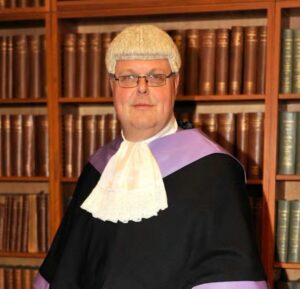
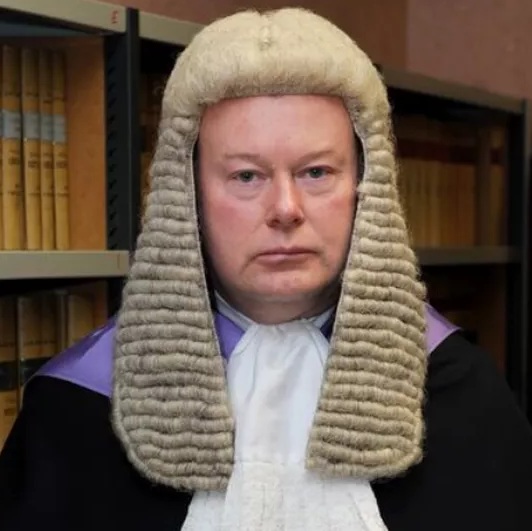
Bands worn over a violet robe and a short wig.
When hearing criminal cases, circuit judges wear a red tippet (sash) over the left shoulder.
When dealing with civil business, circuit judges dress as in criminal cases, but with a lilac tippet and without a wig or bands, wing collar or collarette.
On some occasions – when dealing with certain types of High Court business, or when sitting at the Central Criminal Court (Old Bailey) in London – circuit judges wear a short wig and black silk gown over a court coat and/or waistcoat.

Court Working Dress – Circuit Judge

Check out our articles on Dodgy JudgesJudges Salaries and Fees, His Honour Judge Melbourne Inman KC, His Honour Now His Dishonour, His Honour Judge Michael Slater, His Honour Judge Martin Davis, HHJ Farquhar, Do you Have to Bow to a Judge ?, Can you Email a Judge ?, Can you Criticise a Judge ? and the highly dubious Sussex Family Justice Board.


The Ministry of Injustice is not the Ministry of Justice nor is it affiliated in any way with the justice system, legal profession, police or any other law enforcement agencies.


Latest Articles


Most Popular


You should always seek formal legal advice from a qualified and reputable lawyer (solicitor or barrister).

There are a number of links to Free and Paid For Legal Resources and Legal Organisations on the Free Legal Advice , Legal Aid and Pro Bono pages.

Categories
Judiciary Legal Professionals

District Judge

A District Judge in England and Wales is a judicial officer who presides over lower court proceedings, primarily in the Magistrates’ Courts and County Courts.

Magistrates’ Courts:

  • Criminal Cases: District Judges handle criminal cases, but their jurisdiction is generally limited to less serious offenses or cases where the accused opts for summary trial (trial without a jury). They can sentence defendants for offenses like summary offenses or either-way offenses where the defendant pleads guilty or is found guilty in a summary trial. However, they can only impose sentences up to 6 months imprisonment for a single offense (or up to 12 months in total for multiple offenses).
  • Civil Cases: Although less common, they might deal with civil proceedings in the Magistrates’ Courts, like family proceedings under the Family Law Act 1996.

County Courts:

  • Civil Jurisdiction: In the County Court, District Judges handle a variety of civil matters including small claims (up to £10,000), possession proceedings for property, and other civil disputes. They can also deal with some aspects of insolvency, family law, and housing law.

Other Duties:

  • Appeals: They might hear appeals from decisions made by magistrates or other lower judicial officers.
  • Case Management: District Judges often play a significant role in case management, helping to direct cases towards mediation or trial, making procedural rulings, and sometimes conducting pre-trial reviews or settlement hearings.

District Judges are legally qualified (they must be barristers or solicitors with at least seven years of rights of audience) and are appointed by the Judicial Appointments Commission. They are distinct from “Magistrates,” who are lay judges, meaning they are not legally trained but trained for their role.

The appointment to the position of District Judge is quite competitive, requiring significant legal experience and passing through a rigorous selection process. They play a crucial role in the administration of justice at a grassroots level, dealing with a high volume of cases that affect the daily lives of many citizens.

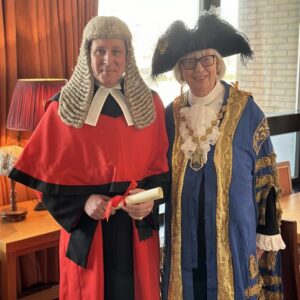
In open court district judges wear the civil robe introduced in October 2008, with blue tabs at the neck and without a wig.

Court Working Dress – District Judge

Check out our articles on Dodgy JudgesJudges Salaries and Fees, His Honour Judge Melbourne Inman KC, His Honour Now His Dishonour, His Honour Judge Michael Slater, His Honour Judge Martin Davis, HHJ Farquhar, Do you Have to Bow to a Judge ?, Can you Email a Judge ?, Can you Criticise a Judge ? and the highly dubious Sussex Family Justice Board.


The Ministry of Injustice is not the Ministry of Justice nor is it affiliated in any way with the justice system, legal profession, police or any other law enforcement agencies.


Latest Articles


Most Popular


You should always seek formal legal advice from a qualified and reputable lawyer (solicitor or barrister).

There are a number of links to Free and Paid For Legal Resources and Legal Organisations on the Free Legal Advice , Legal Aid and Pro Bono pages.

Categories
Judiciary Legal Professionals

Deputy District Judge

Deputy district judges such DDJ Nicholes are appointed by the Lord Chancellor after a fair and open competition administered by the Judicial Appointments Commission, and the statutory qualification is the same as that for appointment as a district judge – a minimum of five years’ right of audience in any part of the Supreme Court, or all proceedings in county courts or magistrates’ courts.

Deputy district judges sit on a fee-paid basis in the county courts and district registries of the High Court for between 15 and 50 days a year. In general their jurisdiction is the same as that of a district judge.

Appointments are for five years, and are automatically extended by the Lord Chancellor for further successive terms of five years – subject to the office holder’s agreement and the retirement age of 70.

In open court, Deputy District Judges wear a black coat with bands, a King’s Counsel’s or junior barrister’s gown with no wig.

Court Working Dress – Deputy District Judge

Deputy District Judge Chris Mills the only Disrict judge in the UK

Read more about DDJ Mills in our Dodgy Judges article.

Deputy District Judge Christopher Mills email address is [email protected]

Deputy District Judge Mills / DDJ Mills South East Circuit
DDJ Mills Brighton Family Court

Check out our articles on Dodgy JudgesJudges Salaries and Fees, His Honour Judge Melbourne Inman KC, His Honour Now His Dishonour, His Honour Judge Michael Slater, His Honour Judge Martin Davis, HHJ Farquhar, Do you Have to Bow to a Judge ?, Can you Email a Judge ?, Can you Criticise a Judge ? and the highly dubious Sussex Family Justice Board.


The Ministry of Injustice is not the Ministry of Justice nor is it affiliated in any way with the justice system, legal profession, police or any other law enforcement agencies.


Latest Articles


Most Popular


You should always seek formal legal advice from a qualified and reputable lawyer (solicitor or barrister).

There are a number of links to Free and Paid For Legal Resources and Legal Organisations on the Free Legal Advice , Legal Aid and Pro Bono pages.
Categories
Judiciary Legal Professionals

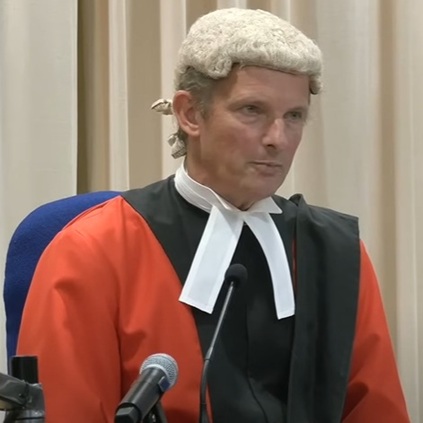
Her Honour Judge Angela Rafferty KC

Her Honour Judge Angela Rafferty KC handed Farhad Mohammad a three-year community order at the Old Bailey on the 23rd October 2024 after he was found guilty of two charges of funding terrorism by making money transfers to his nephew in Syria.

HHJ Rafferty also ordered him to complete 250 hours of unpaid work, to be subject to an electronically monitored curfew and complete a 30-day rehabilitation activity requirement.

The Sentencing Council publish sentencing guidelines for Funding terrorism which comes under the Terrorism Act 2000, s.15, Terrorism Act 2000, s.16, Terrorism Act 2000, s.17, Terrorism Act 2000, s.18.

There was online criticism that the sentence handed down for a terrorism offence was deemed to be too lenient :-

It is assumed Farhad Mohammad demonstrated Culpability C (Performed limited function under direction – Very little or no planning) and Harm was Category 3 (Money or property made, or was likely to make, a minor contribution to furthering terrorism).

It would appear that the sentence handed down by the honourable judge Rafferty to Farhad Mohammad for Funding Terrorism was in line with the Sentencing Council guidelines.

Terrorist groups rely on financial support and funding to be able to operate. While Mohammad’s contributions may not have been vast sums, he was well aware his nephew wanted the money to purchase a firearm and to help fund his fighting in Syria.

Commander Dom Murphy – Met Police Counter Terrorism Command

Counter Terrorism Policing need your help to stop terrorists being able to plan, prepare and carry out attacks, groom or recruit people or encourage others to carry out attacks. You may have seen or heard something that could be that vital piece of information that will help to stop a terrorist attack. Report Online, contacting the police in confidence on 0800 789 321 or in an emergency 999.

HHJ Rafferty is shown on the List of Circuit Judges published on the Courts and Tribunal Judiciary website. Her Honour Judge Rafferty is a Circuit Judge.

Her Honour Judge Angela Margaret Mary Rafferty KCLondon07-01-2019
List of Circuit Judges

Former Chair of the Criminal Bar Association HHJ Angela Rafferty KC is a specialist in grave high profile criminal cases nationwide involving the vulnerable, including young people with mental and physical disabilities, and frequently represents women accused of homicide and young people accused of serious sexual offences in this and other jurisdictions.

In conversation with HHJ Angela Rafferty KCJustice.org.uk

The Judicial Appointments Commission (JAC) selects candidates for judicial office in England and Wales, and for some tribunals with UK-wide powers. The JAC is made up of 15 Commissioners, supported by a Senior Leadership Team, Panel Members and around 90 staff.

Her Honour Judge Angela Rafferty KC was appointed to the JAC as a Judicial Commissioner on the 9th June 2024. Angela was called to the Bar in 1995, appointed a Recorder in 2009 and took silk in 2015.  Since 2019, Angela has sat as a Senior Circuit Judge in the Central Criminal Court.

Her Honour Judge Angela Rafferty KCJudicial Appointments Commission

HHJ Angela Rafferty KC was the trial judge at the Old Bailey for three people who were subsequently jailed for murdering a vulnerable woman they “treated like a slave” by starving, torturing and beating her. HHJ Rafferty sentencing remarks were published on the 1st March 2024. The video was published on the 5th March 2024.

HHJ Rafferty – Trio jailed for over 100 years for murder of woman they treated like slave

HHJ Angela Rafferty appeared on the Bar Council of England Wales YouTube Channel in 2017 for International Women’s Day.

Her Honour Judge Angela Rafferty KCBar Council of England Wales

Through their distinguished track record and their pre-eminent place in the legal world, our new visiting professors will bring the law to life along with giving our students a real time appreciation of its impact both intellectually and professionally

HHJ Angela Rafferty to join Goldsmiths’ Department of Law as a visiting Professor.

The three key values which are central to the role of judicial office holders (JOHs) in England and Wales are:
• Independence
• Impartiality
• Integrity

“Publicity is the very soul of justice. . . . It keeps the judge himself, while trying, under trial….Where there is no publicity there is no justice”

Jeremy BenthamMr Justice Cobb: ‘Justice must be seen to be done’

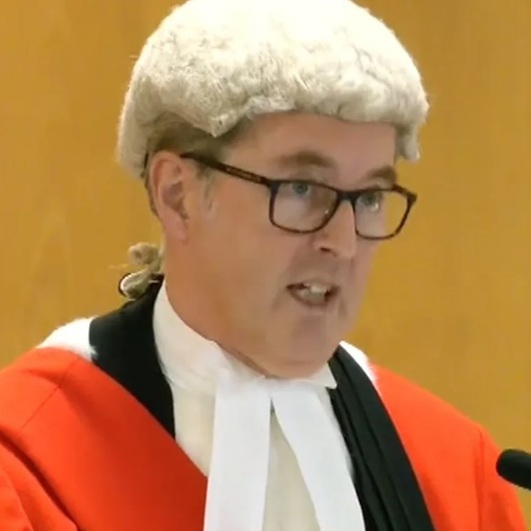
Image of HHJ Rafferty : Bar Council of England and Wales (Screenshot)

Check out our articles on Mr Justice Williams, Dodgy JudgesHis Honour Judge Melbourne Inman KC, His Honour Andrew Menary KC, His Honour Judge Guy Kearl, His Honour Now His Dishonour, His Honour Judge Michael Slater, His Honour Judge Martin Davis, HHJ Farquhar, HHJ Bedford, DDJ Nicholes, Judge Pinder, Do you Have to Bow to a Judge ?, Can you Email a Judge ?, Can you Criticise a Judge ? and the highly dubious Sussex Family Justice Board.


The Ministry of Injustice is not the Ministry of Justice nor is it affiliated in any way with the justice system, legal profession, police or any other law enforcement agencies.


Latest Articles


Most Popular


You should always seek formal legal advice from a qualified and reputable lawyer (solicitor or barrister).

There are a number of links to Free and Paid For Legal Resources and Legal Organisations on the Free Legal Advice , Legal Aid and Pro Bono pages.
Categories
Criminal Justice Law Legal Analysis

Detention at His Majesty’s Pleasure ?

Detention at His Majesty’s Pleasure is a term used in the United Kingdom for an indeterminate sentence where the offender is detained for an unspecified period. This kind of sentence is typically used for young offenders or those convicted of particularly serious crimes, where the length of detention is not fixed at the time of sentencing.

Detention during His Majesty’s Pleasure is a mandatory life sentence and will be imposed when a child or young person is convicted or pleads guilty to murder. Schedule 21 of the Sentencing Act 2020 states that the starting point for determining the minimum sentence where the offender is under 18 years of age is 12 years as opposed to 15 years for those over the age of 18.

Types of sentences for children and young peopleSentencing Council
  1. Purpose: The main idea is that the offender should be detained until they are no longer considered a threat to society or until they have been rehabilitated. This could theoretically mean detention for life, or until the offender’s behaviour and development indicate that release is appropriate.
  2. Who It Applies To: Historically, this sentence was often used for juveniles convicted of serious crimes like murder, where an adult would receive a life sentence. However, it can also apply to adults in certain contexts, particularly where mental health issues are involved. The Mental Health Act 1983 allows for the detention of individuals who have committed offenses but are also suffering from mental disorders. When someone is detained at His Majesty’s Pleasure, especially under a mental health context, it’s often because they’ve been found not guilty by reason of insanity or unfit to plead, or they’ve been convicted of an offense where a psychiatric disposal is deemed more appropriate than a penal sentence.
  3. Legal Framework: The phrase “at His Majesty’s Pleasure” reflects the historical power of the monarch to detain subjects. In modern times, this power is exercised through the Home Office or relevant judicial or parole boards who decide when it’s safe to release the individual.
  4. Review and Release: The detention period is subject to periodic review. Decisions regarding release are based on assessments of risk, rehabilitation progress, and changes in the offender’s maturity and mental state.
  5. Differences from Life Sentences: Unlike a life sentence with a tariff (a minimum term to be served before parole can be considered), detention at His Majesty’s Pleasure doesn’t set a minimum term upfront, although in practice, a minimum term might be recommended by the judge.
  6. Criticism and Reform: This type of sentencing has faced criticism for its uncertainty, which can be psychologically challenging for detainees. There have been calls for reform to provide more clarity or to set tariffs in a way similar to life sentences but tailored to the developmental needs of young offenders.
  7. International Perspective: The concept is somewhat unique to the UK legal system, though other countries have similar provisions for indefinite detention for the purposes of rehabilitation or public protection, particularly for juvenile offenders or those with mental health issues.

In 2002 the then The Lord Chief Justice of England and Wales Baron Woolf published a statement Review of Minimum Terms set for Young Offenders detained at her Majesty’s Pleasure.

King Charles III, formerly known as The Prince of Wales, became King on the death of his mother Queen Elizabeth II on 8 September 2022.

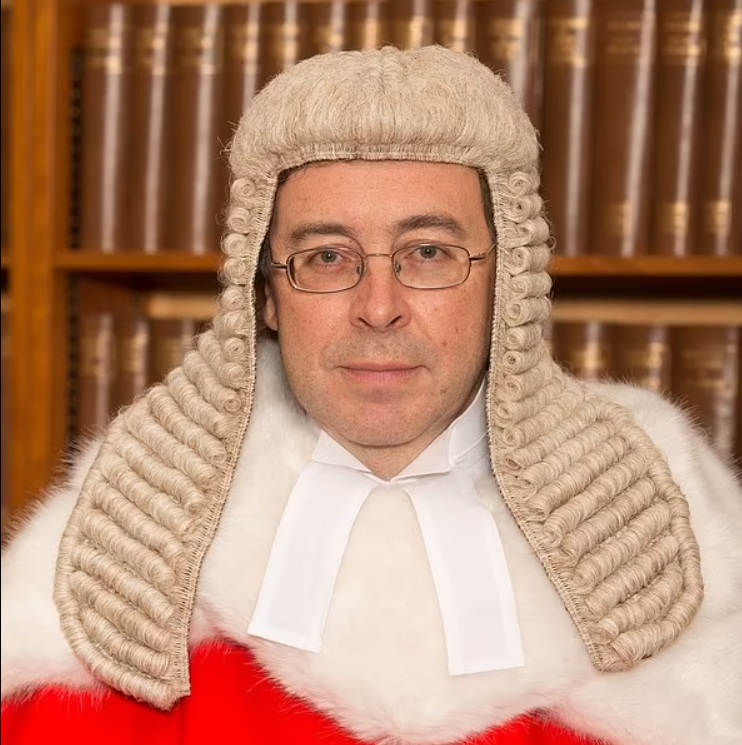
Image of King Charles III created by Grok-3


The Ministry of Injustice is not the Ministry of Justice nor is it affiliated in any way with the justice system, legal profession, police or any other law enforcement agencies.


Latest Articles


Most Popular


You should always seek formal legal advice from a qualified and reputable lawyer (solicitor or barrister).

There are a number of links to Free and Paid For Legal Resources and Legal Organisations on the Free Legal Advice , Legal Aid and Pro Bono pages.
Categories
Criminal Justice Judiciary Legal Professionals

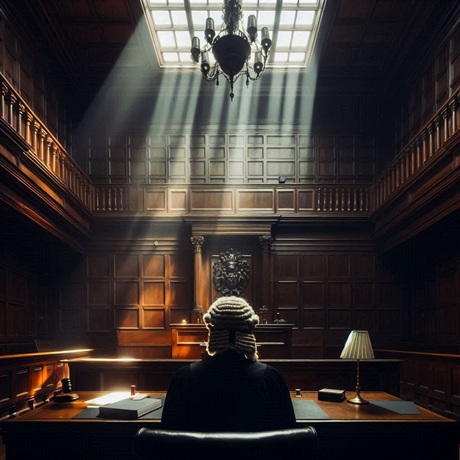
His Honour Judge Jeremy Richardson KC

His Honour Judge Jeremy Richardson KC (The Recorder of Sheffield) sentenced Grandfather Peter Lynch, who had pleaded guilty to a charge of violent disorder, to a jail term of two years and eight months on the 22nd August 2024.

“You did not yourself attack any police officer, as far as can be detected, but what you did was encourage by your conduct others to behave violently and you were part of this mob……What a disgraceful example you are as a grandfather.”

HHJ Richardson KC

Prison Service spokeswoman said on Monday 21st October 2024 “HMP Moorland prisoner Peter Lynch died on October 19 2023.”

“As with all deaths in custody, the Prisons and Probation Ombudsman will investigate.”

There has been an outpouring of public opinion since the death of Peter Lynch including the “harsh sentence” handed down by His Honour Judge Jeremy Richardson KC and the suspected influence of British Prime Minister Sir Keir Starmer KC on the criminal justice system.

Kay Burley asked the Lord Chancellor on Sky TV : Should Peter Lynch a first time offender with a poor health record, have been jailed?

Did Keir Starmer Sign a ‘Death Sentence’ for Peter Lynch? HHJ Richardson KC ?
Judge Jeremy Richardson on X
The Recorder of Sheffield HHJ Jeremy Richardson KC
Did He Deserve Three Years In Jail – His Honour Judge Richardson KC ?

HHJ Richardson is shown on the List of Circuit Judges published on the Courts and Tribunal Judiciary website.

His Honour Judge Jeremy William Richardson KCNorth East14-05-2018
List of Circuit Judges

HHJ Richardson is shown on the Resident Judges list published on the Courts and Tribunal Judiciary website.

CircuitCourtJudgesDate of appointment
 North EastSheffield Combined Court CentreHHJ Jeremy Richardson KC14-05-18
Resident Judges

His Honour Judge Richardson is a Circuit Judge.

His Honour Judge Jeremy Richardson is a Master of the Bench at the Inner Temple. He has been a Judicial Governing Bencher since the 19th July 2007.

HHJ Richardson is also Master of the Inner Temple LGBTQ+ Society, and member of the Equality, Diversity and Inclusivity Sub-Committee.

The three key values which are central to the role of judicial office holders (JOHs) in England and Wales are:
• Independence
• Impartiality
• Integrity

Authorisation to sit as a High Court Judge

HHJ Richardson may be authorised to sit as a High Court Judge by s9(1) of the Senior Courts Act as amended by the Crime and Courts Act 2013.

According to CRIMINAL PRACTICE DIRECTIONS 2015 DIVISION XII HHJ Richardson should be addressed as “My Lord” in court.

Modes of Address B.1 – The following judges, when sitting in court, should be addressed as ‘My Lord’ or ‘My Lady’

(b) any Circuit Judge sitting as a judge of the Court of Appeal (Criminal Division) or the High Court under section 9(1) of the Senior Courts Act 1981;
(d) any Senior Circuit Judge who is an Honorary Recorder.

Description B.3 – In cause lists, forms and orders members of the judiciary should be described as follows:

(a) Circuit Judges, as ‘His [or Her] Honour Judge A’. When the judge is sitting as a judge of the High Court under section 9(1) of the Senior Courts Act 1981, the words ‘sitting as a judge of the High Court’ should be added;

“Publicity is the very soul of justice. . . . It keeps the judge himself, while trying, under trial….Where there is no publicity there is no justice”

Jeremy BenthamMr Justice Cobb: ‘Justice must be seen to be done’

Image of HHJ Richardson : Grimsby Telegraph

Check out our articles on Dodgy JudgesMr Justice Williams, His Honour Judge Melbourne Inman KC, His Honour Andrew Menary KC, His Honour Judge Guy Kearl, His Honour Now His Dishonour, His Honour Judge Michael Slater, His Honour Judge Martin Davis, HHJ Farquhar, HHJ Bedford, DDJ Nicholes, Do you Have to Bow to a Judge ?, Can you Email a Judge ?, Can you Criticise a Judge ? and the highly dubious Sussex Family Justice Board.


The Ministry of Injustice is not the Ministry of Justice nor is it affiliated in any way with the justice system, legal profession, police or any other law enforcement agencies.


Latest Articles


Most Popular


You should always seek formal legal advice from a qualified and reputable lawyer (solicitor or barrister).

There are a number of links to Free and Paid For Legal Resources and Legal Organisations on the Free Legal Advice , Legal Aid and Pro Bono pages.

Categories
Judiciary Legal Analysis Legal Professionals

Can you Email a Judge ?

The Judiciary of England and Wales use Microsoft 365 for email using the ejudiciary.net domain. This domain is connected to the Internet and accepts email via MX ejudiciary-net.mail.protection.outlook.com. This is public information.

ejudiciary.net M365
ejudiciary.netMicrosoft 365

The rule of law is a fundamental constitutional principle which underpins an open, fair and peaceful society, where citizens and businesses can prosper. Our judges and magistrates are its cornerstone.

Lady Chief Justice on the public ejudiciary.net page

I sent an email lawfully requesting information about his “occupation” to His Honour Judge Melbourne Inman KC copying the The Lady Chief Justice of England and Wales (LCJ) on the 21st October 2024.

To: [email protected]
Cc: [email protected]
Subject: HHJ Melbourne Inman KC – Media Enquiry
Importance: High

Dear Judge

cc The Right Honourable The Lady Chief Justice of England and Wales

I asked the Judiciary Press Office for comment (as below) on Friday 18th October 2024 but they have not replied.

Could you please answer the following questions :-

  1. Are you a Circuit Judge or High Court Judge ?
  2. Are you authorised to sit as a High Court Judge ?
  3. Should your occupation at  Companies House be shown as High Court Judge ?

An article was published at noon on the 18th October 2024 https://ministryofinjustice.co.uk/his-honour-judge-melbourne-inman-kc/. It has received a considerable amount of worldwide attention.

The Lady Chief Justice states as a co-signatory of the document Judicial Discipline –  Misconduct and recommending sanctions (https://www.complaints.judicialconduct.gov.uk/rulesandregulations/MisconductandRecommendingSanctions)

“As Lord Chancellor and Lady Chief Justice, we are jointly responsible for judicial discipline………The public has a right to expect that on the rare occasions when judicial office holders do not meet the high standards of conduct expected of them, action will be taken.”

I do not believe that the JCIO will accept a complaint concerning “misrepresentation” hence the cc to The Right Honourable The Lady Chief Justice to deal with and action.

Regards

Email to HHJ Inman and The Lady Chief Justice

An autoreply was received from the LCJ’s former High Court email address.

From: Archived Mail Address – Carr LJ <[email protected]>
Subject: Automatic reply: HHJ Melbourne Inman KC – Media Enquiry

Dame Sue Carr has now been appointed as the Lady Chief Justice of England and Wales, please direct any queries to [email protected]

So yes you can email a judge…however

Sending threatening or malicious messages using a public electronic communication, such as via email, may amount to an offence. Do not do it.

The relevant legislation of England and Wales includes :-

Malicious Communications Act 1988 Section 1
Communications Act 2003 Section 127
Part 10 of the Online Safety Act 2023
Protection from Harassment Act 1997
Computer Misuse Act 1990

The Crown Prosecution Service (CPS) publish legal guidance on Communications Offences.

Judicial Email Format

Judges are by their very nature public figures. Open justice is a fundamental principle at the very heart of the justice system and vital to the rule of law.

‘It is not merely of some importance but is of fundamental importance that justice should not only be done, but should manifestly and undoubtedly be seen to be done’

R v Sussex Justices –  Lord Hewart

Judicial email addresses, including High Court Judges, are widely published on the internet and easily found by a simple Google search. This article only contains publicly and readily available information.

The format for most judicial email addresses are as follows :-

Sent an Email to the Wrong Person ?

“Publicity is the very soul of justice. . . . It keeps the judge himself, while trying, under trial….Where there is no publicity there is no justice”

Jeremy BenthamMr Justice Cobb: ‘Justice must be seen to be done’

Check out our articles on Dodgy JudgesJudges Salaries and Fees, Can you Criticise a Judge, Criminal Justice Secure eMail (CJSM), Do you Have to Bow to a Judge ?, His Honour Now His Dishonour, His Honour Melbourne Inman KC, His Honour Judge Jeremy Richardson KC, His Honour Judge Michael Slater, His Honour Judge Martin Davis, HHJ Farquhar and the highly dubious Sussex Family Justice Board.


The Ministry of Injustice is not the Ministry of Justice nor is it affiliated in any way with the justice system, legal profession, police or any other law enforcement agencies.


Latest Articles


Most Popular


You should always seek formal legal advice from a qualified and reputable lawyer (solicitor or barrister).

There are a number of links to Free and Paid For Legal Resources and Legal Organisations on the Free Legal Advice , Legal Aid and Pro Bono pages.

Categories
Legal Analysis

Lying vs Dishonesty ?

Lying refers to the act of deliberately telling or conveying something that is not true, with the intent to deceive or mislead someone. People, companies and institutions may lie for various reasons, such as shame, panic, or the desire to cover for someone else.

Here are some key aspects of lying :-

  • Intent: The person knows the truth but chooses to say something false.
  • Purpose: It often aims to manipulate the perception or actions of others.
  • Examples: Saying you didn’t do something you actually did, or claiming knowledge of something you don’t know.

Dishonesty, while encompassing lying, is broader and can include various forms of untruthfulness or withholding the truth.

Here’s what dishonesty entails :-

  • Scope: It includes not only lying but also actions like:
    • Misleading: Providing information in a way that leads to a false conclusion without directly lying.
    • Omission: Leaving out important information that would change the understanding of the situation.
    • Exaggeration: Stretching the truth to an extent that it misrepresents reality.
    • Deception: Using any method (including lies, but not limited to) to make someone believe something that isn’t true.
  • Intent: While lying always involves intent to deceive, dishonesty can sometimes be less deliberate, such as when someone might inadvertently mislead by not clarifying a misunderstanding.
  • Examples:
    • Not correcting someone’s false assumption (omission).
    • Overstating one’s qualifications in a resume (exaggeration).
    • Crafting a story in a way that manipulates the truth without directly lying (misleading).

Key Differences:

  • Directness: Lying is direct falsification of truth, while dishonesty can be indirect or through omission.
  • Intent: Lying always requires intent to deceive; dishonesty might not always involve deliberate deceit.
  • Behaviour: Lying is a specific behaviour within the broader spectrum of dishonesty.

A Lucas Direction, stemming from the case of R v Lucas (Ruth) [1981] EWCA Crim J0519-8, is a legal principle used in criminal trials to guide the jury on how to consider the evidence of lies told by a defendant. The case of Regina v Lucas (Ruth) is a landmark decision that established the criteria under which a lie can be considered as evidence of guilt.

In essence, all lies are dishonest, but not all dishonesty involves lying. Dishonesty can be more passive or indirectly manipulative, whereas lying is an active, deliberate fabrication of the truth.


The Ministry of Injustice is not the Ministry of Justice nor is it affiliated in any way with the justice system, legal profession, police or any other law enforcement agencies.


Latest Articles


Most Popular


You should always seek formal legal advice from a qualified and reputable lawyer (solicitor or barrister).

There are a number of links to Free and Paid For Legal Resources and Legal Organisations on the Free Legal Advice , Legal Aid and Pro Bono pages.

Categories
Criminal Justice Judiciary Legal Professionals

His Honour Judge Melbourne Inman KC

His Honour Judge Melbourne Inman KC (The Recorder of Birmingham) sentenced Lucy Connolly at Birmingham Crown Court to two years and seven months in prison for publishing written material that incited racial hatred. Lucy Connolly was ordered to serve 40% of her 31-month sentence in prison before being released on licence.

His Honour Judge Melbourne Donald Inman KC retires as a Senior Circuit Judge with effect from 1 July 2025 – Updated 24th July 2025

HHJ Melbourne Inman KC told Birmingham Crown Court the sentence for these offences was intended to “punish and deter”.

His Honour Judge Melbourne Inman KC – Rex v Lucy Connolly

His Honour Judge Melbourne Inman KC on X !

HHJ Inman was shown on the List of Circuit Judges published on the Courts and Tribunal Judiciary website.

His Honour Judge Inman KCMidlands13-10-2014
List of Circuit Judges

HHJ Inman was shown on the Resident Judges list published on the Courts and Tribunal Judiciary website.

CircuitCourtJudgesDate of appointment
 MidlandBirmingham Crown CourtHHJ Melbourne Inman KC13-10-14
Resident Judges

His Honour Judge Inman was a Circuit Judge.

Companies House listed Melbourne Donald INMAN as a DIRECTOR of  CHIPPING CAMPDEN SCHOOL (07680770) with his occupation listed as High Court Judge.

On the Chipping Campden School Trustees page his bio states “I am a Senior Circuit Judge and have sat as a Judge for seventeen years.”

HHJ Inman – High Court Judge ? – Companies House – 18th October 2024

Update 23rd October 2024 – Following an email sent to HHJ Inman and the Lady Chief Justice on the 21st October 2024 asking for clarification, a CH01 Change of Particulars for Director was filed at Companies House on the 23rd October 2024. Mr Melbourne Donald Inman occupation was changed to “JUDICIARY”. Needless to say HHJ Inman and the Lady Chief Justice did not respond to my email.

HHJ Inman – Change of Occupation to Judiciary – Companies House – 23rd October 2024

(1) It is an offence for a person, without reasonable excuse, to—

(a) deliver or cause to be delivered to the registrar, for any purpose of the Companies Acts, a document that is misleading, false or deceptive in a material particular, or

(b) make to the registrar, for any purpose of the Companies Acts, a statement that is misleading, false or deceptive in a material particular.

Section 1112 of the Companies Act 2006

I did not believe that HHJ Melbourne Inman KC was a High Court Judge so his submission and entry at Companies House was false. I could not find any evidence that he was ever authorised to sit as a Deputy High Court Judge. Regardless of whether HHJ Inman was ever authorised to sit as a High Court Judge, his occupation is still a Circuit Judge (Senior).

Was HHJ Inman listing his occupation as a High Court Judge at Companies House an honest mistake or deliberate dishonesty (Fraud) ?

(1) A person is in breach of this section if he—

(a) dishonestly makes a false representation, and

(b )intends, by making the representation—

(i) to make a gain for himself or another, or

(ii) to cause loss to another or to expose another to a risk of loss.

(2) A representation is false if—

(a) it is untrue or misleading, and

(b) the person making it knows that it is, or might be, untrue or misleading

Fraud Act 2006 – Section 2 Fraud by false representation

The three key values which are central to the role of judicial office holders (JOHs) in England and Wales are:
• Independence
• Impartiality
• Integrity

If HHJ Melbourne Inman KC is not a High Court Judge then this would normally need to be referred to the Police, JCIO and Companies House to investigate. Can you Email a Judge ? No one is above the law.

The Judicial Press Office was contacted for comment but no response was received.

Authorisation to sit as a High Court Judge

HHJ Inman may have been authorised to sit as a High Court Judge by s9(1) of the Senior Courts Act as amended by the Crime and Courts Act 2013.

According to CRIMINAL PRACTICE DIRECTIONS 2015 DIVISION XII HHJ Inman should be addressed as “My Lord” in court.

Modes of Address B.1 – The following judges, when sitting in court, should be addressed as ‘My Lord’ or ‘My Lady’

(b) any Circuit Judge sitting as a judge of the Court of Appeal (Criminal Division) or the High Court under section 9(1) of the Senior Courts Act 1981;
(d) any Senior Circuit Judge who is an Honorary Recorder.

Description B.3 – In cause lists, forms and orders members of the judiciary should be described as follows:

(a) Circuit Judges, as ‘His [or Her] Honour Judge A’. When the judge is sitting as a judge of the High Court under section 9(1) of the Senior Courts Act 1981, the words ‘sitting as a judge of the High Court’ should be added;

The Judicial Appointments Commission have published a Section 9(1) Policy which lays out the selection of persons for membership of the pool of judges who are authorised to act as judges of the High Court under s9(1) of the Senior Courts Act, as amended by the Crime and Courts Act 2013.

The Judicial Appointments Commission have also published a document Section 9(1) protocol. This protocol concerns the process by which authorisations for Recorders and Circuit Judges to sit as judges of the High Court under section 9(1) of the Senior Courts Act 1981 should take place.

Section 23 of The Courts Act 1971 covers a Circuit judge or Recorder sitting as High Court Judge.

(1) If requested to do so by or on behalf of the Lord Chancellor, a Circuit judge or Recorder shall sit as a judge of the High Court for the hearing of such case or cases or at such place and for such time as may be specified by or on behalf of the Lord Chancellor.

(2) So long as a Circuit judge or Recorder sits as a judge of the High Court in pursuance of a request under this section he shall be treated, subject to subsection (3) below, for all purposes as, and accordingly may perform any of the functions of, a puisne judge of the High Court.

(3) A Circuit judge or Recorder sitting as a judge of the High Court in pursuance of a request under this section shall not be treated as a judge of the High Court for the purpose of any provision made by or under any enactment and relating to—

(a) the appointment, retirement, removal or disqualification of judges of the High Court,
(b) the tenure of office and oaths to be taken by such judges, or
(c) the remuneration, allowances or pensions of such judges.

HHJ Inman KC (The Recorder of Birmingham)29.8K Views

“Publicity is the very soul of justice. . . . It keeps the judge himself, while trying, under trial….Where there is no publicity there is no justice”

Jeremy BenthamMr Justice Cobb: ‘Justice must be seen to be done’

Check out our articles on Dodgy JudgesJudges Salaries and Fees, Mr Justice Williams, His Honour Andrew Menary KC, His Honour Judge Guy Kearl, His Honour Now His Dishonour, His Honour Judge Michael Slater, His Honour Judge Jeremy William Richardson KC, His Honour Judge Martin Davis, HHJ Farquhar, HHJ Bedford, DDJ Nicholes, Do you Have to Bow to a Judge ?, Can you Email a Judge ?, Can you Criticise a Judge ? and the highly dubious Sussex Family Justice Board.


The Ministry of Injustice is not the Ministry of Justice nor is it affiliated in any way with the justice system, legal profession, police or any other law enforcement agencies.


Latest Articles


Most Popular


You should always seek formal legal advice from a qualified and reputable lawyer (solicitor or barrister).

There are a number of links to Free and Paid For Legal Resources and Legal Organisations on the Free Legal Advice , Legal Aid and Pro Bono pages.
Categories
Civil Justice Legal Professionals

What is a Costs Lawyer ?

A costs lawyer in England and Wales is a legal professional specialised in handling matters related to the costs of legal proceedings. A Costs Lawyer has the legal right to conduct costs litigation and enter the court record on all issues specified between Parts 43 and 48 of the Civil Procedure Rules.  They also have Rights of Audience to attend court within costs proceedings.

The Register of Costs Lawyers includes the names of all Costs Lawyers who hold a 2024 practising certificate. It also shows the start date of their current practising certificate, their practice areas, any additional organisations in which they practice, and any disciplinary decisions or published decisions of the Legal Ombudsman.

You can Find a Costs Lawyer at the Association of Costs Lawyers (ACL). The ACL is the representative body for Costs Lawyers and promotes the interests of Costs Lawyers and lobbies on their behalf.

In order to qualify as a Costs Lawyer, you must:

  • have successfully completed the Costs Lawyer Qualification; and
  • have completed, or be currently undertaking, two years of Qualifying Experience.

The Costs Lawyer Qualification is a course of study in costs law and practice, delivered by a training provider that is accredited by the CLSB. You might be eligible for exemptions from certain aspects of the Costs Lawyer Qualification if you have completed relevant prior learning, such as a law degree or a professional training course.

Qualifying Experience is work undertaken in costs law and practice for a period of two years under the supervision of a suitably qualified person. This can be carried out before, during or after studying for the Costs Lawyer Qualification, subject to certain conditions.

How to become a Costs LawyerCosts Lawyer Standards Board
  • Role and Functionality: Costs lawyers primarily deal with the assessment, negotiation, and management of legal costs. This includes drafting bills of costs, preparing for detailed assessments where the court reviews the reasonableness and proportionality of legal costs, negotiating with opposing parties on cost issues, and advising on costs budgeting, which is crucial under the current civil procedure rules in England and Wales.
  • Regulation and Qualification: Costs lawyers are regulated by the Costs Lawyer Standards Board (CLSB), which sets and maintains professional conduct standards. To become a costs lawyer, one typically needs to complete the Costs Lawyer Qualification, although exemptions might apply for those with relevant qualifications or experience, including from overseas if recognized under European professional qualification rules. The CLSB regulates Costs Lawyers in England and Wales under the regulatory framework set out in the Legal Services Act 2007.
  • Professional Context: Unlike barristers who advocate in court or solicitors who handle a broader legal practice, costs lawyers focus narrowly on the financial aspects of legal cases. They might work independently, within law firms, or as part of specialised costs departments. Their expertise is vital in ensuring that clients receive or pay fair legal costs, which can be significant in complex litigation.

If you’re not satisfied with any aspect of the service you have received from your Costs Lawyer, the first thing to do is raise the matter with the Costs Lawyer involved, or with the firm in which they work. In many cases, an issue can be resolved by talking things through and agreeing a way forward.

Sometimes informal resolution will not solve the problem and you might want to make a more formal complaint. All Costs Lawyers are required to have effective procedures in place for the resolution of complaints. Your Costs Lawyer should have provided their complaints procedure to you at key junctures in your relationship. If you don’t have a copy of your Costs Lawyer’s complaints procedure, you can ask for it at any time.

If you want to make a formal complaint, set out in an email or letter why a problem has arisen and what you think the Costs Lawyer could do to resolve it. Refer to the Costs Lawyer’s complaints procedure and make it clear that you expect it to be followed. This way, everyone will understand that the complaint has moved beyond the informal resolution stage.

Complain about a Costs LawyerCosts Lawyer Standards Board

The existence of costs lawyers highlights the complexity of legal costs within the legal system of England and Wales, where costs can be a significant deterrent or incentive in pursuing or defending legal action.

Check out our related articles on Law Society, Law Commission, Solicitors, Solicitors Regulation Authority, Barristers, Bar Council of England and Wales, Bar Standards Board, Legal Ombudsman, Rule of Law, Open Justice and the highly questionable Sussex Family Justice Board.


The Ministry of Injustice is not the Ministry of Justice nor is it affiliated in any way with the justice system, legal profession, police or any other law enforcement agencies.


Latest Articles


Most Popular


You should always seek formal legal advice from a qualified and reputable lawyer (solicitor or barrister).

There are a number of links to Free and Paid For Legal Resources and Legal Organisations on the Free Legal Advice , Legal Aid and Pro Bono pages.
Rule of Law - Open Justice - Policing By Consent