Categories
Civil Justice Criminal Justice Family Law Judiciary Legal Professionals

How to Complain about a Magistrate ?

Magistrates (justice of the peace or JP) are essential to the UK’s justice system and preside over cases in magistrates’ courts.

Magistrates hear less serious criminal cases (summary offence and some either-way offences) like minor assaults, motoring offenses, theft, and minor criminal damage but they can also hear civil cases such as those involving council tax and child maintenance, and family court proceedings. Magistrates deal with the majority of criminal cases.

If you believe a magistrate’s conduct was inappropriate, you can make a complaint. The process is governed by specific legislation and rules, ensuring total transparency and accountability.

Members of the judiciary should seek to be courteous, patient, tolerant and punctual and should respect the dignity of all. They should ensure that no one is exposed to any display of bias or prejudice on grounds which include but are not to be limited to “race, colour, sex, religion, national origin, caste, disability, age, marital status, sexual orientation, social and economic status and other like causes

Guide to Judicial Conduct

This article provides a comprehensive guide to complaining about lay magistrates and district judges (magistrates’ courts) in the UK.

The Role of Magistrates

Magistrates include lay magistrates and district judges. Lay magistrates, per the Courts Act 2003, are unpaid community volunteers trained to handle minor criminal, family and civil cases.

District judges, appointed under the same Act, are salaried, legally qualified professionals managing complex cases full-time.

Complaints typically address conduct, not judicial decisions, which are subject to appeal under the Criminal Justice Act 2003 or Magistrates’ Courts Act 1980 etc.

Grounds for a Complaint

The Judicial Conduct (Magistrates) Rules 2023 govern lay magistrate conduct, while district judges, as judicial officeholders, are subject to the Judicial Conduct Rules 2023 and the Judicial Discipline (Prescribed Procedures) Regulations 2023.

Both must adhere to the Guide to Judicial Conduct (revised July 2023), which sets ethical standards like impartiality and integrity. Complaints about either can include:

  • Rudeness, unprofessionalism, or dismissive behaviour in court breaching the Guide’s principles.
  • Apparent bias, prejudice, or discriminatory remarks potentially violating the Equality Act 2010.
  • Inappropriate personal conduct during hearings, such as failing to maintain decorum.
  • For district judges, additional concerns may include misuse of judicial authority or failure to uphold the professional standards in the Judicial Conduct Rules 2023.

Complaints about judicial decisions or case outcomes are not permitted; these require appeals to higher courts, such as the Crown Court or High Court, under the Magistrates’ Courts Act 1980 or Senior Courts Act 1981.

Complaints Process

Step 1: Gather Evidence

A robust complaint requires:

  • Details of the incident (date, time, court location).
  • The magistrate’s name (lay or district judge) or description.
  • A factual account of the behaviour.
  • Witness names and contact details.

The need for clear evidence aligns with guidelines from the Judicial Conduct Investigations Office (JCIO) and Advisory Committees.

Step 2: Submit to the Correct Authority

The complaints process varies by magistrate type, per the Constitutional Reform Act 2005.

  • Lay Magistrates: Complaints go to the local Advisory Committee under the Judicial Conduct (Magistrates) Rules 2023. Find contact details via the magistrates’ court or gov.uk. Submit a formal letter or email with your name, contact details, incident description, evidence, and desired outcome (e.g., investigation or apology). Complaints should be lodged within three months.
  • District Judges: Complaints are submitted directly to the JCIO under the Judicial Conduct Rules 2023 and Judicial Discipline (Prescribed Procedures) Regulations 2023, via their online portal (complaints.judicialconduct.gov.uk) or post, with the same detailed requirements.

Ensure submissions are polite and concise.

Step 3: Investigation Process

For lay magistrates, the Advisory Committee investigates under the Judicial Conduct (Magistrates) Rules 2023, reviewing records and interviewing parties confidentially.

For district judges, the JCIO investigates under the Judicial Conduct Rules 2023.

Outcomes, which may include retraining or removal, are authorised by the Lord Chancellor and Lord Chief Justice under the Constitutional Reform Act 2005.

Step 4: Escalating the Complaint

For lay magistrates, if dissatisfied with the Advisory Committee’s response, request a JCIO review within 28 days (or sooner if the process exceeds six months), per the Judicial Conduct (Magistrates) Rules 2023. You should submit prior correspondence via the JCIO’s portal.

For district judges, the JCIO’s decision is final, though clarification can be sought.

Additionally, if you believe the JCIO mishandled the process (e.g., procedural errors, delays, or failure to follow the Regulations), you can escalate to the Judicial Appointments and Conduct Ombudsman (JACO) within 28 days of the JCIO’s decision.

Step 5: Seek Legal Advice

For complex issues or case outcome impacts, consult a solicitor about appeals or judicial review under the Magistrates’ Courts Act 1980 or Senior Courts Act 1981.

Judicial Complaints Disciplinary Outcomes

The Judicial Conduct Investigations Office (JCIO) publishes statements on its website when a disciplinary sanction is issued to a judicial office holder. 

Complaints about lay magistrates from 2025/2026 are below (as of 21st October 2025).

For other judicial holders and up to date disciplinary statements visit the JCIO Disciplinary Statements page or the Dodgy Judges article on this site.

Summary

Complaints about lay magistrates follow the Judicial Conduct (Magistrates) Rules 2023, while district judge complaints adhere to the Judicial Conduct Rules 2023 and Judicial Discipline (Prescribed Procedures) Regulations 2023, with both guided by the Guide to Judicial Conduct.

Submit lay magistrate complaints to the Advisory Committee and district judge complaints to the JCIO. Provide clear evidence and act promptly. Check gov.uk or the JCIO website for details.

Check out our related articles on Chief Magistrate, Judiciary, Dodgy Magistrates, Rule of Law, Open Justice, Is the Law Black and White ?, Abuse of Process, What Does Lady Justice Symbolise ?, McKenzie Friend, Law Society, Law Commission, McKenzie Friend Right of Audience, Solicitors, Solicitors Regulation Authority, Barristers, Bar Council of England and Wales, Bar Standards Board, R v Sussex Justices, Police Impartiality and the highly questionable Sussex Family Justice Board.


The Ministry of Injustice is not the Ministry of Justice nor is it affiliated in any way with the justice system, legal profession, police or any other law enforcement agencies.


Latest Articles


Most Popular


You should always seek formal legal advice from a qualified and reputable lawyer (solicitor or barrister).

There are a number of links to Free and Paid For Legal Resources and Legal Organisations on the Free Legal Advice , Legal Aid and Pro Bono pages.


Categories
Criminal Justice Law Legal Professionals Police

What is the Criminal Justice Secure eMail (CJSM) System ?

The Criminal Justice Secure eMail (CJSM) is a secure group email service available to any justice organisation or practitioner that needs to send or receive sensitive information.

A typical CJSM secure email address might have the format [email protected].

CJSM has been in operation for over 20 years and enables information up to the “OFFICIAL” and “OFFICIAL-SENSITIVE” classification levels to be communicated between assured organisations, both in the public and private sector, such as the Crown Prosecution Service, victim support organisations, the police, probation, legal representatives, healthcare, private prisons and others.

The CJSM (Criminal Justice Secure eMail) service has over 660,000 users, 8,000+ organisations and handles over 50 million messages annually across the UK justice system.

It also offers:

  • a direct connection to central government departments, police and NHS
  • an onboarding and assurance process to provide high levels of security
  • the most complete directory of justice professionals
  • administration tools so organisations can manage their own users
  • a dedicated helpdesk
CJSM – Secure, seamless communication across the justice community

As of the 1st October 2025, Egress Software Technologies (often referred to as Egress Systems or Egress) continues to run the Criminal Justice Secure Mail (CJSM) service for the Ministry of Justice.

Egress have managed the platform since taking over from Vodafone in 2019 and they handle operational delivery, support, and integrations for secure communications in the UK criminal justice system.

It is believed that the Criminal Justice Secure Mail (CJSM) service relies on a combination of proprietary and standard software components including the open source Haraka SMTP Server. The MoJ tender reveals that the existing CJSM service is hosted on MS Azure and hosted mailboxes are on Dovecot.

CJSM used to publish a number of useful guides for the Criminal Justice Secure Mail (CJSM) service. Webmail quick reference guide, Multi-factor authentication guide, CJSM Defend guide and CJSM Website Enhancements 2025 were removed in February 2026

The Ministry of Justice maintains an open microsite for CJSM at: https://github.com/ministryofjustice/cjsm

  • This repo includes various guides/documents under the /training or /downloads folders

You can contact the CJSM Helpdesk on 020 7604 5598. Lines are open every weekday 8am-7pm. Or email [email protected]

The Judiciary of England and Wales use Microsoft 365 for email. Can you Email a Judge ?

How to Get a CJSM Account ?

To obtain a Criminal Justice Secure Mail (CJSM) account, you must be part of an organization involved in the UK criminal justice system, as the service is not available to the general public. You can request access at the CJSM website at https://cjsm.net.

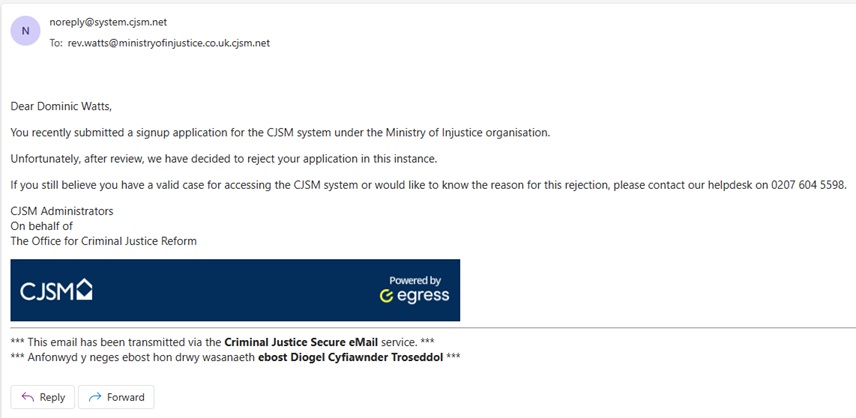
The CJSM application was rejected for the Ministry of Injustice so I setup my own CJSM email address [email protected]

If you have arrived at the Ministry of Injustice from https://cjsm.uk (MOI domain) you may well have been looking for https://cjsm.net which is the official website for The Criminal Justice Secure eMail (CJSM).

Is CJSM Secure ?

The Criminal Justice Secure Mail (CJSM) service is designed to be secure for its intended purpose, transmitting sensitive information up to the “OFFICIAL” and “OFFICIAL-SENSITIVE” classification levels within the UK criminal justice system.

However, its security has been debated due to historical issues and the evolving nature of cyber threats.

Security Strengths
  • End-to-End Encryption: CJSM uses dedicated servers to encrypt emails and attachments (up to 10MB) between registered users, ensuring data confidentiality during transmission. This aligns with UK government standards for handling sensitive justice-related data.
  • Multi-Factor Authentication (MFA): Access to the CJSM portal requires MFA, reducing the risk of unauthorized logins.
  • Restricted Access: Only approved organizations (e.g., police, courts, legal firms) can register, with strict vetting processes. This limits exposure to external threats.
  • Operational Oversight by Egress: Since Egress took over in 2019, they’ve addressed some legacy vulnerabilities (e.g., outdated protocols like RC4 and SSLv3 used under Vodafone). Egress’s expertise in secure email and compliance with ISO 27001 and Cyber Essentials Plus bolsters trust.
  • No Major Breaches Reported: Despite past concerns, no significant data breaches have been publicly documented, indicating functional security for its scope.
  • Policy Safeguards: CJSM prohibits storing emails on unapproved cloud services and restricts overseas access, minimizing data leakage risks.
Historical Security Issues (Pre-2019)

When Vodafone managed CJSM, security flaws were flagged in 2015, raising concerns that persist in discussions about the system’s legacy:

  • Outdated Encryption: Reliance on RC4 (a weak cipher) and SSLv2/SSLv3 protocols, vulnerable to attacks like POODLE.
  • Weak Certificates: Use of a self-signed 1024-bit RSA key, inadequate for modern standards.
  • Poor SSL/TLS Rating: An “F” grade from SSL Labs due to insecure cipher suites, prompting some organizations to block CJSM traffic.
  • Audit Gaps: Ineffective penetration testing failed to address these vulnerabilities promptly. While Egress has likely mitigated these (e.g., upgrading to stronger TLS protocols), specific technical details post-2019 are not publicly disclosed, as is typical for government systems.

Tender and the Transition to Cross Justice Secure Mail (CJSM Replacement)

While Egress operates the current CJSM, the UK Ministry of Justice (MoJ) is actively procuring a new system called Cross Justice Secure Mail to replace it. This upgrade aims to modernise secure email, file encryption and disaster recovery across justice partners.

The tender for Cross Justice Secure Mail (CJSM), the replacement for the existing Criminal Justice Secure Mail (CJSM) service, was issued by the UK Ministry of Justice (MoJ).

It aims to procure a modernized secure email, file encryption, and disaster recovery platform to support over 500,000 users across the criminal justice system in England, Wales, Scotland, and Northern Ireland.

The procurement follows a selective restricted procedure under the Procurement Act 2023, with submissions via the MoJ’s Jaggaer eSourcing Portal.

Key Timeline
  • Procurement Launch: November 8th 2024
  • Tender Submission Deadline: December 13th 2024 (bids closed)
  • Contract Award: Expected in late 2025
  • Implementation Phase: Up to 12 months, starting October 27th 2025
  • Live Service Phase: 60 months (5 years), from October 2026 to October 2031
  • Extensions: Up to 24 months (two 12-month periods), for a maximum total of 8 years
Contract Value
  • Estimated Total: £26–30 million (depending on final scope)
  • Influencing Factors:
    • Tendered prices and implementation plans
    • Uptake of optional services
    • Extension options exercised
    • Participation by additional contracting authorities (e.g., police, courts, probation services)

As of the 1st October 2025, the evaluation phase is ongoing with no award of contract announced yet.

Check out our related articles on Rule of Law, Open Justice, Is the Law Black and White ?, What Does Lady Justice Symbolise ?, Can a Judge Direct a Jury to Find a Defendant Not Guilty ?,Law Society, Law Commission, Solicitors, Solicitors Regulation Authority, Barristers, Bar Council of England and Wales, Bar Standards Board, Contra Mundum, R v Sussex Justices, Police Impartiality and the highly questionable Sussex Family Justice Board.


The Ministry of Injustice is not the Ministry of Justice nor is it affiliated in any way with the justice system, legal profession, police or any other law enforcement agencies.


Latest Articles


Most Popular


You should always seek formal legal advice from a qualified and reputable lawyer (solicitor or barrister).

There are a number of links to Free and Paid For Legal Resources and Legal Organisations on the Free Legal Advice , Legal Aid and Pro Bono pages.

Categories
Criminal Justice Law Legal Analysis Legal Professionals

What is a Defendant’s Costs Order ?

A Defendant’s Costs Order (DCO) under Section 16 of the Prosecution of Offences Act 1985, is a court order that enables a defendant who is found not guilty (or whose case is dismissed) to reclaim reasonable expenses they incurred while defending themselves in court.

These costs can include legal fees, travel expenses or other out-of-pocket costs directly related to the case.

Key Provisions of Section 16 Prosecution of Offences Act 1985

Section 16 of the Act provides the legal framework for courts to award costs to acquitted defendants. The main points are:

  1. Eligibility:
    • The defendant must be acquitted of the charges or have the case against them discontinued/dismissed.
    • The order typically applies to defendants who privately funded their defense. If legal aid was used, a DCO is generally not applicable, as the state already covered legal costs.
  2. Types of Costs Recoverable:
    • Legal costs: Fees paid to solicitors or barristers for representation.
    • Out-of-pocket expenses: Costs like travel to court, accommodation (if necessary), or loss of earnings due to court attendance.
    • Costs must be deemed reasonable and directly related to the defense.
  3. Court’s Discretion:
    • The court has the authority to decide whether to grant a DCO and how much to award.
    • Factors considered include:
      • Whether the prosecution acted unreasonably in bringing or conducting the case (e.g., insufficient evidence or procedural errors).
      • The financial impact on the defendant.
      • The reasonableness of the costs claimed.
    • If the prosecution’s case was reasonable, even if it failed, the court may refuse to award costs.
  4. Funding Source:
    • Costs awarded under a DCO are typically paid from central funds (government funds), not by the prosecution directly unless specific misconduct by the prosecution is identified.

Criminal Practice Directions

The Criminal Practice Directions 2023 (CPD) provide guidance on the application of the Criminal Procedure Rules in England and Wales, including how costs, such as a Defendant’s Costs Order (DCO) under Section 16 of the Prosecution of Offences Act 1985, are handled in criminal cases.

Specifically, Practice Direction (Costs in Criminal Proceedings) 2015 sections 2.1 (Magistrates Court), 2.2 (Crown Court), 2.3 (High Court) and 2.4 (Court of Appeal – Criminal Division) addresses the principles for awarding costs from central funds in criminal proceedings.

Application Process

  • When to Apply: The application for a DCO is usually made by the defendant or their legal representative at the end of the trial, immediately after the acquittal.
  • Evidence Required: The defendant must provide evidence of costs, such as invoices for legal fees, travel receipts, or proof of lost earnings.
  • Court Decision: The magistrates will review the application and decide whether to grant the order and what amount is reasonable. The awarded amount may not cover all expenses if some are deemed excessive.

Limitations

  • Not Automatic: A DCO is not guaranteed, even if acquitted. The court may refuse if it believes the prosecution acted appropriately or if costs are not sufficiently justified.
  • Reasonable Costs Only: The court will only cover costs considered proportionate and necessary. Extravagant legal fees or unrelated expenses are unlikely to be reimbursed.
  • No Punitive Element: The DCO is meant to compensate, not punish the prosecution, so awards are limited to actual losses.

Practical Considerations

  • Privately Funded Defendants: Those who paid for their own defense are the primary beneficiaries. If you used legal aid, you typically cannot claim additional costs under a DCO.
  • Magistrates’ Court Context: In magistrates’ courts, where cases are often less complex than in Crown Courts, the costs claimed are usually lower, but the principles of Section 16 still apply.
  • Appeals: If a DCO is refused or the amount awarded is insufficient, there may be limited grounds to appeal, typically requiring evidence of a legal error by the court.

Example Scenario

If you were charged with a minor offense (e.g., a traffic violation) in a magistrates’ court, hired a private solicitor, and were acquitted, you could apply for a DCO to recover your solicitor’s fees and travel costs to court.

If the court finds that the prosecution’s case was weak or improperly brought, they may award costs from central funds, but only up to an amount they deem reasonable.

Additional Notes

  • Time Limits: Applications for a DCO should be made promptly, typically at the hearing where the acquittal is granted, though courts may allow later applications in exceptional cases.
  • Legal Advice: A solicitor can help calculate and justify costs to maximize the chances of a successful DCO application.
  • Other Jurisdictions: This explanation applies to England and Wales. Rules in Scotland, Northern Ireland, or other jurisdictions may differ.

Check out our related articles on Public Spaces Protection Order (PSPO), Norwich Pharmacal Orders, Wasted Costs Order, Rule of Law, Open Justice, Is the Law Black and White ?, Abuse of Process, What Does Lady Justice Symbolise ?, McKenzie Friend, Can a Judge Direct a Jury to Find a Defendant Not Guilty ?,Law Society, Law Commission, McKenzie Friend Right of Audience, Solicitors, Solicitors Regulation Authority, Barristers, Bar Council of England and Wales, Bar Standards Board, Contra Mundum, R v Sussex Justices, Police Impartiality and the highly questionable Sussex Family Justice Board.


The Ministry of Injustice is not the Ministry of Justice nor is it affiliated in any way with the justice system, legal profession, police or any other law enforcement agencies.


Latest Articles


Most Popular


You should always seek formal legal advice from a qualified and reputable lawyer (solicitor or barrister).

There are a number of links to Free and Paid For Legal Resources and Legal Organisations on the Free Legal Advice , Legal Aid and Pro Bono pages.

Categories
Criminal Justice Law Legal Analysis

What is the Youth Justice Board for England and Wales ?

The Youth Justice Board (YJB) for England and Wales is dedicated to overseeing and improving youth justice services.

We are an organisation of around 100 people and our headquarters is in London.

Our vision is for a youth justice system that sees children as children, treats them fairly and helps them to build on their strengths so they can make a constructive contribution to society. This will prevent offending and create safer communities with fewer victims.

Youth Justice Board – About Us

Established under the Crime and Disorder Act 1998, the YJB is a non-departmental public body sponsored by the Ministry of Justice. Its primary role is to ensure that the youth justice system effectively prevents offending and reoffending by children and young people under 18, while safeguarding their welfare.

Below, we explore the YJB’s purpose, structure, and key functions.

Leadership

The Youth Justice Board (YJB) for England and Wales is led by a board of experts and a chief executive, with oversight from the Ministry of Justice.

  • Chair: The YJB is chaired by Keith Fraser. The chair leads the board, providing strategic direction and ensuring effective governance. Keith Fraser, appointed in 2020, brings experience from policing and public sector leadership, with a focus on diversity and inclusion in justice systems.
  • Chief Executive: Steph Roberts-Bibby serves as the Chief Executive, overseeing day-to-day operations and implementing the board’s strategies. Sturt, who joined in 2020, has a background in criminal justice, having previously held senior roles in the prison and probation services.

The Board has corporate responsibility for ensuring that the YJB fulfils its strategic objectives, which are agreed with the Secretary of State for Justice, and for ensuring the efficient and effective use of staff and other resources.

The Chair and board members are appointed by the Secretary of State for Justice.

Purpose and Objectives

The YJB aims to create a youth justice system that is fair, effective, and focused on rehabilitation. Its core mission is to prevent crime by young people through early intervention, robust supervision, and tailored support. The board strives to balance accountability with the welfare of young offenders, recognising that many have complex needs, such as mental health issues or disadvantaged backgrounds. By promoting positive outcomes, the YJB seeks to reduce reoffending rates and help young people reintegrate into society as law-abiding citizens.

A key objective is to ensure the system is child-centred. This means decisions prioritise the best interests of the child, aligning with the principles of the United Nations Convention on the Rights of the Child. The YJB also works to address disparities, ensuring equitable treatment for all young people, regardless of background.

  • using information and evidence to form an expert view of how to get the best outcomes for children who offend and for victims of crime
  • advising the Secretary of State for Justice, government departments, local authorities, those working in youth justice services and other organisations about how well the system is operating, and how improvements can be made
  • identifying and sharing best practice
  • promoting the voice of the child, including taking advice from our youth advisory panel of children and young adults who have current or previous experience of the youth justice system
  • commissioning research and publishing information in connection with good practice
  • monitoring the youth justice system and the provision of youth justice services
  • making grants, with the approval of the Secretary of State, for the purposes of the operation of the youth justice system and services
  • providing information technology related assistance for the operation of the youth justice system and services
Youth Justice Board – Our Responsibilities

Structure and Governance

The YJB is led by a board of experts appointed by the Secretary of State for Justice. This board includes professionals with expertise in youth justice, social work, policing, and education, ensuring a multidisciplinary approach. The organisation is chaired by an appointed leader, with a chief executive overseeing day-to-day operations. It operates independently but collaborates closely with government departments, local authorities, and youth offending teams (YOTs).The YJB is headquartered in London but works nationally, engaging with regional services to implement its strategies. It reports to Parliament through the Ministry of Justice and is subject to scrutiny to ensure transparency and accountability.

Key Functions

The YJB’s responsibilities are wide-ranging. It sets standards for youth justice services, monitors their performance, and provides guidance to YOTs, which are local multi-agency teams managing young offenders. The board also oversees the secure estate, ensuring safe and rehabilitative environments for young people in custody, such as young offender institutions.

Additionally, the YJB promotes evidence-based practices by commissioning research and sharing best practices. It advises ministers on youth justice policy and advocates for systemic improvements. The board also allocates funding to YOTs and other initiatives, ensuring resources are used effectively to support prevention and rehabilitation.

Impact and Challenges

Since its inception, the YJB has contributed to a significant decline in youth offending rates, with fewer young people entering the justice system. However, challenges remain, including addressing over-representation of minority groups and supporting young people with complex needs. By fostering collaboration and innovation, the YJB continues to shape a more effective and compassionate youth justice system.

For more information, visit the Youth Justice Board for England and Wales official page on the UK government website.

Check out our related articles on Rule of Law, Open Justice, Is the Law Black and White ?, Family Justice Board, Civil Justice Council, Abuse of Process, What Does Lady Justice Symbolise ?, McKenzie Friend, Wasted Costs Order, Can a Judge Direct a Jury to Find a Defendant Not Guilty ?,Law Society, Law Commission, McKenzie Friend Right of Audience, Solicitors, Solicitors Regulation Authority, Barristers, Bar Council of England and Wales, Bar Standards Board, Contra Mundum, R v Sussex Justices, Police Impartiality and the highly questionable Sussex Family Justice Board.


The Ministry of Injustice is not the Ministry of Justice nor is it affiliated in any way with the justice system, legal profession, police or any other law enforcement agencies.


Latest Articles


Most Popular


You should always seek formal legal advice from a qualified and reputable lawyer (solicitor or barrister).

There are a number of links to Free and Paid For Legal Resources and Legal Organisations on the Free Legal Advice , Legal Aid and Pro Bono pages.

Categories
Civil Justice Criminal Justice Family Law Law Legal Analysis Legal Professionals

What is a Wasted Costs Order ?

In the legal system of England and Wales, a wasted costs order is a mechanism used by courts to address improper, unreasonable, or negligent conduct by legal representatives that results in unnecessary costs in criminal, civil or family proceedings.

This article explains what a wasted costs order is, how it applies and its significance in ensuring fairness and efficiency in the judicial process.

Definition of a Wasted Costs Order

A wasted costs order is a court order that requires a legal representative—such as a solicitor, barrister, or other advocate—to personally bear the costs incurred due to their improper, unreasonable, or negligent conduct.

These costs may be payable to the opposing party, their own client, or, in criminal cases, sometimes to public funds (e.g., the Legal Aid Agency).

The concept is governed by Section 19A of the Prosecution of Offences Act 1985 for criminal cases, Section 51(6) of the Senior Courts Act 1981 for civil cases and family cases.

Further guidance provided by the Criminal Procedure Rules 2010 (CrimPR 45.8 and CrimPR 45.9), Civil Procedure Rules (CPR 46.8 and Practice Direction 46) and Family Procedure Rules (FPR 28.1), which incorporate CPR 46.8.

“Wasted costs” refer to expenses incurred unnecessarily as a direct result of a legal representative’s conduct, which could have been avoided had they acted appropriately.

This distinguishes wasted costs orders from standard cost orders, which typically arise from the outcome of a case rather than the behaviour of legal professionals.

When Can a Wasted Costs Order Be Made ?

The court has discretion to issue a wasted costs order in both civil and criminal proceedings, but it must satisfy a strict two-stage test, as established in Ridehalgh v Horsefield [1994] Ch 205 for civil cases and reflected in criminal case law such as R v P [2011] EWCA Crim 1130. The two stages are:

  1. Improper, Unreasonable, or Negligent Conduct: The court must determine that the legal representative’s actions were improper, unreasonable, or negligent. For example:
    • Improper conduct includes dishonest or unethical behaviour, such as deliberately misleading the court or pursuing a baseless case.
    • Unreasonable conduct involves actions that are vexatious or misguided, such as persisting with a hopeless defence or prosecution in a criminal case.
    • Negligent conduct refers to failing to meet the standard of care expected of a competent legal professional, such as missing court deadlines or failing to prepare adequately.
  2. Causation of Wasted Costs: The court must be satisfied that the conduct directly caused unnecessary costs. For instance, if a barrister’s failure to advise a defendant properly in a criminal case leads to an unnecessary hearing, the costs of that hearing may be deemed “wasted.”

Courts exercise significant caution when issuing wasted costs orders due to their serious professional and financial implications for legal representatives. The burden of proof lies with the party seeking the order (or the court, if acting on its own initiative), and the threshold for proving misconduct is high.

Making an Application in Criminal, Civil and Family Proceedings

Criminal Proceedings

In criminal cases, wasted costs orders are addressed under Section 19A of the Prosecution of Offences Act 1985 and CrimPR 45.8 (which covers costs resulting from unnecessary or improper acts or omissions) and CrimPR 45.9 (which specifically deals with applications for wasted costs orders against legal representatives). These orders can apply to both prosecution and defence counsel and may involve costs payable to the opposing party, the client, or public funds (e.g., legal aid). Examples of conduct leading to wasted costs in criminal cases include:

  • A prosecution lawyer pursuing a case without sufficient evidence, causing unnecessary court hearings.
  • A defence lawyer failing to advise a client properly, leading to a trial that could have been avoided through a guilty plea or withdrawal.
  • Missing procedural deadlines, resulting in wasted court time or resources.

For instance, in R v Farooqi [2013] EWCA Crim 1649, the Court of Appeal considered a wasted costs order against a barrister whose conduct was deemed improper, though the order was ultimately not imposed due to procedural issues.

The Criminal Procedure Rule Committee and Ministry of Justice publish the Application for a wasted, etc. costs order under CrimPR 45.8, 45.9 or 45.10 form which must be served on the court and other parties.

Civil Proceedings

In civil cases, wasted costs orders are governed by CPR 46.8 and Section 51(6) of the Senior Courts Act 1981. They are typically sought by the opposing party who has incurred unnecessary costs due to the other side’s legal representative’s conduct or by a client against their own lawyer. Examples include pursuing a claim with no reasonable prospect of success or failing to comply with court orders, leading to adjournments.

  • A party can apply for a wasted costs order by filing an application notice in accordance with Part 23 of the CPR or by making an oral application during a hearing.
  • The court can also make a wasted costs order of its own initiative. 
Family Proceedings

There is no specific form titled “Application for a Wasted Costs Order” for family proceedings, just as in civil proceedings. Instead, applications are made under FPR Part 18 (Applications in Family Proceedings), which mirrors CPR Part 23.

In family proceedings, the Form C2 is typically used for applications within existing proceedings (e.g., children’s cases), while Form N244 (the standard civil application form) is used for financial remedy proceedings or where no specific family form applies.

Who Can Apply for a Wasted Costs Order ?

A wasted costs order can be sought by:

  • The opposing party in criminal, civil or family proceedings, who has incurred unnecessary costs due to the other side’s legal representative’s conduct.
  • The legal representative’s own client, if they have suffered financial loss as a result of their lawyer’s actions (e.g., wasted legal fees or costs of unnecessary proceedings).
  • The court itself, which can initiate a wasted costs order on its own motion (suo motu) if it identifies egregious conduct during proceedings.

In criminal cases, the court may also consider the impact on public funds, particularly where legal aid is involved.

The court may require written submissions or a hearing to determine whether the order is justified. Appeals against wasted costs orders in criminal proceedings follow CrimPR Part 34 (for magistrates’ courts to the Crown Court) or CrimPR Part 39 (for Crown Court to the Court of Appeal).

Examples of Conduct Leading to Wasted Costs Orders

Some examples of conduct that might lead to a wasted costs order in civil or criminal proceedings include:

  • Pursuing a case (civil or criminal) with no realistic prospect of success, such as a baseless civil claim or a criminal defence lacking any evidential foundation.
  • Failing to comply with court orders or procedural rules, leading to adjournments or additional hearings.
  • Providing misleading information to the court or failing to disclose relevant facts, such as withholding key evidence in a criminal trial.
  • Acting in a way that unnecessarily prolongs proceedings, such as making frivolous applications or failing to prepare adequately for trial.

Implications and Considerations

Wasted costs orders serve as a deterrent against poor professional conduct and promote fairness and efficiency in both civil and criminal proceedings. They protect parties from bearing the financial burden of their opponent’s or their own lawyer’s misconduct and, in criminal cases, safeguard public funds.

However, courts are cautious about issuing such orders for several reasons:

  • Professional Consequences: A wasted costs order can harm a lawyer’s reputation and financial standing, so courts ensure the evidence is robust and the conduct sufficiently serious.
  • Access to Justice: Courts avoid discouraging lawyers from taking on challenging cases or acting fearlessly, particularly in criminal defence work, where robust advocacy is essential.
  • Proportionality: The costs claimed must be proportionate to the misconduct, and minor errors or oversights are unlikely to justify an order.

Legal representatives are typically given an opportunity to respond to allegations of misconduct before an order is made, ensuring fairness and due process. In criminal cases, the court may also consider the public interest and the impact on legal aid budgets.

Conclusion

In England and Wales, a wasted costs order is a vital tool to address improper, unreasonable, or negligent conduct by legal representatives in criminal, civil and proceedings.

Governed by statute and procedural rules, these orders ensure accountability, protect parties from unnecessary costs, and uphold the integrity of the judicial process.

While rarely used due to their high threshold and significant implications, wasted costs orders play a crucial role in maintaining professionalism and efficiency in the legal system. Legal representatives must act with diligence and integrity to avoid the serious consequences of such an order.

Check out our related articles on Defendant’s Costs Order, Norwich Pharmacal Orders, Public Spaces Protection Order (PSPO), Rule of Law, Open Justice, Is the Law Black and White ?, Abuse of Process, What Does Lady Justice Symbolise ?, McKenzie Friend, Can a Judge Direct a Jury to Find a Defendant Not Guilty ?,Law Society, Law Commission, McKenzie Friend Right of Audience, Solicitors, Solicitors Regulation Authority, Barristers, Bar Council of England and Wales, Bar Standards Board, Contra Mundum, R v Sussex Justices, Police Impartiality and the highly questionable Sussex Family Justice Board.


The Ministry of Injustice is not the Ministry of Justice nor is it affiliated in any way with the justice system, legal profession, police or any other law enforcement agencies.


Latest Articles


Most Popular


You should always seek formal legal advice from a qualified and reputable lawyer (solicitor or barrister).

There are a number of links to Free and Paid For Legal Resources and Legal Organisations on the Free Legal Advice , Legal Aid and Pro Bono pages.

Categories
Criminal Justice Law Legal Analysis Police

Police Surveillance

The case of R v Sutherland & Others [2002] EW Misc 1 (EWCC) stands as a seminal case that highlights the critical importance of transparency in criminal investigations and the protection of defendants’ rights to a fair trial under Article 6 of the Human Rights Act 1998.

This high-profile murder trial collapsed due to improper police conduct, leaving a lasting impact on the application of the Criminal Procedure and Investigations Act 1996 (CPIA) and the Regulation of Investigatory Powers Act 2000 (RIPA).

The case serves as a stark reminder of the boundaries of lawful surveillance and the necessity of proper disclosure in criminal proceedings.

Background of the Case

The case involved Robert Sutherland and four co-defendants, charged with murder and conspiracy to murder following a fatal incident in the Midlands.

The prosecution’s case hinged on evidence obtained through covert surveillance, including audio recordings made at Grantham and Sleaford police stations.

However, it was revealed that the police had secretly recorded privileged conversations between the defendants and their legal advisors, violating the defendants’ right to confidential legal consultation.

This misconduct led to an application to stay the proceedings on the grounds of abuse of process, arguing that the surveillance had fatally undermined the trial’s fairness.

The High Court judge agreed, ruling that the police had “made a mockery of the police caution” and “undermined the statutory right of a defendant to confer with a solicitor in private.” As a result, the case was dismissed, and all defendants were acquitted.

Impact on Disclosure Obligations

R v Sutherland & Others [2002] significantly clarified disclosure obligations under the CPIA 1996. The Act requires the prosecution to disclose all material that might undermine their case or assist the defence.

The case established that even non-incriminating surveillance evidence, such as recordings yielding no useful evidence, must be disclosed. The court emphasised that the existence of surveillance itself is material, as it may support defence arguments questioning the investigation’s thoroughness or integrity.

For example, extensive surveillance producing no incriminating results could strengthen a claim of innocence. This ruling has shaped how prosecution teams manage evidence, stressing meticulous record-keeping and transparency to ensure fairness.

Implications for Surveillance Practices

The case also exposed serious issues with police surveillance under RIPA 2000, which governs covert investigative techniques.

The unauthorised recording of privileged communications breached RIPA’s requirements for lawful, proportionate, and authorised surveillance.

The court’s strong condemnation highlighted the risks of overreach in surveillance operations and their potential to derail prosecutions.

This aspect of the case has led to increased scrutiny of police practices and reinforced the importance of independent oversight, such as by Surveillance Commissioners, to ensure compliance with RIPA.

Directed Surveillance Authority under the Regulation of Investigatory Powers Act 2000

The Regulation of Investigatory Powers Act 2000 (RIPA) provides the legal framework for authorising directed surveillance in the UK, which involves covert monitoring of individuals’ activities in non-intrusive settings, such as public places, to gather intelligence for investigations.

Directed Surveillance Authority (DSA) under RIPA requires that such operations be necessary, proportionate, and approved by a designated senior officer within a public authority, such as the police or intelligence services.

The DSA ensures compliance with strict criteria to prevent abuse, safeguarding individuals’ privacy while enabling lawful investigations. Oversight by the Investigatory Powers Commissioner’s Office (IPCO) ensures adherence to RIPA’s guidelines, with failures to comply, as seen in cases like R v Sutherland & Others [2002], potentially leading to evidence being deemed inadmissible and undermining prosecutions.

As per the requirements of R v SUTHERLAND, if the task has a RIPA / DSA authorisation, NPAS will require a full copy of the DSA authorisation detailing exactly what is (and isn’t) authorised and the means by which it can be obtained, details of the authorising officer, date authorised and the review / expiry dates before that tasking can be actioned.

National Police Air Service – NPAS – OPERATIONS CENTRE FORM – REQUEST FOR PRE-PLANNED AIR SUPPORT

Broader Consequences and Legacy

The collapse of the trial raised concerns about public confidence in the criminal justice system. The acquittal, while legally justified, left the victim’s family feeling “completely let down,” underscoring the human cost of investigative failures.

The case has been widely cited in discussions about the ethical limits of covert operations and the need for robust training for law enforcement.

The Signature Brand have integrated the case into training on disclosure and covert tactics, highlighting its practical implications. For defence lawyers, it provides a powerful tool to challenge prosecution cases by scrutinising disclosure completeness, particularly in surveillance-heavy cases.

Conclusion

R v Sutherland & Others [2002] remains a cornerstone of UK case law, reinforcing the principles of fairness, transparency, and accountability in criminal proceedings.

Its legacy continues to influence how surveillance evidence and disclosure are handled, ensuring defendants’ rights are protected while upholding judicial integrity. The case serves as a cautionary tale that procedural missteps, even if well-intentioned, can have profound consequences, highlighting the delicate balance between effective policing and adherence to the rule of law.

Check out our articles on Policing by Consent, Are the Police for Hire ?, Police Impartiality, Police Professional Standards, Independent Office for Police Conduct (IOPC),Police Public Confidence and Engagement, Crime Reporting, What is a Police and Crime Commissioner ?, Sussex Police, Policing, Police News, Two Tiered Policing, Thought Police, Wasting Police Time, Police Community Support Officers (PCSO), Met Police, Free Speech Union, Chief Constable Jo Shiner, R v Sussex Justices and the highly questionable Sussex Family Justice Board.


The Ministry of Injustice is not the Ministry of Justice nor is it affiliated in any way with the justice system, legal profession, police or any other law enforcement agencies.


Latest Articles


Most Popular


You should always seek formal legal advice from a qualified and reputable lawyer (solicitor or barrister).

There are a number of links to Free and Paid For Legal Resources and Legal Organisations on the Free Legal Advice , Legal Aid and Pro Bono pages.
Categories
Criminal Justice Law Legal Analysis

What is an Abuse of Process in Criminal Law ?

In criminal law an abuse of process occurs when the criminal justice system is misused in a way that undermines fairness, justice or the integrity of legal proceedings.

It involves actions that exploit the judicial process for improper purposes, such as harassing a defendant, causing unjust delays, or pursuing a case without legitimate grounds.

The concept is enshrined in the court’s inherent jurisdiction to protect its processes, as guided by the Criminal Procedure Rules 2020(CrimPR) and established case law.

Defining Abuse of Process

An abuse of process arises when the prosecution’s conduct or case circumstances render a fair trial impossible or unjust.

CPR Rule 3.28, part of the case management framework, empowers courts to give directions to ensure proceedings are conducted efficiently and fairly, which includes identifying and addressing potential abuses of process.

This rule supports the overriding objective in CPR 1.1 to deal with cases justly, ensuring fairness, efficiency, and compliance with the European Convention on Human Rights and Human Rights Act 1998, particularly Article 6 (right to a fair trial). Examples of abuse of process include:

  1. Improper Motives: Prosecuting to harass or intimidate rather than seek justice.
  2. Unreasonable Delay: Excessive delays that prejudice the defendant’s defence, such as faded memories or lost evidence.
  3. Non-Disclosure: Failing to disclose exculpatory evidence, breaching the Criminal Procedure and Investigations Act 1996.
  4. Entrapment: Inducing a defendant to commit a crime they would not otherwise have committed.
  5. Bad Faith Prosecutions: Pursuing a case without sufficient evidence or for ulterior motives, like political pressure.

Legal Framework

The Criminal Procedure Rules 2020 (CrimPR) are a comprehensive set of rules governing the practice and procedure of criminal courts in England and Wales. They provide a framework to ensure criminal cases are managed justly, efficiently, and fairly, as mandated by the Courts Act 2003, which empowers the Criminal Procedure Rule Committee to make these rules.

CrimPR 1.1, the overriding objective, requires courts to manage cases to avoid unfairness, inefficiency, or prejudice. Unlike specific statutory provisions in other contexts, criminal abuse of process relies on judicial discretion and precedent.

1.1.—(1) The overriding objective of this procedural code is that criminal cases be dealt with justly.

(2) Dealing with a criminal case justly includes―

(a) acquitting the innocent and convicting the guilty;

(b) treating all participants with politeness and respect;

(c) dealing with the prosecution and the defence fairly;

(d) recognising the rights of a defendant, particularly those under Article 6 of the European Convention on Human Rights;

(e) respecting the interests of witnesses, victims and jurors and keeping them informed of the progress of the case;

(f) dealing with the case efficiently and expeditiously;

(g) ensuring that appropriate information is available to the court when bail and sentence are considered; and

(h) dealing with the case in ways that take into account―

(i) the gravity of the offence alleged,

(ii) the complexity of what is in issue,

(iii) the severity of the consequences for the defendant and others affected, and

(iv) the needs of other cases.

The Criminal Procedure Rules 2020 – 1.1 The Overriding Objective

CrimPR 1.2 outlines the duty of all participants in a criminal case to actively assist the court in achieving the overriding objective.

1.2.—(1) Each participant, in the conduct of each case, must―

(a) prepare and conduct the case in accordance with the overriding objective;

(b) comply with these Rules, practice directions and directions made by the court; and

(c) at once inform the court and all parties of any significant failure (whether or not that participant is responsible for that failure) to take any procedural step required by these Rules, any practice direction or any direction of the court. A failure is significant if it might hinder the court in furthering the overriding objective.

(2) Anyone involved in any way with a criminal case is a participant in its conduct for the purposes of this rule.

The Criminal Procedure Rules 2020 – 1.2 The duty of the participants in a criminal case

CrimPR 3.28 allows courts to give directions for the effective management of criminal cases, which includes addressing abuses of process. While the rule itself focuses on case progression, it enables judges to scrutinise proceedings for potential misuse, ensuring they align with the overriding objective of fairness.

3.28.—(1) This rule applies where a defendant wants the Crown Court to stay the case on the grounds that the proceedings are an abuse of the court, or otherwise unfair.

(2) Such a defendant must—

(a) apply in writing—

(i) as soon as practicable after becoming aware of the grounds for doing so,

(ii) at a pre-trial hearing, unless the grounds for the application do not arise until trial, and

(iii) in any event, before the defendant pleads guilty or the jury (if there is one) retires to consider its verdict at trial;

(b) serve the application on—

(i) the court officer, and

(ii) each other party; and

(c) in the application—

(i) explain the grounds on which it is made,

(ii) include, attach or identify all supporting material,

(iii) specify relevant events, dates and propositions of law, and

(iv) identify any witness the applicant wants to call to give evidence in person.

(3) A party who wants to make representations in response to the application must serve the representations on—

(a) the court officer; and

(b) each other party,

not more than 10 business days after service of the application.

The Criminal Procedure Rules 2020 – 3.28 Application to stay case for abuse of process

The landmark case R v Horseferry Road Magistrates’ Court, ex parte Bennett [1994] 1 AC 42 established that courts can stay or dismiss proceedings deemed abusive. Rule 3.28 supports this by providing a mechanism for courts to intervene when proceedings risk unfairness or oppression.

Unlike specific statutory provisions in other contexts, criminal abuse of process relies on judicial discretion, with Rule 3.28 facilitating proactive case management to prevent or remedy abuses. Courts assess whether continuing a case would undermine public confidence or violate defendants’ rights.

Judicial Response

Courts have broad powers to address abuse of process, including:

  • Staying Proceedings: Halting a case if a fair trial is impossible or unjust, as supported by CrimPR Rule 3.28 directions.
  • Dismissing Charges: Dropping charges due to prosecutorial misconduct.
  • Excluding Evidence: Suppressing improperly obtained evidence under Section 78 of the Police and Criminal Evidence Act 1984.

For instance, in R v Beckford [1996] 1 Cr App R 94, non-disclosure of evidence was deemed an abuse, prompting judicial intervention. Similarly, R v Maxwell [2010] UKSC 48 clarified that remedies depend on the abuse’s severity and impact on fairness.

Importance of Preventing Abuse of Process

Preventing abuse of process, as facilitated by CrimPR Rule 3.28, is vital to maintaining public trust in the criminal justice system. It protects defendants from oppressive treatment, ensures efficient use of court resources, and upholds the integrity of proceedings.

Check out our related articles on Rule of Law, Open Justice, Is the Law Black and White ?, What Does Lady Justice Symbolise ?, Wasted Cost Orders, McKenzie Friend, Can a Judge Direct a Jury to Find a Defendant Not Guilty ?, Law Society, Law Commission, McKenzie Friend Right of Audience, Solicitors, Solicitors Regulation Authority, Barristers, Bar Council of England and Wales, Bar Standards Board, Contra Mundum, R v Sussex Justices, Police Impartiality and the highly questionable Sussex Family Justice Board.


The Ministry of Injustice is not the Ministry of Justice nor is it affiliated in any way with the justice system, legal profession, police or any other law enforcement agencies.


Latest Articles


Most Popular


You should always seek formal legal advice from a qualified and reputable lawyer (solicitor or barrister).

There are a number of links to Free and Paid For Legal Resources and Legal Organisations on the Free Legal Advice , Legal Aid and Pro Bono pages.
Categories
Criminal Justice Law Legal Analysis

McKenzie Friends and Right of Audience in a Magistrates or Crown Court

A McKenzie Friend can provide moral support, take notes, help organise case papers, and offer quiet advice on the conduct of the case. They do not have an automatic right to act as an advocate, conduct litigation, or address the court.

Can a McKenzie Friend Help You in Court? Everything* You Need to Know!Alan Robertshaw Barrister

Right of Audience

In criminal proceedings, McKenzie Friends generally do not have a right of audience. This means they cannot speak on behalf of the litigant, make oral submissions or examine witnesses unless the court explicitly grants permission.

The court may grant a right of audience in exceptional circumstances, but this is rare. The decision is at the discretion of the presiding magistrate or judge, guided by the interests of justice.

Examples of exceptional circumstances may include:

  • The litigant has health issues preventing them from effectively addressing the court.
  • The litigant lacks the ability to articulate their case (e.g., due to language barriers or intellectual limitations).
  • The complexity of the case requires assistance to ensure a fair hearing.

Criminal vs Family and Civil Procedure

Unlike civil and family proceedings, where guidance like the Practice Guidance: McKenzie Friends (Civil and Family Courts) (2010) applies, criminal proceedings are not explicitly covered by this guidance.

Courts in criminal cases are more cautious about granting rights of audience due to the serious nature of criminal proceedings, which involve public interest and potential penalties like imprisonment.

The Legal Services Act 2007 (sections 12–19 and Schedule 3) makes it a criminal offense for an unqualified person to exercise rights of audience or conduct litigation unless authorised by the court on a case-by-case basis.

Court’s Discretion and Restrictions

A litigant must request permission for a McKenzie Friend to have a right of audience at the start of the hearing. The court will consider factors such as:

  • The litigant’s ability to represent themselves.
  • The complexity of the legal issues.
  • Whether the McKenzie Friend’s involvement would impede the administration of justice.

The court may refuse or revoke permission if the McKenzie Friend disrupts proceedings, acts improperly, or breaches confidentiality.

The court may also require the McKenzie Friend to provide their name, contact details, and a statement confirming they understand their role and duties, including confidentiality.

Court Denying a McKenzie Friend the Right of Audience

A judge is expected to provide reasons when denying a McKenzie friend the right of audience (permission to speak on behalf of a litigant in person).

This aligns with principles of fairness and transparency under Legal Services Act 2007 (c. 29), specifically under sections 208, 210, 211, Schedule 21 paragraph 84(d), and Schedule 23, which gives courts discretion to grant such rights only for “good reason,” typically in exceptional circumstances.

The Practice Guidance on McKenzie Friends (Civil and Family Courts) [2010] 1 WLR 1881 emphasises that decisions should be justified to ensure litigants understand the basis for refusal, allowing for potential appeals by the litigant (not the McKenzie friend).

Practical Considerations

In magistrates’ courts, where proceedings are often faster-paced and less formal than in higher courts, magistrates may be more reluctant to allow a McKenzie Friend to speak, as the litigant is normally expected to represent themselves.

If a McKenzie Friend is granted a right of audience, their role is still limited to specific tasks (e.g., addressing a point of law or cross-examining a witness) rather than acting as a full advocate throughout the hearing.

Fee-charging McKenzie Friends are viewed with caution, and courts may scrutinise their involvement to ensure they are not acting as unqualified legal representatives.

Relevant Guidance and Rules

While the Practice Guidance: McKenzie Friends (Civil and Family Courts) (2010) does not apply to criminal cases, it provides a framework that courts may refer to analogously.

The Criminal Procedure Rules 2010 do not specifically address McKenzie Friends but emphasise the court’s overriding objective to deal with cases justly, which includes ensuring a fair hearing for unrepresented defendants.

Article 6 of the European Convention on Human Rights (incorporated into UK law via the Human Rights Act 1998) supports the right to a fair trial, which may bolster a litigant’s request for assistance from a McKenzie Friend.

Case Law and Precedents

McKenzie v McKenzie [1970] 3 WLR 472 CA: Established the principle that litigants in person have a right to reasonable assistance.

Clarkson v Gilbert [2000] 2 FLR 839: Clarified that the court has unfettered discretion to grant a right of audience, and such decisions should not be limited to “exceptional” circumstances but depend on the case’s specifics.

Re N (A Child) (McKenzie Friend: Rights of Audience) [2008] EWHC 2042 (Fam): Emphasised that granting a right of audience should serve the interests of justice and that courts should consider the practical realities of limited legal aid availability.

Limitations and Risks of McKenzie Friends

McKenzie Friends are not regulated like solicitors or barristers, so there is no guarantee of their competence or accountability. Courts may exclude a McKenzie Friend if they undermine the efficient administration of justice (e.g., by providing improper advice or disrupting proceedings).

Litigants using a McKenzie Friend cannot recover costs for their services from the opposing party, even if successful, as costs are limited to those of a litigant in person.

Explanation of Clarkson v Gilbert

Clarkson v Gilbert [2000] 2 FLR 839 is a significant Court of Appeal case in England and Wales that clarified the principles governing the granting of a right of audience to a non-lawyer, such as a McKenzie Friend or a close relative, under section 27(2)(c) of the Courts and Legal Services Act 1990.

The case is particularly relevant to litigants in person who seek assistance from unqualified individuals to represent them in court proceedings, including in criminal, civil, or family matters.

Factual and Procedural Background

Parties and Context: The claimant, Petruska Clarkson, a psychotherapist, initiated legal proceedings against multiple defendants (also psychotherapists) alleging conspiracy, inducement to breach contract, and libel. These claims arose after her suspension from the Gestalt Psychotherapy Training Institute.

McKenzie Friend: Clarkson’s husband, Vincent Keter, who had a law degree and had completed Bar finals but was not yet called to the Bar, sought to represent her in court. He applied for a right of audience to act as her advocate in the litigation, including at trial and interlocutory hearings.

Initial Order: On 14 May 1999, Morland J granted Keter an ex parte order (without notice to the defendants) allowing him rights of audience under section 27(2)(c) of the Courts and Legal Services Act 1990, citing Clarkson’s ill health (an angina attack and depression) and her lack of financial means to hire legal representation.

Challenge: The defendants applied to set aside Morland J’s order, arguing insufficient evidence (e.g., outdated medical reports) and Keter’s questionable conduct, including misrepresenting himself as an advocate. On 16 December 1999, Eady J set aside the order, prompting Clarkson’s appeal to the Court of Appeal.

Appeal: The Court of Appeal, presided over by Lord Woolf CJ, alongside Waller LJ and Clarke LJ, heard the appeal on 14 June 2000. The key issue was whether Keter, as a close relative and non-lawyer, should be granted a right of audience to represent Clarkson.

Legal Issues

The court addressed the following legal questions:

  • Whether a close relative, such as a spouse, should be granted a right of audience under section 27(2)(c) of the Courts and Legal Services Act 1990.
  • Whether “exceptional circumstances” are required to grant such rights to an unqualified person, particularly a family member.
  • The appropriate exercise of judicial discretion in such cases, balancing the interests of justice with the proper administration of the courts.
  • Court’s Reasoning and Decision: The Court of Appeal allowed Clarkson’s appeal, restoring Morland J’s order granting Keter rights of audience.
  • Judicial Discretion Under Section 27(2)(c): Section 27(2)(c) of the Courts and Legal Services Act 1990 allows courts to grant a right of audience to a person not otherwise entitled, in relation to specific proceedings, at the court’s discretion.
  • The court emphasised that this discretion is unfettered but must be exercised in light of the statutory objective in section 17(1) (to develop legal services while maintaining the proper administration of justice) and section 17(3) (general principles governing professional advocates).
  • Distinction Between Professional and Family Advocates: The court distinguished between unqualified individuals offering advocacy services generally (e.g., professional McKenzie Friends) and close relatives assisting a family member.

    For professional McKenzie Friends, the court typically requires exceptional circumstances to grant a right of audience, as established in D v S (Rights of Audience) [1997] 1 FLR 724. This is because such individuals may lack professional regulation and accountability. For close relatives, such as a spouse, the test is less stringent.

    The court held that the question is whether there is good reason to grant the right of audience, based on the specific circumstances of the case, rather than requiring exceptional circumstances.
  • Factors Justifying a Right of Audience: Lord Woolf CJ noted that the overriding objective is to ensure justice is done. With legal aid less readily available, litigants in person may need assistance to present their case effectively.

    Relevant factors include the litigant’s health (e.g., Clarkson’s angina and depression) and financial means (e.g., inability to afford legal representation after unsuccessful attempts to secure conditional fee arrangements or pro bono assistance).

    In this case, the court found that Clarkson’s health issues and lack of means justified allowing Keter to act as her advocate, as there was a risk she would be deprived of a fair hearing otherwise.
  • Critique of the Lower Court: The court held that Eady J erred by applying the “exceptional circumstances” test from D v S to a case involving a close relative.

    Clarke LJ clarified that the discretion under section 27(2)(c) is not fettered by a requirement for exceptional circumstances in such cases. Instead, the court must consider whether it is just to permit the advocate, based on the case’s facts.
  • Practical Considerations: The court acknowledged that litigants in person have a right to conduct their own litigation but may need assistance due to practical difficulties. A McKenzie Friend’s role (e.g., giving advice or taking notes) does not automatically extend to advocacy unless the court grants permission.

    The court noted concerns about Keter’s conduct (e.g., describing himself as an advocate) but found these insufficient to deny the right of audience, given the need to ensure justice for Clarkson.

    The court emphasised that the litigant should generally apply in person for such permission at the start of the hearing, allowing the court to assess the need directly.
  • Statutory Framework: The court highlighted the tension between allowing a close relative to act as an advocate and the statutory duties under section 27(2A) of the Courts and Legal Services Act 1990, which require advocates to act with independence and comply with professional conduct rules. A family member may struggle to maintain such independence, but this did not preclude granting the right in this case.
  • Holding and Implications: The Court of Appeal allowed the appeal, restoring Keter’s right of audience to represent Clarkson in the litigation.

    The court found that her ill health and lack of means constituted good reason for granting the right, and the decision was necessary to ensure justice.
    Implications: The case clarified that the test for granting a right of audience to a close relative is whether there is good reason, not necessarily exceptional circumstances, distinguishing such cases from those involving professional McKenzie Friends.

    It recognised the practical reality of reduced legal aid availability, increasing the need for assistance for litigants in person.

    The decision reinforced the court’s discretion to balance the interests of justice with the need to maintain proper administration, particularly in cases where the litigant’s ability to represent themselves is impaired.

    The case remains a key authority in determining when McKenzie Friends or relatives may be granted rights of audience, especially in civil and family proceedings, and its principles are often applied analogously in criminal proceedings (though courts are more cautious in criminal cases due to their seriousness).

Conclusion

While Clarkson v Gilbert was a civil case, its principles are relevant to magistrates’ and crown courts in criminal proceedings:

Check out our related articles on Magistrate, Chief Magistrate, Dodgy Magistrates, Rule of Law, Open Justice, Is the Law Black and White ?, What Does Lady Justice Symbolise ?, McKenzie Friend, Can a Judge Direct a Jury to Find a Defendant Not Guilty ?,Law Society, Law Commission, Solicitors, Solicitors Regulation Authority, Barristers, Bar Council of England and Wales, Bar Standards Board, Contra Mundum, R v Sussex Justices, Police Impartiality and the highly questionable Sussex Family Justice Board.


The Ministry of Injustice is not the Ministry of Justice nor is it affiliated in any way with the justice system, legal profession, police or any other law enforcement agencies.


Latest Articles


Most Popular


You should always seek formal legal advice from a qualified and reputable lawyer (solicitor or barrister).

There are a number of links to Free and Paid For Legal Resources and Legal Organisations on the Free Legal Advice , Legal Aid and Pro Bono pages.

Categories
Civil Justice Criminal Justice Judiciary Legal Professionals

Watch UK Court Proceedings Online

The latest cases in the Crown Court and Court of Appeal are available on the Sky News Courts YouTube channel. These videos are an opportunity to see justice in action.

Section 41 of the Criminal Justice Act 1925 (CJA 1925) makes it an offence to take any photograph, make or attempt to make any portrait or sketch of a justice or a witness in, or a party to, any proceedings before the court, either in the courtroom or its precincts.

The Crimes and Courts Act 2013 allows the ban to be disapplied in certain circumstances by secondary legislation. For instance, the Court of Appeal and Competition Appeal Tribunal can broadcast proceedings. The Crown court can broadcast sentencing remarks. The Supreme Court is excluded from the two bans because cases heard by the UK’s highest court, which was established in 2009, would have previously been heard in the House of Lords where broadcasting was allowed.

See Photography in Court for more information.

High Profile Cases Videos

Lady Chief Justice gives judgment in the Court of Appeal – Shamima Begum
High Court Judge Mr Justice Goss imposed life sentences with whole-life orders – Lucy Letby

Latest Court Proceedings Videos

Please be advised that videos may contain graphic descriptions of serious crimes, including murder and sexual offences.

Check out our related articles on Rule of Law, Open Justice, Is the Law Black and White ?, Abuse of Process, What Does Lady Justice Symbolise ?, McKenzie Friend, Can a Judge Direct a Jury to Find a Defendant Not Guilty ?, Law Society, Law Commission, McKenzie Friend Right of Audience, Solicitors, Solicitors Regulation Authority, Barristers, Bar Council of England and Wales, Bar Standards Board, Contra Mundum, R v Sussex Justices, Police Impartiality and the highly questionable Sussex Family Justice Board.


The Ministry of Injustice is not the Ministry of Justice nor is it affiliated in any way with the justice system, legal profession, police or any other law enforcement agencies.


Latest Articles


Most Popular


You should always seek formal legal advice from a qualified and reputable lawyer (solicitor or barrister).

There are a number of links to Free and Paid For Legal Resources and Legal Organisations on the Free Legal Advice , Legal Aid and Pro Bono pages.
Categories
Criminal Justice Law Legal Analysis

What is the Forensic Science Regulator ?

Forensic science is a cornerstone of modern criminal justice, providing critical evidence that can make or break a case. However, the reliability and accuracy of forensic evidence are paramount to ensuring justice is served.

In the United Kingdom, the Forensic Science Regulator (FSR) plays a pivotal role in maintaining the integrity of forensic science services across England and Wales.

Established in 2007 and granted statutory powers through the Forensic Science Regulator Act 2021, the FSR ensures that forensic science providers adhere to rigorous scientific quality standards, safeguarding the criminal justice system from errors that could lead to miscarriages of justice.

The FSR’s primary mission is to establish and enforce quality standards for forensic science activities, from crime scene analysis to courtroom testimony. Operating as an independent public appointee, sponsored by but separate from the Home Office, the FSR collaborates with stakeholders across the criminal justice system, including police forces, forensic providers, prosecutors, and defense teams.

Its overarching goal is to ensure that all forensic science activities—whether conducted by large organizations, small private firms, or individual practitioners—meet consistent, high-quality standards. This applies equally to prosecution and defense experts, fostering a level playing field and enhancing public confidence in the justice system.

The Forensic Science Regulator Act 2021 marked a significant milestone, transforming the FSR from a non-statutory body into a statutory one with enhanced authority. Prior to 2021, the FSR relied on voluntary compliance, which led to inconsistent adoption of standards, particularly among smaller providers and police forces.

The Act empowered the FSR to publish a statutory Code of Practice, first enforced in October 2023, which outlines requirements for 51 defined forensic science activities (FSAs), with 34 currently subject to the Code. This Code mandates quality management systems (QMS) and, for many FSAs, accreditation to international standards like ISO/IEC 17025, assessed by the United Kingdom Accreditation Service (UKAS).

The FSR can now investigate non-compliance and issue compliance notices, with the power to halt forensic activities that risk prejudicing criminal proceedings.

The FSR’s work extends beyond enforcement. It collaborates with specialist working groups and the Forensic Science Advisory Council (FSAC) to develop standards for disciplines such as DNA analysis, fingerprint examination, and digital forensics.

These groups review existing standards, propose improvements, and ensure ongoing research supports advancements in forensic science. The FSR also publishes technical guidance, newsletters, and annual reports to keep practitioners informed and foster a culture of continuous improvement. For instance, its 2023 annual report emphasised the importance of coordinated proficiency testing and highlighted challenges in implementing the statutory Code, such as resource constraints and the complexity of regulating over 100 organizations.

Despite its successes, the FSR faces challenges. Critics argue that its “light touch” approach before 2021 left gaps in regulation, with some providers failing to achieve accreditation. Resource limitations and austerity measures have strained the FSR’s capacity to oversee a diverse forensic landscape, particularly as new technologies and methods emerge.

The 2023 conference underscored the FSR’s commitment to proportionate regulation, encouraging self-reporting of errors to build a robust quality culture without overburdening providers. However, achieving full compliance across all FSAs remains a work in progress, with ongoing efforts to balance regulatory rigor with practical implementation.

The Forensic Science Regulator established several specialist working groups to advise on specific areas of forensic science and to undertake studies within their areas of expertise.

  1. Forensic Science Advisory Council
  2. Contamination Specialist Group
  3. Biology Specialist Group
  4. Fingerprint Quality Specialist Group
  5. Digital Forensics Specialist Group
  6. DNA Analysis Specialist Group
  7. End User Specialist Group
  8. Forensic Pathology Specialist Group
  9. Medical Forensics Specialist Group
  10. Quality Standards Specialist Group
  11. Evidence Assessment Specialist Group
  12. Incident Examination Specialist Group
  13. Firearms Specialist Group
  14. Interpretation Specialist Group
  15. Drugs and Toxicology Specialist Group

The FSR’s impact is undeniable. By setting clear standards, promoting accreditation, and fostering stakeholder collaboration, it ensures forensic evidence is reliable and admissible in court. Its statutory powers have strengthened its ability to address quality failures, protecting the integrity of criminal investigations and trials. As forensic science evolves, the FSR’s role in adapting standards and supporting innovation will be crucial to maintaining public trust in the justice system.

The email address for general inquiries to the Forensic Science Regulator is [email protected]

Check out our articles on Rule of Law, Open Justice, Justice System, Criminal Justice, Criminal Cases Review Commission, R v Sussex Justices, Litigants in Person, McKenzie Friend, Reasonable Person Test, What is Bail ?, Do you Have to Bow to a Judge ?, Can you Email a Judge ?, Can you Criticise a Judge ? and the highly dubious Sussex Family Justice Board.


The Ministry of Injustice is not the Ministry of Justice nor is it affiliated in any way with the justice system, legal profession, police or any other law enforcement agencies.


Latest Articles


Most Popular


You should always seek formal legal advice from a qualified and reputable lawyer (solicitor or barrister).

There are a number of links to Free and Paid For Legal Resources and Legal Organisations on the Free Legal Advice , Legal Aid and Pro Bono pages.

Rule of Law - Open Justice - Policing By Consent