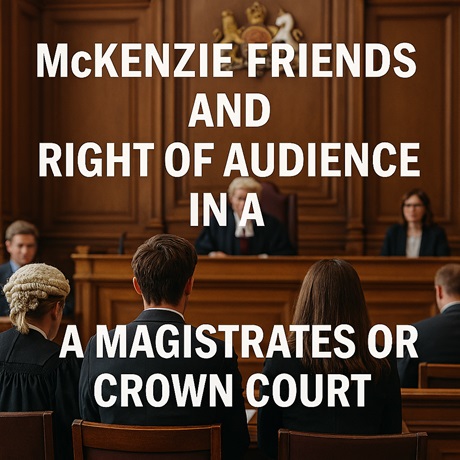
A McKenzie Friend can provide moral support, take notes, help organise case papers, and offer quiet advice on the conduct of the case. They do not have an automatic right to act as an advocate, conduct litigation, or address the court.
Right of Audience
In criminal proceedings, McKenzie Friends generally do not have a right of audience. This means they cannot speak on behalf of the litigant, make oral submissions or examine witnesses unless the court explicitly grants permission.
The court may grant a right of audience in exceptional circumstances, but this is rare. The decision is at the discretion of the presiding magistrate or judge, guided by the interests of justice.
Examples of exceptional circumstances may include:
- The litigant has health issues preventing them from effectively addressing the court.
- The litigant lacks the ability to articulate their case (e.g., due to language barriers or intellectual limitations).
- The complexity of the case requires assistance to ensure a fair hearing.
Criminal vs Family and Civil Procedure
Unlike civil and family proceedings, where guidance like the Practice Guidance: McKenzie Friends (Civil and Family Courts) (2010) applies, criminal proceedings are not explicitly covered by this guidance.
Courts in criminal cases are more cautious about granting rights of audience due to the serious nature of criminal proceedings, which involve public interest and potential penalties like imprisonment.
The Legal Services Act 2007 (sections 12–19 and Schedule 3) makes it a criminal offense for an unqualified person to exercise rights of audience or conduct litigation unless authorised by the court on a case-by-case basis.
Court’s Discretion and Restrictions
A litigant must request permission for a McKenzie Friend to have a right of audience at the start of the hearing. The court will consider factors such as:
- The litigant’s ability to represent themselves.
- The complexity of the legal issues.
- Whether the McKenzie Friend’s involvement would impede the administration of justice.
The court may refuse or revoke permission if the McKenzie Friend disrupts proceedings, acts improperly, or breaches confidentiality.
The court may also require the McKenzie Friend to provide their name, contact details, and a statement confirming they understand their role and duties, including confidentiality.
Court Denying a McKenzie Friend the Right of Audience
A judge is expected to provide reasons when denying a McKenzie friend the right of audience (permission to speak on behalf of a litigant in person).
This aligns with principles of fairness and transparency under Legal Services Act 2007 (c. 29), specifically under sections 208, 210, 211, Schedule 21 paragraph 84(d), and Schedule 23, which gives courts discretion to grant such rights only for “good reason,” typically in exceptional circumstances.
The Practice Guidance on McKenzie Friends (Civil and Family Courts) [2010] 1 WLR 1881 emphasises that decisions should be justified to ensure litigants understand the basis for refusal, allowing for potential appeals by the litigant (not the McKenzie friend).
Practical Considerations
In magistrates’ courts, where proceedings are often faster-paced and less formal than in higher courts, magistrates may be more reluctant to allow a McKenzie Friend to speak, as the litigant is normally expected to represent themselves.
If a McKenzie Friend is granted a right of audience, their role is still limited to specific tasks (e.g., addressing a point of law or cross-examining a witness) rather than acting as a full advocate throughout the hearing.
Fee-charging McKenzie Friends are viewed with caution, and courts may scrutinise their involvement to ensure they are not acting as unqualified legal representatives.
Relevant Guidance and Rules
While the Practice Guidance: McKenzie Friends (Civil and Family Courts) (2010) does not apply to criminal cases, it provides a framework that courts may refer to analogously.
The Criminal Procedure Rules 2010 do not specifically address McKenzie Friends but emphasise the court’s overriding objective to deal with cases justly, which includes ensuring a fair hearing for unrepresented defendants.
Article 6 of the European Convention on Human Rights (incorporated into UK law via the Human Rights Act 1998) supports the right to a fair trial, which may bolster a litigant’s request for assistance from a McKenzie Friend.
Case Law and Precedents
McKenzie v McKenzie [1970] 3 WLR 472 CA: Established the principle that litigants in person have a right to reasonable assistance.
Clarkson v Gilbert [2000] 2 FLR 839: Clarified that the court has unfettered discretion to grant a right of audience, and such decisions should not be limited to “exceptional” circumstances but depend on the case’s specifics.
Re N (A Child) (McKenzie Friend: Rights of Audience) [2008] EWHC 2042 (Fam): Emphasised that granting a right of audience should serve the interests of justice and that courts should consider the practical realities of limited legal aid availability.
Limitations and Risks of McKenzie Friends
McKenzie Friends are not regulated like solicitors or barristers, so there is no guarantee of their competence or accountability. Courts may exclude a McKenzie Friend if they undermine the efficient administration of justice (e.g., by providing improper advice or disrupting proceedings).
Litigants using a McKenzie Friend cannot recover costs for their services from the opposing party, even if successful, as costs are limited to those of a litigant in person.
Explanation of Clarkson v Gilbert
Clarkson v Gilbert [2000] 2 FLR 839 is a significant Court of Appeal case in England and Wales that clarified the principles governing the granting of a right of audience to a non-lawyer, such as a McKenzie Friend or a close relative, under section 27(2)(c) of the Courts and Legal Services Act 1990.
The case is particularly relevant to litigants in person who seek assistance from unqualified individuals to represent them in court proceedings, including in criminal, civil, or family matters.
Factual and Procedural Background
Parties and Context: The claimant, Petruska Clarkson, a psychotherapist, initiated legal proceedings against multiple defendants (also psychotherapists) alleging conspiracy, inducement to breach contract, and libel. These claims arose after her suspension from the Gestalt Psychotherapy Training Institute.
McKenzie Friend: Clarkson’s husband, Vincent Keter, who had a law degree and had completed Bar finals but was not yet called to the Bar, sought to represent her in court. He applied for a right of audience to act as her advocate in the litigation, including at trial and interlocutory hearings.
Initial Order: On 14 May 1999, Morland J granted Keter an ex parte order (without notice to the defendants) allowing him rights of audience under section 27(2)(c) of the Courts and Legal Services Act 1990, citing Clarkson’s ill health (an angina attack and depression) and her lack of financial means to hire legal representation.
Challenge: The defendants applied to set aside Morland J’s order, arguing insufficient evidence (e.g., outdated medical reports) and Keter’s questionable conduct, including misrepresenting himself as an advocate. On 16 December 1999, Eady J set aside the order, prompting Clarkson’s appeal to the Court of Appeal.
Appeal: The Court of Appeal, presided over by Lord Woolf CJ, alongside Waller LJ and Clarke LJ, heard the appeal on 14 June 2000. The key issue was whether Keter, as a close relative and non-lawyer, should be granted a right of audience to represent Clarkson.
Legal Issues
The court addressed the following legal questions:
- Whether a close relative, such as a spouse, should be granted a right of audience under section 27(2)(c) of the Courts and Legal Services Act 1990.
- Whether “exceptional circumstances” are required to grant such rights to an unqualified person, particularly a family member.
- The appropriate exercise of judicial discretion in such cases, balancing the interests of justice with the proper administration of the courts.
- Court’s Reasoning and Decision: The Court of Appeal allowed Clarkson’s appeal, restoring Morland J’s order granting Keter rights of audience.
- Judicial Discretion Under Section 27(2)(c): Section 27(2)(c) of the Courts and Legal Services Act 1990 allows courts to grant a right of audience to a person not otherwise entitled, in relation to specific proceedings, at the court’s discretion.
- The court emphasised that this discretion is unfettered but must be exercised in light of the statutory objective in section 17(1) (to develop legal services while maintaining the proper administration of justice) and section 17(3) (general principles governing professional advocates).
- Distinction Between Professional and Family Advocates: The court distinguished between unqualified individuals offering advocacy services generally (e.g., professional McKenzie Friends) and close relatives assisting a family member.
For professional McKenzie Friends, the court typically requires exceptional circumstances to grant a right of audience, as established in D v S (Rights of Audience) [1997] 1 FLR 724. This is because such individuals may lack professional regulation and accountability. For close relatives, such as a spouse, the test is less stringent.
The court held that the question is whether there is good reason to grant the right of audience, based on the specific circumstances of the case, rather than requiring exceptional circumstances. - Factors Justifying a Right of Audience: Lord Woolf CJ noted that the overriding objective is to ensure justice is done. With legal aid less readily available, litigants in person may need assistance to present their case effectively.
Relevant factors include the litigant’s health (e.g., Clarkson’s angina and depression) and financial means (e.g., inability to afford legal representation after unsuccessful attempts to secure conditional fee arrangements or pro bono assistance).
In this case, the court found that Clarkson’s health issues and lack of means justified allowing Keter to act as her advocate, as there was a risk she would be deprived of a fair hearing otherwise. - Critique of the Lower Court: The court held that Eady J erred by applying the “exceptional circumstances” test from D v S to a case involving a close relative.
Clarke LJ clarified that the discretion under section 27(2)(c) is not fettered by a requirement for exceptional circumstances in such cases. Instead, the court must consider whether it is just to permit the advocate, based on the case’s facts. - Practical Considerations: The court acknowledged that litigants in person have a right to conduct their own litigation but may need assistance due to practical difficulties. A McKenzie Friend’s role (e.g., giving advice or taking notes) does not automatically extend to advocacy unless the court grants permission.
The court noted concerns about Keter’s conduct (e.g., describing himself as an advocate) but found these insufficient to deny the right of audience, given the need to ensure justice for Clarkson.
The court emphasised that the litigant should generally apply in person for such permission at the start of the hearing, allowing the court to assess the need directly. - Statutory Framework: The court highlighted the tension between allowing a close relative to act as an advocate and the statutory duties under section 27(2A) of the Courts and Legal Services Act 1990, which require advocates to act with independence and comply with professional conduct rules. A family member may struggle to maintain such independence, but this did not preclude granting the right in this case.
- Holding and Implications: The Court of Appeal allowed the appeal, restoring Keter’s right of audience to represent Clarkson in the litigation.
The court found that her ill health and lack of means constituted good reason for granting the right, and the decision was necessary to ensure justice.
• Implications: The case clarified that the test for granting a right of audience to a close relative is whether there is good reason, not necessarily exceptional circumstances, distinguishing such cases from those involving professional McKenzie Friends.
It recognised the practical reality of reduced legal aid availability, increasing the need for assistance for litigants in person.
The decision reinforced the court’s discretion to balance the interests of justice with the need to maintain proper administration, particularly in cases where the litigant’s ability to represent themselves is impaired.
The case remains a key authority in determining when McKenzie Friends or relatives may be granted rights of audience, especially in civil and family proceedings, and its principles are often applied analogously in criminal proceedings (though courts are more cautious in criminal cases due to their seriousness).
Conclusion
While Clarkson v Gilbert was a civil case, its principles are relevant to magistrates’ and crown courts in criminal proceedings:
Check out our related articles on Magistrate, Chief Magistrate, Dodgy Magistrates, Rule of Law, Open Justice, Is the Law Black and White ?, What Does Lady Justice Symbolise ?, McKenzie Friend, Can a Judge Direct a Jury to Find a Defendant Not Guilty ?,Law Society, Law Commission, Solicitors, Solicitors Regulation Authority, Barristers, Bar Council of England and Wales, Bar Standards Board, Contra Mundum, R v Sussex Justices, Police Impartiality and the highly questionable Sussex Family Justice Board.
The Ministry of Injustice is not the Ministry of Justice nor is it affiliated in any way with the justice system, legal profession, police or any other law enforcement agencies.
“Publicity is the very soul of justice. . . . It keeps the judge himself, while trying, under trial….Where there is no publicity there is no justice”
Jeremy Bentham – Mr Justice Cobb: ‘Justice must be seen to be done’
Latest Articles ↓
- His Honour Judge Daniel Sawyer
 Judge Daniel Sawyer, known as His Honour Judge Daniel Sawyer,… Read more: His Honour Judge Daniel Sawyer
 - UK National Centre for Information Defence
 Prime Minister Andy Burnham used his first United Nations General… Read more: UK National Centre for Information Defence
 - Judges Behaving Badly and His Honour Judge Simon Oliver
 On the 27th August 2026 the Crown Prosecution Service announced… Read more: Judges Behaving Badly and His Honour Judge Simon Oliver
 - Jo Morris Barrister
 Jo Morris is a practising criminal barrister of Drystone Chambers… Read more: Jo Morris Barrister
 - Good Law Project
 The Good Law Project is a UK campaigning organisation that… Read more: Good Law Project
 - Police Federation of England and Wales (PFEW)
 The Police Federation of England and Wales (PFEW) is the… Read more: Police Federation of England and Wales (PFEW)
 - What is the Criminal Justice System (CJS) Common Platform ?
 The Criminal Justice System Common Platform (also known as HMCTS… Read more: What is the Criminal Justice System (CJS) Common Platform ?
 - Strategic Lawsuit Against Public Participation (SLAPPs)
 Strategic Lawsuits Against Public Participation, or SLAPPs, are legal actions… Read more: Strategic Lawsuit Against Public Participation (SLAPPs)
 - His Honour Judge Tony Baumgartner – Recorder of Westminster
 Judge Tony Alan Walter Baumgartner, known as His Honour Judge… Read more: His Honour Judge Tony Baumgartner – Recorder of Westminster
 - New Protocol for Legal Professionals to Raise Informal Concerns About Judges Behaviour
 On the 8th July 2026, the Courts and Tribunals Judiciary… Read more: New Protocol for Legal Professionals to Raise Informal Concerns About Judges Behaviour
 - The Policing Performance System
 In April 2026, His Majesty’s Inspectorate of Constabulary and Fire… Read more: The Policing Performance System
 - What is the Judicial College ?
 The Judicial College serves as the central pillar of professional… Read more: What is the Judicial College ?
Most Popular ↓
You should always seek formal legal advice from a qualified and reputable lawyer (solicitor or barrister).
There are a number of links to Free and Paid For Legal Resources and Legal Organisations on the Free Legal Advice , Legal Aid and Pro Bono pages.